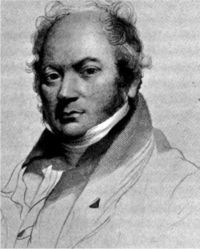
John Thomas Smith

John Thomas Smith

Summary

Portrait of John Thomas Smith John Thomas Smith Nollekens and his times (1829)

The expression of a feature,—an eye for instance, so fascinating to the beholder, in which the very focus and soul of the modeller is seated,—if carelessly finished, might be lost for ever, particularly if too much of the stone were cut away. What an acquisition, then, an excellent carver must be in the studio of the classic Sculptor of high fame, whose mind must necessarily be engaged upon his designs; and whose hand, had it once been master of the tool, for the want of practice, could not manage it with so much ease as that of the artist who is continually employed on the marble only
Source: Wikisource

Portrait of John Thomas Smith John Thomas Smith Nollekens and his times (1829)

The best plates in this series are,—the first of an aged man, with a white beard sweeping the ground, and writing in a book with each hand, naked; a human figure pressing out his brain through his ears; and the great sea-serpent; but perhaps the best is a figure sinking in a stormy sea at sun-set, the splendid light of which, and the foam upon the black waves, are almost magical effects of colouring. Beneath the first design is engraven "Lambeth, printed by W, Blake, 1794."
Source: Wikisource

Portrait of John Thomas Smith John Thomas Smith Nollekens and his times (1829)

My reader will recollect, that Bacon was the first artist who had the honour of being presented, in 1769, with the gold medal from the Royal Academy, as a modeller. Such a distinguished mark of the estimation of his talents by so honourable a body, consisting of the most eminent artists of his day, together with the preceding sums, amounting to 215l. 5s., voted to him by the Society of Arts, must excite a blush upon the cheek of those who have trifled away their time, whilst it also acts as a stimulus to others, who are only commencing their career.
Source: Wikisource

Get perspective with Kwize: daily news enlightened by great literature