
“ Grove with such a possibility; she hadn't, the truth was, at first attracted him in that way. Now he thought that he had been blind to have missed her resemblance to Cytherea. She was Cytherea! This, in a measure, accounted for him, since, with so much to consider, he badly needed an accounting. It wasn't simply, here, that he had kissed a married woman; there was nothing revolutionary or specially threatening in that; it was the sensation of danger, of lightning, the recognition of that profoundly disturbing countenance, which filled him with gravity and a determined plan of restraint. ”
Cytherea
Definition and stakes
Cytherea, a taxonomic term introduced by Lamarck in 1805, refers to a group of bivalve mollusks that were later reclassified under a homonymous name. This concept connects scientific classification with literary symbolism, as seen in works by Thomas Hardy and Joseph Hergesheimer, who portray Cytherea as a symbol of emotional and moral intricacy.
While biologists such as G. B. Sowerby describe its structural features, novelists invest it with symbolic meaning, reflecting human conflicts and aspirations. The term’s dual function—as both a biological organism and a narrative prototype—highlights its lasting significance across various fields.
Quotes about “Cytherea”
 Thomas Hardy,
Desperate Remedies — 4. FROM THE TWENTY-FIRST OF JUNE TO THE END OF JULY
(1871)
Thomas Hardy,
Desperate Remedies — 4. FROM THE TWENTY-FIRST OF JUNE TO THE END OF JULY
(1871)
“ They cannot make out what the disease is. O Cytherea! how I wish they knew! This suspense is wearing me out. Could not Miss Aldclyffe spare you for a day? Do come to me. We will talk about the best course then. I am sorry to complain, but I am worn out.' Cytherea went to Miss Aldclyffe, and told her of the melancholy turn her brother's illness had taken. ”
“ The first step in such a course of practical wisdom would be to put Cytherea out of his life, dislodge her finally from his thoughts, and the over-mantel downstairs. This, diplomatically with the doll, he could, of course, do now, whenever he chose. With that, and whatever it represented, accomplished, Lee had a premonition, his life would be secure, placid. ”
 Harriet Beecher Stowe,
The Atlantic Monthly
(1866)
Harriet Beecher Stowe,
The Atlantic Monthly
(1866)
“ If the tie between you is that of true and honest love, Cytherea will put on a gingham wrapper, and with her own sculptured hands wring out the flannels which shall relieve your pains; and she will be no true woman if she do not prefer to do this to employing any nurse that could be hired. ”
 Elizabeth Barrett Browning,
Prometheus Bound, and other poems
(1851)
Elizabeth Barrett Browning,
Prometheus Bound, and other poems
(1851)
“ Ah, ah, Cytherea! Adonis is dead,— She wept tear after tear, with the blood which was shed; And both turned into flowers for the earth's garden-close; Her tears, to the wind-flower,—his blood, to the rose. ”
 Charles Kingsley,
Hypatia/22
(1853)
Charles Kingsley,
Hypatia/22
(1853)
“ The artist was for the moment transformed into the goddess. The theatre, and Alexandria, and the gorgeous pageant beyond, had vanished from her imagination, and therefore from the imagination of the spectators, under the constraining inspiration of her art, and they and she alike saw nothing but the lonely sea around Cytherea, and the goddess hovering above its emerald mirror, raying forth on sea, and air, and shore, beauty, and joy, and love. . . .Philammon's eyes were bursting from his head with shame and horror: and yet he could not hate her; not even despise her. ”
 G. B. Sowerby,
A conchological manual
G. B. Sowerby,
A conchological manual
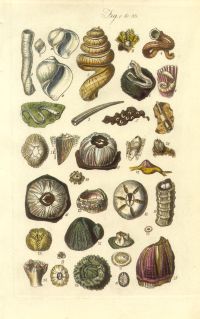
“ CYRENA. Auct. Fam. Fluviatile Conchaceæ, Lam. Conchacea, Bl—Descr. Suborbicular, equivalve, inequilateral, ventricose, corroded at the umbones, thick, covered with a thick epidermis; hinge with three cardinal and two remote lateral teeth in each valve. Muscular impressions two in each valve; palleal impression not sinuated.—Obs. This genus is distinguished from Venus, Cytherea and Cyprina, by having two remote lateral teeth; and from Cyclas by the thickness of the shell. This genus is mostly fluviatile; the recent species are tropical, and the fossil are found in the newest formations. Fig. ”
 Philip Parker King,
Narrative of a Survey of the Intertropical and Western Coasts of Australia…
Philip Parker King,
Narrative of a Survey of the Intertropical and Western Coasts of Australia…
“ Yet most of these peculiarities of structure might perhaps be adduced in support of the opinion advanced, being apparent adaptations to the supposed economy.There is one fact that will hardly be brought forward as an objection, and which yet seems to me to present a difficulty, to this opinion; namely, the greater simplicity in Cycadeae, and in the principal part of Coniferae, of the supposed ovulum which consists of a nucleus and one coat only, compared with the organ as generally existing when enclosed in an ovarium. ”
William Griffith, Journals of Travels in Assam, Burma…
“ However different a boyau may seem to many, yet when viewed in conjunction with Cycadeæ, the graduation to the present case becomes natural, and even the resemblance may be perfect, because in Cycas the grains of pollen get into the nucleus bodily, although they would still seem to throw out short tails.Wonderful is the simplicity of nature! The male organ in its essence, consists of a single cell containing molecular matter. ”
Various, Encyclopaedia Britannica, 11th Edition…
“ After pollination the pollen-tube grows into the nucellar tissue, as in cycads, and the pollen-grain itself (fig. 13, Pg) hangs down into the pollen-chamber; two large spirally ciliated spermatozoids are produced, their manner of development agreeing very closely with that of the corresponding cells in Cycas and Zamia. After fertilization the ovum-nucleus divides and cell-formation proceeds rapidly, especially in the lower part of the ovum, in which the cotyledon and axis of the embryo are differentiated; the long, tangled suspensor of the cycadean embryo is not found in Ginkgo. ”
Peter Chalmers Mitchell and Sydney Howard Vines, 1911 Encyclopædia Britannica (1911)
“ In asexual reproduction by spore formation, the spore proliferates without the aid of another spore; in true sexual reproduction the gametes may be regarded as special kinds of spores which appear in two forms, the egg-cell, ovum or female gamete not proceeding to proliferate into a new organism until it has been stimulated by partial or complete fusion with the other form, the spermatozoon or male gamete. The act of fusion or conjugation in question is usually spoken of as fertilization, and the zygote, or starting-point of the new organism, is the fertilized egg-cell. ”
Alfred B. Rendle, Arthur G. Tansley, Joseph R. Green, Charles E. Moss, Harold W. T. Wager, Sydney H. Vines, and William T. Thiselton-Dyer, 1911 Encyclopædia Britannica (1911)
“ In the other Phanerogams the male cell, which is non-motile, is carried to the oosphere by means of a pollen tube. In the spermatozoids of Chara, Vascular Cryptogams, and in those of Cycas, Zamia and Ginkgo, the cilia arise from a centrosome-like body which is found on one side of the nucleus of the spermatozoid mother-cell. This body has been called a blepharoplast, and in the Pteridophytes, Cycads and Ginkgo it gives rise to the spiral band on which the cilia are formed. ”
Harold Mellor Woodcock, 1911 Encyclopædia Britannica, Volume 12… (1911)
“ Around this some of the cytoplasm condenses, the rest forming a residuum. The sporoblast or gamete thus formed is completely isogamous and normally conjugates with the like one from the other associate, when a single zygote results which becomes a spore containing eight sporozoites, in the ordinary manner. Sometimes, however, the septum between the two halves of the cyst does not break down, in which case parthenogenesis occurs, each sporoblast developing by itself into a small spore. ”
Alfred B. Rendle, Arthur G. Tansley, Joseph R. Green, Charles E. Moss, Harold W. T. Wager, Sydney H. Vines, and William T. Thiselton-Dyer, 1911 Encyclopædia Britannica (1911)
“ Evidence is not wanting, however, that the cytoplasm must be regarded as, fundamentally, a semifluid, homogeneous substance in which by its own activity, granules, vacuoles, fibrils, &c., can be formed as secondary structures. The cytoplasm is largely concerned in the formation of spindle fibres and centrosomes, and such structures as the cell membrane, cilia, or fiagella, the coenocentrum, nematoplasts or vibrioids and physodes are also products of its activity. ”
Alfred B. Rendle, Arthur G. Tansley, Joseph R. Green, Charles E. Moss, Harold W. T. Wager, Sydney H. Vines, and William T. Thiselton-Dyer, 1911 Encyclopædia Britannica (1911)
“ In the Algae, such as Fucus, Volvox, Oedogonium, Bulbochaete, and in the Fungus Monoblepharis, the spermatozoid is a small oval or elongate cell containing nucleus, cytoplasm and sometimes plastids. In the Characeae, the Vascular Cryptogams, in Zamia and Cycas, and in Ginkgo, the spermatozoids are more or less highly modified cells with two or more cilia, and resemble in many respects, both in their structure and mode of formation, the spermatozoids of animals. ”
Marcus Manuel Hartog, 1911 Encyclopædia Britannica, Volume 22… (1911)
“ Encystment, or at least a resting stage at full growth, is very characteristic, and frequently an excretion of granules takes place into the first-formed cyst, whereupon a second inner cyst is formed which may be followed by a third. These brood-cysts, in which multiple fission takes place, may be of two kinds, ordinary and resting, the latter being distinguished by a firm, and usually ornamented and cuticularized cell-wall, and only producing its zoo spores after an interval. ”
Max Braun, The Animal Parasites of Man
“ The granular cytoplasm contains a varying number of vacuoles, one of which may be contractile, and is generally situated near the area from which the flagella arise, that is, at the anterior extremity. The cytoplasm, moreover, contains the nucleus, which is nearly always single; and in many species there are also yellow, brown, or green chromatophores of various shapes, such as occur in plants. Some species feed after the manner of green plants (holophytic) , or of plants devoid of chlorophyll (saprophytic) ; others, again, ingest solid food, and for this purpose usually possess a cytostome ”
Marcus Manuel Hartog, 1911 Encyclopædia Britannica (1911)
“ Equal conjugation was demonstrated fully by F. Schaudinn in Actinophrys; two individuals approach and enter into close contact, and are surrounded by a common cyst wall. The nucleus of either male divides; and one nucleus passes to the surface at either side, and is budded off with a small portion of the cytoplasm as an abortive cell ”
Harry Marshall Ward and Vernon Herbert Blackman, 1911 Encyclopædia Britannica (1911)
“ The most reasonable interpretation of the spermatia is that they are abortive male cells. They have never been found to cause infection, and they have not the characters of conidia; the large size of their nuclei, the reduction of their cytoplasm and the absence of reserve material and their thin cell wall all point to their being male gametes. Although in the forms without aecidia the two generations are not sharply marked off from one another, we may look up the generation with single nuclei in the cells as the gametophyte and that with conjugate nuclei as the sporophyte. ”
William Thiselton-Dyer, Makers of British botany — Harry Marshall Ward 1854…
“ The solution was given in 1888 in a paper in the Annals of Botany, "On a Lily Disease," which has now become classical. He discusses the fungus which produces it, and shows that the tips of the hyphae secrete a cellulose-dissolving ferment which enables them to pierce the cell-walls of the host. This ferment has since been described as cytase. He shows that its production would determine the passage from a merely saprophytic to a parasitic habit, and makes the suggestion that an organism might be educated to pass from one to the other. ”
Frederick Currey, Natural History Review: a quarterly journal of biological science
“ The case of the Cycadcæ he considers very conclusive, as showing that the development in the embryo-sac can only proceed up to the point at which the stimulus to the commencement of the formation of an embryo must be given, and that where this stimulus is wanting, the germinal vesicle, even in vigorous seeds, exhibits no further development. ”
H. Marshall Ward, Disease in plants
“ Irritation and hypertrophy of cells, however, may be induced by parasites which never bring their protoplasm into direct contact with that of the host. Many Chytridiaceae penetrate the cells of plants, and grow inside them as short tubes, vesicles, etc., the protoplasm of which is separated by their own cell-walls from that of the host-cell; nevertheless hypertrophy and abnormal cell-divisions and secretions are induced, and the effect even extends to neighbouring cells—e.g. Synchytrium—showing [128] that some influence is exerted through cells themselves not directly affected. ”
 Eugenius Warming,
A handbook of systematic botany
(1895)
Eugenius Warming,
A handbook of systematic botany
(1895)
“ Between each cycle of fertile leaves there are a number of imperfect or barren ones as in the case of the female plant of Cycas. The spores are liberated by the decay of the sporangium. The two kinds of sporangia develope at the commencement in the same way. The archesporium is, at first, a hypodermal layer of cells which grow out in the direction perpendicular to the surface of the leaf, and divide by a number of walls parallel to this direction, forming a sporogenous mass of cells. ”
Marcus Hartog, The Cambridge natural history, Vol… (1906)
“ We find no case of a differentiation of the cytoplasm within the cell into definite muscular fibrils. In the lower Plants single naked motile cells disseminate the species; and the pairing-cells, or at least the males, have the same motile character. In higher Cryptogams, Cycads, and Ginkgo (the Maiden-hair Tree) , the sperms alone are free-swimming; and as we pass to Flowering Plants, the migratory character of the male cells is restricted to the smallest limits. {39}though never wholly absent. Intracellular movements of the protoplasm are, however, found in all Plants. ”
 Patrick Manson,
Tropical Diseases
(1919)
Patrick Manson,
Tropical Diseases
(1919)
“ The youngest parasites appear to be round cells provided with a cuticle and a single nucleus. By repeated division of this nucleus the parasite becomes a multinucleate plasmodium. The cyst contents become divided into pansporoblasts in the centre, while the periphery contains the granular nuclei. The sporonts grow in size, and by repeated division form clusters of spores, a kind of a morula enclosed in a membrane. When ripe the cyst bursts and scatters its contents into the surrounding tissues. ”
J. T. Cunningham, Hormones and Heredity
“ Cytology is in fact a branch of anatomy, and in the anatomy of the cell we have made some progress, but our knowledge of the physiology of the cell is still infinitesimal. The nucleus, and especially the chromosomes, are supposed in some unknown way to influence or govern the metabolism of the cytoplasm. From this point of view the hypothesis mentioned above that the sex-difference in the gametes is not qualitative but quantitative is probably nearer to the truth. ”
 Julius von Sachs,
History of botany
(1890)
Julius von Sachs,
History of botany
(1890)
“ Soon after, the cytoblasts are seen as granular coagulations from the granular mass; they grow considerably in this free condition, but as soon as they have reached their full size, a delicate transparent vesicle is formed upon them; this is the young cell, which at first presents the appearance of a very flat segment of a sphere, whose plane side is formed by the cytoblast, the convex by the young cell (the cell-membrane) , which rests upon the cytoblast as a watch-glass on a watch. ”
Max Braun, The Animal Parasites of Man
“ They increase in size, but encystment occurs early, the outer layer becoming firm so that the organisms have a definite contour. Each is soon multinucleate and the cytoplasm segments around the nuclei. The cyst thus becomes full of uninucleate pansporoblasts or sporonts, with a peripheral layer of undifferentiated protoplasm. The pansporoblasts grow in size. In the larger cysts the formation of pansporoblasts progresses at the expense of the peripheral layer of protoplasm, which, however, continues to grow, so that the cyst as a whole increases in size. ”
Marcus Hartog, The Cambridge natural history, Vol… (1906)
“ The two cells then fuse completely, and surround themselves with a second gelatinous cyst wall, separated from the outer one by a layer of siliceous spicules. The nucleus appears to divide at least twice before the young creep out, to divide immediately into as many Actinophrys-like cells as there were nuclei; then each of these multiplies its nuclei, to become apocytial like the adult form. ”
Max Braun, The Animal Parasites of Man
“ The ectoplasm is less refractile than the rest of the cytoplasm; it also stains less intensely (fig. 1) , and is best seen on protrusion of a pseudopodium. Red blood corpuscles are rarely, if ever, found ingested in the cytoplasm.Fig. 3.—Entamœba coli: life-cycle, a-e, stages in binary fission; A-D, schizogony, with formation of eight merozoites; 2–10, cyst formation or sporogony, with formation of eight nucleate cysts. (After Castellani and Chalmers) The nucleus is vesicular, and is spherical when inactive, measuring 5 μ to 7 μ, with a thick nuclear membrane. ”
 Herbert Spencer,
The Principles of Biology — Chapter II.7
(1898)
Herbert Spencer,
The Principles of Biology — Chapter II.7
(1898)
“ Moreover, among the lower Algæ, which show the beginning of sexual differentiation, the smaller gametes, which we must regard as incipient sperm-cells, are sometimes able to fuse inter se, and give rise to a zygote which will produce a new plant. All which evidence is in perfect harmony with the foregoing conclusion; since, if sperm-cells and germ-cells have natures not essentially unlike those of unspecialized cells in general, their natures cannot be essentially unlike each other. ”
Marcus Hartog, The Cambridge natural history, Vol… (1906)
“ Reproduction by fission is not rare, and in some cases (Acanthocystis) the cell becomes multinuclear, and buds off 1-nucleate cells. In such cases the buds at first lack a centrosome, and a new one is formed first in the nucleus, and passes out into the cytoplasm. ”
