Louie M. Knight Dutton, Devonshire
“ The average price per stone of fat Devon cattle was higher in 1908 than that of any other breed in England, and the value per head of three-year-old Devon store cattle was only exceeded by that of Herefords. ”
Louie M. Knight Dutton, Devonshire
“ The average price per stone of fat Devon cattle was higher in 1908 than that of any other breed in England, and the value per head of three-year-old Devon store cattle was only exceeded by that of Herefords. ”
Ladies in the Field: Sketches of Sport
“ The sky is cloudless, and a little way off, lies a herd of Devon cattle, quietly chewing the cud, and mildly wondering what has brought such a large party, evidently bent on play instead of work, to their retreat. ”
Charles Bullard Fairbanks, My Unknown Chum: "Aguecheek"
“ Buckminster's Devon cattle—their hair cropped close for obvious reasons—moving about among the crowd, filling the air with damns and brandy fumes. There were others in a more advanced stage of "fancy" existence—men with all the humanity blotted out of them, not a spark of intellect left in their beery countenances. There were women drabbled with dirt, soggy with liquor, with eyes artificially black. ”
Richard Lamb Allen, Domestic Animals
“ The Devon is intelligent, gentle, and tractable; is good for milk, and unsurpassed for the yoke and for fattening. No animal is better suited to our scanty or luxuriant hill pastures than the Devon, and none make a better return for the attention and food received. They ensure a rapid improvement when mixed with other cattle, imparting their color and characteristics in an eminent degree. Several importations have been made into this country within the last 30 years, of the choicest animals, and though not yet numerous in the United States, we possess some of the best specimens that exist. ”
W. H. R. Curtler, A Short History of English Agriculture
“ He also compares them to the cattle of Sussex and the native cattle of Norfolk. [747] The Devons then differed very much in different parts of the county; those of North Devon taking the lead, being 'nearly what cattle ought to be'. They were, considered as draught animals, the best workers anywhere beyond all comparison, though rather small, for which deficiency they made up in exertion and agility. As dairy cattle they were not very good, since rearing for the east country graziers had long been the main object of Devon cattle farmers, but as grazing cattle they were excellent. ”
S. L. Goodale, The Principles of Breeding
“ The example of various opulent breeders and farmers in all parts of the country has tended to spread this improvement, by which the North Devon cattle have become more general and fashionable. The leading characteristics of the North Devon breed are such as qualify them for every hardship. They are cast in a peculiar mold, with a degree of elegance in their movement which is not to be excelled. ”
James Wilson, The evolution of British cattle and the fashioning of breeds…
“ The white-coloured cattle of Devon size are white Devons, from which any number of white Devons might be produced, and by the use of such cattle the whole red Devon breed could be made white in not so very many generations. There are, however, hybrids which are not obvious intermediates, but which masquerade in the guise of one of their parents. The progeny of black and red cattle are black, yet they are hybrids nevertheless. ”
 W. H. Hudson,
Afoot in England
“ One day, in a meadow a few miles from Abbotsbury, I came upon a herd of about fifty milch cows scattered over a considerable space of ground, some lying down, others standing ruminating, and still others moving about and cropping the long flowery grasses. All were of that fine rich red colour frequently seen in Dorset and Devon cattle, which is brighter than the reds of other red animals in this country, wild and domestic, with the sole exception of a rare variety of the collie dog. ”
S. L. Goodale, The Principles of Breeding
“ Such are the North Devon cattle, and it is fortunate that attention was drawn to the merits of this variety before facilities for inter-communication had so greatly increased as of late, and while yet the race in some districts remained pure. All that breeders have done to better it, is by selections and rejections from within itself; and so, much improvement has been effected without any adulteration. ”
Various, Herd Record of the Association of Breeders of Thorough-Bred Neat Stock
“ It has been the design of the Committee on Devon pedigrees to perfect a Devon Herd Book that would meet the wants of all American Breeders of Devon cattle. To accomplish this they have been untiring in their labors, sparing no pains to thoroughly investigate each pedigree; and have decided upon each, according to the facts received from the testimony given. While some have been rejected, others have been deferred [8] till more light can be given to prove their purity of blood, which may be done in season for the second volume. ”
Robert Jennings, Cattle and Their Diseases
“ Careful observations will establish the fact, that the cattle in Devonshire, Sussex, Wales, and Scotland are essentially the same. They are middle horned; not extraordinary milkers, and remarkable for the quality rather than the quantity of their milk; active at work, and with an unequalled aptitude to fatten. They have all the characters of the same breed, changed by soil, climate, and time, yet little changed by man. The color, even, may be almost traced, namely: the red of the Devon, the Sussex, and the Hereford ”
James Wilson, The evolution of British cattle and the fashioning of breeds…
“ Here we are concerned only with cattle. One statement regarding Bakewell, namely, that he thought the Devon cattle incapable of improvement by crossing with any other breed, indicates that, at one time, Bakewell held his neighbours' views as to how cattle should be improved, and this is confirmed by the fact that his stock were gathered from herds in different parts of the country, and that the cows he bought from Mr. Webster of Canley were put to a bull from Westmoreland. ”
John Presland, Lynton and Lynmouth: A Pageant of Cliff & Moorland
“ But when the cattle are diseased, they have, or had as late as 1883, when the ceremony was witnessed and recorded, a rite which is more than a charm; for a sheep or calf is taken from the herd and sacrificed, and either burned, or buried in a corner of the field belonging to the farmer whose cattle are diseased. But there is another practice in Devon and Cornwall which we may proclaim a superstition, but to which the tragedies of these wild coasts give but too grim an earnestness to those who practise it. ”
Various, Herd Record of the Association of Breeders of Thorough-Bred Neat Stock
“ At the Smithfield show of fat cattle, held at the London market place, in 1858, the gold medal for the best ox or steer of any breed in the show yard was awarded to a Devon, bred and owned by the Earl of Leicester. They are highly esteemed in the Smithfield market, not only for the excellence of the meat, but because its size is more agreeable on most tables than the huge joints of some other breeds. In weight they are much excelled, but the opinion of the Devon breeder is, that more meat can be made from them, with a given amount of food, than from any other breed. ”
Various, Encyclopaedia Britannica, 11th Edition…
“ The South Devon or South Hams cattle are almost restricted to that southern part of the county of Devon known as the Hams, whence they are also called “Hammers.” With a somewhat ungainly head, lemon-yellow hair, yellow skin, and large but hardly handsome udder, the South Devon breed more resembles the Guernsey, with which it is supposed to be connected, than the trim-built cattle of the hills of North Devon. The cows are large, heavy milkers, and produce excellent butter. They are rarely seen outside their locality except when they appear in the showyards. ”
S. L. Goodale, The Principles of Breeding
“ The thighs of the cows are occasionally light, but the bull and ox are full of muscle, with a deep and rich flank. On the whole there is scarcely [137] any breed of cattle so rich and mellow in its touch, so silky and fine in its hair, and altogether so handsome in its appearance, as the North Devon, added to which they have a greater proportion of weight in the most valuable joints and less in the coarse, than any other breed, and also consume less food in its production. ”
 Alfred Charles True,
The New International Encyclopædia…
“ The cows are better milkers. The Devons are an exceedingly symmetrical, beautiful race, originated in North and South Devonshire. They are of a rich red color, and although the bulls and cows are rather small, the oxen grow to great size. The Devon oxen have long been prized as work animals. In regard to the relative merits of the different beef breeds no general conclusion can be safely stated. ”
Various, Encyclopaedia Britannica, 11th Edition…
“ Rather less than three-quarters of the total area of the county is under cultivation; the cultivated area falling a little below the average of the English counties. There are, however, about 160,000 acres of hill pasture in addition to the area in permanent pasture, which is more than one-half that of the cultivated area. The Devon breed of cattle is well adapted both for fattening and for dairy purposes; while sheep are kept in great numbers on the hill pastures. Devonshire is one of the chief cattle-farming and sheep-farming counties. ”
W. H. R. Curtler, A Short History of English Agriculture
“ Herefordshire cattle have long been famous as one of the finest breeds in the world. Marshall, writing in 1788, does not hesitate to say, 'The Herefordshire breed of cattle, taking it all in all, may without risque be deemed the first breed of cattle in the land.' Their origin has been accounted for in various ways. Some say they were originally brown or reddish-brown from Normandy or Devon, others that they came from Wales, while it is recorded that Lord Scudamore in the latter half of the seventeenth century introduced red cows with white faces from Flanders. ”
W. H. R. Curtler, A Short History of English Agriculture
“ At the end of the eighteenth century the principal North Devon yeomen were all breeders, and every week you might see in the Molton Market, their natural locality, animals that would now be called choice. There were few cattle shows in those days, and therefore the relative value of animals was not so easily tested. The war prices tempted many farmers to sell their best bulls and cows out of the district, so that good animals were becoming scarce, and the breed generally going back. ”
W. H. R. Curtler, A Short History of English Agriculture
“ The great variety of cattle in Great Britain may be due to their being the descendants of several species, or to difference of climate and soil, or to spontaneous variation, but the chief cause is the diligent selection of breeders. Marshall is quite positive [737] that the Hereford, Devon, Sussex, and the black mountain breeds of Scotland and Wales are all descended from the original native breed of this island, that the Shorthorns came from the Continent, and the Longhorns probably from Ireland. Bradley's division of cattle into black, white, and red tells us little. ”
Various, Herd Record of the Association of Breeders of Thorough-Bred Neat Stock
“ That the Devons are an ancient race of cattle, there can be no doubt. There is no race in England that can claim such undisputed antiquity. They bear all the characteristic marks of resemblance of the ancient races of the south of England and Wales; even the color, red, is traced in the Devon, Sussex and Hereford.The distinction between a "breed" and "race," Goodale defines as follows: "By breeds are understood such varieties as were originally produced by a cross or mixture, and subsequently established by selecting for breeding purposes only the best specimens, and rejecting all others. ”
James Wilson, The evolution of British cattle and the fashioning of breeds…
“ Devon Cattle, 42, 43, 100, 104, 115, 124 Devon Natts (Polled Cattle) , 59, 64 Dobinson's Importations of Dutch Cattle, 78 Durham (the) Dun Cow, 51 Durham (old) Polled Cattle, 50 Dutch (the) Cattle, 64, 70, 75, 76, 77, 89, 102, 118, 128 ”
S. Baring-Gould, A Book of Dartmoor
“ Tenements there must be, but they should be in the sheltered valleys, and the wide hillsides and sweeps of moor should be left severely alone. As it is, encroachments have gone on unchecked, rather have been encouraged. Every parish in Devon has a right to send cattle to the moor, excepting only Barnstaple and Totnes. ”
Various, Encyclopaedia Britannica, 11th Edition…
“ As milk-producers, and therefore as dairy cattle, certain strains of the Shorthorn (registered as well as non-pedigree) , the Lincolnshire Red Shorthorn, South Devon, Longhorn, Red Polled, Ayrshire, Jersey, Guernsey, Kerry and Dexter breeds have acquired eminence. Such breeds as the Shorthorn, Lincolnshire Red Shorthorn, South Devon, Welsh, Red Polled and Dexter are claimed as useful beef-makers as well as milk-producers, and are classified as dual-purpose animals. ”
Various, Herd Record of the Association of Breeders of Thorough-Bred Neat Stock
“ In the New York market the "red oxen of Connecticut" most generally bring the highest price, they being Devon Grades. The Devons have the preference of all other breeds for the yoke, being strong, active, and of great endurance; and are remarkable for docility and good temper.The cattle in many sections of New England resemble the Devons in many respects, and the fact that most of the early settlers were from the south of England, renders it quite probable that they selected their cattle from that region. ”
James Wilson, The evolution of British cattle and the fashioning of breeds…
“ Their colour is not recorded, but, in the "Annals of Agriculture" for 1792, a writer called Treby mentions both yellow and hornless cattle in South Devon.' [35] The Somerset Polls.—These are also extinct. Low wrote of them: "The Sheeted Breed of Somerset ... has existed in the same parts of of England from time immemorial. The red colour of the hair has a slight yellow tinge, and the white colour passes like a sheet over the body. The individuals are sometimes horned, but more frequently they are hornless." ”
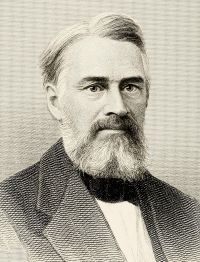 Charles Louis Flint,
Milch Cows and Dairy Farming
“ It is safe, therefore, to say that an animal whose udder and lacteal glands are regarded, by those who best know her capacities and her merits, as of only one quarter part as much consequence as the color of her nose, or half as much as the shape and size of her horns, cannot be recommended for the dairy. The improved North Devon cow may be classed, in this respect, with the Hereford, neither of which has well-developed milk-vessels—a point of the utmost consequence to the practical dairyman. ”
Richard Lamb Allen, Domestic Animals
“ They are not as good milkers as the Devons. This is so generally acknowledged, that while there are many dairies of Devon cows in various parts of the country, a dairy of Herefords is rarely to be found. To compensate for this, they are even more kindly feeders than the Devons. Their beef may be objected to by some as being occasionally a little too large in the bone, and the fore-quarters being coarse and heavy; but the meat of the best pieces is often very fine-grained and beautifully marbled. ”
Various, Herd Record of the Association of Breeders of Thorough-Bred Neat Stock
“ The quality of the Devon beef is unsurpassed, even rivalling the little black West Highland ox, in the estimation of the London west-end butcher, whose fastidious customers oblige him to kill none but beef of the finest quality and flavor. ”
Charles Louis Flint,
Milch Cows and Dairy Farming
“ But, unfortunately, very few herds are to be found where attention has been paid to breeding for milk; and great milkers are the exception, and very rarely met with among the pure breeds. In their native country they are bred almost exclusively for beef. The estimation in which they are held as dairy stock, even by Devon breeders themselves, both in England and in this country, has been shown in the low value placed upon the development of the udder in the establishment of the scale of points spoken of on a preceding page ”
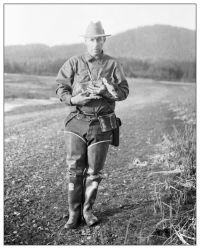 Hal G. Evarts,
Tumbleweeds
(1923)
“ In a breeding-ranch country the herd would have been worked on the spot, calves roped and ironed with the brand worn by their mothers, and only the beef steers cut into a day herd, the she-stuff and all stock younger than two-year-olds [88] being allowed to scatter once more on the range. But there were no calves to brand, no she-stock on the range, for of late the cowmen of the Strip had come to follow one set rule in accord with the transition of the cow business, forming an intermediate link between the old-time cattle kings of the open range and the modern feeders of the corn belt. ”
Robert Jennings, Cattle and Their Diseases
“ The want of care and attention to the udder, soon after calving, especially if the cow be on luxuriant grass, often injures her milking properties exceedingly. The practice in the county of Hereford has generally been to let the calves suckle from four to six months, and bull calves often run eight months with the cow. But their dairy qualities are perhaps as good as those of any cattle whose fattening properties have been so carefully developed ”