Irrawaddy River

Definition and stakes

Julius Smith,  Ten years in Burma (1902)

“ When one little portion is worked for a distance, the vein is lost, being removed or buried too deep for work.
The Irrawaddy River deserves special mention. It rises somewhere in the heights of Thibet near the headwaters of the Indus and the Ramaputra. It is noteworthy that the three great rivers of Southern Asia rise very near each other and flow to the ocean so far apart. The Irrawaddy breaks through the hills of northern Burma, and descends into the plains, widening and gathering volume till it reaches the sea. It has several navigable river tributaries, of which the Chindwin is chief.
”
Source: Gutenberg

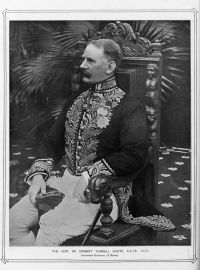
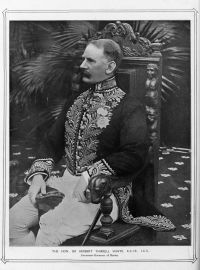
Portrait of Herbert Thirkell White Herbert Thirkell White,  Provincial Geographies of India (1923)

“ Often at Prome and below Mandalay, rows of steamers have been held fast for days. Elsewhere, steamers have grounded and remained high and dry for months till released by the rise of the river. Meanwhile the vessel becomes a stationary dwelling round which the caretaker plants a little garden for profit and for pastime. In the rains, high rises flood the banks to the destruction of growing crops. At the same time, the silt deposited enriches the soil.
The scenery of the Irrawaddy has been often celebrated. It is declared to be "as stately as it is beautiful; as passionate as it is serene."
”
Source: Wikisource

Various,  Encyclopaedia Britannica, 11th Edition…

“ The Mogaung river, rising in the watershed which divides the Irrawaddy and the Chindwin drainages, flows south and south-east for 180 m. before it joins the Irrawaddy, and is navigable for steamers as far as Kamaing for about four months in the year. South of Thayetmyo, where arms of the Arakan Yomas approach the river and almost meet that spur of the Pegu Yomas which formed till 1886 the [v.04 p.0839] northern boundary of British Burma, the valley of the Irrawaddy opens out again, and at Yegin Mingyi near Myanaung the influence of the tide is first felt, and the delta may be said to begin. ”
Source: Gutenberg

Get perspective with Kwize: daily news enlightened by great literature