Li Bai

Definition and stakes

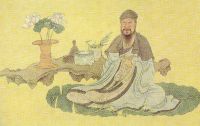
Bai Li,  The Poet Li Po, A.D. 701-762

“ In Li’s whole works there are said to be only nine poems in the strict seven-character metre. Most of his familiar short poems are in the old style, which neglects the formal arrangement of tones. The value of his poetry lay in beauty of words, not in beauty of thought. Unfortunately no one either here or in China can appreciate the music of his verse, for we do not know how Chinese was pronounced in the eighth century. Even to the modern Chinese, his poetry exists more for the eye than for the ear. ”
Source: Gutenberg

Bai Li,  The Poet Li Po, A.D. 701-762

“ Such themes are always felt by the Chinese to be in part allegorical, the deserted lady symbolizing the minister whose counsels a wicked monarch will not heed.
Such poems form the dullest section of Chinese poetry, and are certainly frequent in Li’s works. But his most monotonous feature is the mechanical recurrence of certain [4] reflections about the impermanence of human things, as opposed to the immutability of Nature. Probably about half the poems contain some reference to the fact that rivers do not return to their sources, while man changes hour by hour.
”
Source: Gutenberg

Bai Li,  The Poet Li Po, A.D. 701-762

“ Many vulgar people expressed surprise, but Wang replied: ‘The reason why vulgar people find Li Po’s poetry congenial is that it is easy to enjoy. His intellectual outlook was mean and sordid, and out of ten poems nine deal with wine or women; nevertheless, the abundance of his talent makes it impossible to leave him out of account.’”
Finally Huang T’ing-chien (A.D. 1050-1110) , accepted by the Chinese as one of their greatest writers, says with reference to Li’s poetry: “The quest for unusual expressions is in itself a literary disease.
”
Source: Gutenberg

Get perspective with Kwize: daily news enlightened by great literature