“ Byrajee Pirtha Raj was no stranger to him. Through his works; through the strange yet always noble inspirations that had surged to his soul when he was, as he still firmly believed, holding commune with him; through the impression of himself he had left upon his friends and contemporaries, all of whom looked upon him as something more than a man, the young rajah had learned to know his father ”
Raj
Definition and stakes
The theme of “Raj” has been addressed by authors such as Sir Valentine Chirol, C. Despard, Flora Annie Webster Steel, Talbot Mundy and John P. Jones. It is often associated with terms like Hinduism, India, Brahmin, Raja and Hindu.
Quotes about “Raj”
 Flora Annie Webster Steel,
India Through the Ages: A Popular and Picturesque History of Hindustan
Flora Annie Webster Steel,
India Through the Ages: A Popular and Picturesque History of Hindustan
“ How many times has the fate of India been decided amongst its semi-barren stretches, where the low dhâk bushes glow like sunset clouds on the horizon? First by the mythical, legendary Pândus and Kurus, backed by the gods, protected by showers of celestial arrows. Next, when Shahâb-ud-din-Mahomed Ghori broke down the Râjput resistance, and Prithvi-râj, the flower of Râjput chivalry, was killed flying for his life amongst the sugarcane brakes. ”
Talbot Mundy, The Winds of the World
“ Is it not so?""Art thou thyself for the Raj?" asked Yasmini."I lead a squadron of Sikh cavalry," said Ranjoor Singh, "and you ask me am I for the Raj?""The buffalo that carries water for the office lawn is for the Raj!" said Yasmini. ”
Flora Annie Webster Steel,
India Through the Ages: A Popular and Picturesque History of Hindustan
“ It is virtually a claim for universal supremacy, for divine honour. Every one concerned in it, even the scullion in the kitchen who helps to cook the feast, must be of royal blood. So all India's princes were bidden to take their part in it, excepting Prithvi-Râj, and in his place an image of clay was made and set to the lowest job--that of door-keeper.Thus the Râjah of Kanauj strove to save his dignity, for the rites were equally old, equally honourable; but what man, even though he were king, could calculate on what a young girl, just blossoming into womanhood, would say or do? ”
Sir Valentine Chirol, India, Old and New
“ The Raj would have been a mechanical and iron thing if the spirit of India had not responded to it. We must remember, too, that the educated Indian has come to the front by hard work; he has seized the education which we offered him because he first saw its advantages ”
 John P. Jones,
India, Its Life and Thought
John P. Jones,
India, Its Life and Thought
“ They wisely realize that the British Raj presents to them, as a community, far better opportunity and larger favours than would accrue to them under any other possible government, even though their warlike traits might lead them once more to subdue and rule the land themselves. ”
“ CHAPTER XVIII HOOSANEE'S MISSIONSo ran the speech which the young rajah of Gumilcund addressed to his people on that memorable night. The effect was tremendous. As from one man the voices of the multitude rose in shouts of applause. 'It is the voice of the dead. Byrajee Pirtha Raj, our father, has come back to us from the grave. We will do his bidding.' So the tumultuous cries rang out.Presently a herald went down amongst them, and imposed silence. Their rajah was pleased with their warm reception of his address; but business and not acclamation was the purpose of their coming together. ”
Sir Valentine Chirol, India, Old and New
“ Their survival has indeed always been an anomaly, though hitherto, on the whole, equally creditable to the British Raj that preserved them from extinction in the old days of stress and storm and to the rulers who have justified British statesmanship by their fine loyalty. ”
Sir Valentine Chirol, India, Old and New
“ Fifty years later, when the Raj was confronted with a less violent but more insidious movement of revolt, a large part of the Western-educated classes, whose influence and numbers had increased immensely in the interval, were, if not in league, at least to some extent in sympathy with it, and many of those who deplored and reprobated it remained sulking in their tents. Government, they declared, had always despised their co-operation. ”
Sir Valentine Chirol, Indian Unrest
“ For they believe that, whatever may be the fate of the British raj, the future must belong to the more virile peoples of India, and certainly those who do not merely put their trust in the fighting traditions of a conquering race may find a good deal of encouragement for the faith within them from the vital statistics of Hindus and Mahomedans respectively in India. ”
“ Brave, true, strong and noble, denying themselves, and thinking sternly and simply of their duty, were the citizens whom she had sent to govern India. 'I speak what I know,' cried the young rajah, 'for though I belong to you now, none of you are ignorant of the fact that England has been the home of my childhood. I am English and I am Indian, in a sense which it would be impossible for me to explain, and I speak with a full knowledge of the political position of both countries, when I say that England and India are necessary one to the other. ”
 L. Adams Beck,
The splendour of Asia: The story and teaching of the Buddha
(1926)
L. Adams Beck,
The splendour of Asia: The story and teaching of the Buddha
(1926)
“ Now, when the time for instruction came, the Maharaja considered whom he should employ to teach his son. Should it be a man of the Wanderers, who, having cast the world utterly aside, scans its wisdom with the diamond ray of perfect comprehension—one of the Unfettered? Or should it be one of the men of braided hair—a Brahman hermit, held, as yet, in family ties, but living the life of pure contemplation? ”
 Romesh Chunder Dutt,
The Slave Girl of Agra
(1909)
Romesh Chunder Dutt,
The Slave Girl of Agra
(1909)
“ Thou art a gifted boy, Jamshid, and hast played better to-night than I ever heard thee play before during these weeks that we have been in Rajasthan. Take this coin and be thou successful in the profession thou hast chosen. ”
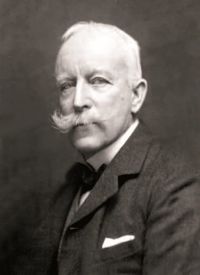 Thomas Hungerford Holdich,
1911 Encyclopædia Britannica
(1910)
Thomas Hungerford Holdich,
1911 Encyclopædia Britannica
(1910)
“ Subordinate officers and rapacious governors of forts wield all the power of the state, and tyranny, oppression and anarchy reign over the whole country. The Dharm raja succeeds as an incarnation of the deity. ”
The prem sagur (1848)
“ Then Raja Joodisthur having seated Shree Krishnù Chund Jee upon a throne, together with his eight queens, offered adoration to him, presenting sandal, unbroken rice, flowers, perfume, lamps and consecrated food; after this he worshipped all the gods, saints, sages, brahmins and Rajas, arrayed them in dresses of different colours, made marks upon their foreheads with sandal and saffron, decorated them with garlands of flowers, and sprinkling perfume, the Raja, with due observance of what was right and fitting, behaved to them all with the most engaging politeness. ”
Krishna-Dwaipayana Vyasa, The Mahabharata
“ But as he could not discover the Rani, he again addressed the Raja, saying, 'it is not proper that I should be treated by thee with deceit. Thy Rani is not in the private apartments, for I could not find her.' The Raja, thus addressed, considered for a while and replied, 'Recollect, Sir, with attention whether thou best not in a state of defilement in consequence of contact with the impurities of a repast. ”
The prem sagur (1848)
“ Raja! you are very fortunate in constantly beholding Shree Krishnù Chund, and obliterating the sins of each birth; the lord, whom Shivù, Bruhmù and all the other gods wander about seeking, continually protects you; the Huri, whose mysteries jogees and sages, or whose passions are under complete subjection, and saints and wise men cannot discover, comes to receive your orders ”
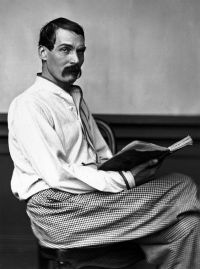 Sir Richard Francis Burton,
Vikram and the Vampire; or, Tales of Hindu Devilry
Sir Richard Francis Burton,
Vikram and the Vampire; or, Tales of Hindu Devilry
“ O, why do not children and young parrots sprout in crops from the ground—from budding trees or vine-stocks?’‘I was thinking, sire,’ said the young Dharma Dhwaj to the warrior king his father, ‘what women would say of us if they could compose Sanskrit verses!’‘Then keep your thoughts to yourself,’ replied the Raja, nettled at his son daring to say a word in favour of the sex. ”
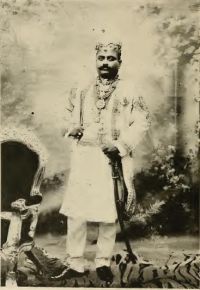 Venkata Ranga Rao,
Advice to the Indian Aristocracy
(1905)
Venkata Ranga Rao,
Advice to the Indian Aristocracy
(1905)
“ It has been my good fortune to be associated with most capable, public-spirited, and high-minded princes and noblemen such as their Highnesses the Maharaja of Travancore, and the Raja of Cochin, and the Maharaja of Bobbili, but I have numbered among my friends in India others born to high station, and possessed of very great merits, who have nevertheless had short or unsuccessful lives, owing to their neglect of some of the lessons the Maharaja essays to teach. ”
Anonymous, Malay Annals (1821)
“ This was observed by the raja, who was enraged at it, conceiving it to have been done solely for the purpose of attracting the lady's attention, and displaying his skill. He accordingly ordered him to be put to death. ”
Venkata Ranga Rao,
Advice to the Indian Aristocracy
(1905)
“ It is very painful to such as love India, and her sons of every rank and station, to look back upon many careers of great promise, which have come to a sad and premature end, and though the like happens in other countries as well as in India, there are certain temptations to which the great in our Eastern Empire are especially subject, and it is with these for the most part that the Maharaja is concerned. ”
R. G. Latham, The Natural History of the Varieties of Man
“ When I find that each rajah is said to possess the power of life and death over his retainers, I find a statement that requires much explanation before it can be made compatible with the asserted freedom of the people at large. ”
Anonymous, Malay Annals (1821)
“ One day the Pati Ari Gaja Mada, having arrayed himself in mean apparel, went aboard a prahu, in which the crew were of the lowest order, and heard them, who did not suspect him to be present, talking on the subject. "Were I the Pati Ari Gaja Mada," says one, "I should soon pounce upon the Princess, for I should become raja." "How fine that would be," said another. "No doubt," says another, "he will make her his wife, for he is a great man, and who can oppose him." ”
 Joseph Jacobs,
Indian Fairy Tales
(1892)
Joseph Jacobs,
Indian Fairy Tales
(1892)
“ The rat raja entered first to condole with his protector on his misfortune, and undertook to supply his protector with provisions. "Whatever sweetmeats or bread are prepared in any house, one and all of you must try to bring whatever you can to our benefactor. Whatever clothes you find hanging in a house, cut down, dip the pieces in water, and bring the wet bits to our benefactor. ”
Venkata Ranga Rao,
Advice to the Indian Aristocracy
(1905)
“ They might be reminded with advantage, as the Maharaja takes occasion to remind the Hindus, that according to the sacred writings enjoyment of life also is a duty. Who will dare to improve upon what a Hindu Maharaja of high character and standing has to say upon the sacred theme of charity? ”
Cavelly Venkata Ramaswamie, Biographical Sketches of Dekkan Poets (1829)
“ A grammarian and poet of the Telugu country, he was educated in his infancy in the Telugu languages, and soon became a proficient; he held some post in the royal house-hold at Andhra, and obtained the surname of Raja, on account of the respect paid to him by princes. ”
L. Adams Beck,
The splendour of Asia: The story and teaching of the Buddha
(1926)
“ So the Maharaja, receiving him in his arms, blessed his son, rejoicing in his happy fate who was the father of such a one as the world could not show the like. And in his ears the voices of prophecy made a changing music of pride and triumph. And the Maharani, overweighted with gladness, like a lily surcharged with dew, was borne to her noble couch of ivory and gold; and Prajapati watched each breath she drew, so great were her love and fear. ”
T. W. Rhys Davids, Mahapadana Sutta
“ Now when Bandhuman the raja had seen the babe, he sent for the brahmin soothsayers 1 , saying: — " Let the reverend brahmin soothsayers see the child." Then, brethren, when the brahmin soothsayers had seen the child, they said to Bandhuman the raja : — " Rejoice, lord, for one of the Mighty Ones is born thy son ! Fortune is thine, my lord, good fortune is thine, in that in thy family such a son has come to birth ! For this babe, my lord, is endowed with the thirty-two marks of the Great Man ; and to one so endowed two careers lie open, and none other. ”
Anonymous, Malay Annals (1821)
“ I ask the young lady who sits uppermost;" but, he did not know that she was the natural daughter of the raja. Then loud laughed the raja, saying, "Whichever of them you please, you are welcome to her." The raja then ordered a hundred prows to be prepared, and sent his daughter Putri Ganggang under the care of Tun Parekpatih Pand to the land of Samadra. ”
Venkata Ranga Rao,
Advice to the Indian Aristocracy
(1905)
“ Few Parliamentary candidates in these days dare say as much! The Maharaja deals with religious questions in a down-right practical manner, the applications of which throughout the world's history would have changed the history of the world. ”
Venkata Ranga Rao,
A Revised and Enlarged Account of the Bobbili Zemindari
(1907)
“ He came on his elephant, attended by his brother-in-law and another person employed in his service chiefly as a legal adviser, on account of his supposed knowledge of the Regulations. The Raja is an active, intelligent man, and manages and looks minutely into all his own affairs. ”
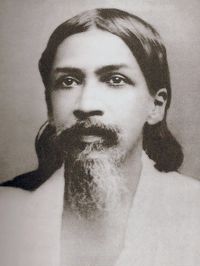 Aurobindo Ghose,
Essays On The Gita
(1922)
Aurobindo Ghose,
Essays On The Gita
(1922)
“ Dominated by rajas, man flings himself into the battle and attempts to use the struggle of forces for his own egoistic benefit, to slay, conquer, dominate, enjoy; or, helped by a certain measure of the sattwic quality, the rajasic man makes the struggle itself a means of increasing inner mastery, joy, power, possession. ”
Venkata Ranga Rao,
Advice to the Indian Aristocracy
(1905)
“ The Maharaja having devoted a chapter to courage now shows his own, by entering the nursery, wherein he wisely deprecates intellectual forcing, urges that Hindu teachers are best for Hindu girls, and that European tutors for boys, themselves need supervision. ”
Anonymous, Malay Annals (1821)
“ THERE was a raja of the land of Kling, named Adi Bernilam Raja Mudeliar, who was descended of Raja Suran. He was raja of the city of Bija Nagara, and had a son named Jambuga Rama Mudeliar, who succeeded to the throne on the death of his father. ”
Venkata Ranga Rao,
Advice to the Indian Aristocracy
(1905)
“ Towards the end of his book, the Maharaja, as men in their later lives, gets back to religion, and with robust common-sense untainted with theology he beats the whole Hindu system into shape, wipes off excrescences, and shows up the underlying truths in strong relief. ”
The prem sagur (1848)
“ The Raja hired for the performance of the religious ceremonies Bhurdooaj, Goutum, Bisist, Biswamittrù, Bamdeo, Purasur, Byas, Kusyp and other great priests, sages and brahmins; who, having repeated incantations from the Vedas, summoned all the gods; and, having caused the Raja to make a vow of giving alms of the sacrifice, they began to prepare the burnt offerings. ”
 Kate Milner Rabb,
National Epics
Kate Milner Rabb,
National Epics
“ Its historical basis is the strife between the Aryan invaders of India and the original inhabitants, illustrated in the strife between the sons of the Raja Pandu and the blind Raja, Dhrita-rashtra, which forms the main story of the poem. Though marred by the exaggerations peculiar to the Hindu, the poem is a great treasure house of Indian history, and from it the Indian poets, historical writers, and philosophers have drawn much of their material. ”
L. Adams Beck,
The splendour of Asia: The story and teaching of the Buddha
(1926)
“ His son moved before him, beautiful exceedingly, perfect in duty not only to his father and his foster-mother, Prajapati the fair and noble, but also to all with whom he had to do, quick to smile and reply, glad in a boy’s sports and games, and yet—apart. As a man, looking down through the clear crystal of a lake, may behold beneath it groves of strange leafage where silver fish dart and disappear in a life unknown to him, so the Maharaja, looking through the translucence of his son’s eyes uplifted to his, knew that they revealed yet hid a world in which he had no part. ”
 F. Max Müller,
Auld lang syne. Second series
(1899)
F. Max Müller,
Auld lang syne. Second series
(1899)
“ After Rammohun Roy’s death there was a pause, for nothing moves in India without a leader, and, though there were followers of the enlightened Râjah, there was for a time no leader of sufficient strength to inspire enthusiasm and to command respect. What happens generally to religious reformers happened in India also. ”
 Mahatma Gandhi,
Indian Home Rule
Mahatma Gandhi,
Indian Home Rule
“ We measure the universe by our own miserable foot-rule. When we are slaves, we think that the whole universe is enslaved. Because we are in an abject condition, we think that the whole of India is in that condition. As a matter of fact, it is not so, but it is as well to impute our slavery to the whole of India. But if we bear in mind the above fact we can see that, if we become free, India is free. And in this [Pg 69] thought you have a definition of Swaraj. It is Swaraj when we learn to rule ourselves. ”
 Natesa Sastri,
Hindu Feasts, Fasts and Ceremonies
(1903)
Natesa Sastri,
Hindu Feasts, Fasts and Ceremonies
(1903)
“ Kings, instead of protecting their subjects, will plunder them under the pretence of levying taxes. Men of all degrees will believe themselves to be equal to the Brahmans. Everyone who happens to have cars, elephants or steeds will fancy himself to be a Rajah. ”
