Vibrio cholerae

Definition and stakes

E. R. Stitt The diagnostics and treatment of tropical diseases (1922)

Etiology.—The cholera vibrio, Spirillum cholerae asiaticae, was discovered by Koch in 1883 and is a short curved organism which, from its shape, is often called the comma bacillus. In addition to single spirilla there may be “S” shapes from attachment of pairs. In cultures in peptone solutions long filamentous forms may be seen which however are exceedingly rare in the rice-water stools. A stained smear from a fleck of mucus gives the fish-in-the-stream appearance. Besides comma-shaped organisms we may have coccoid or rod-shaped forms. In old cultures marked pleomorphism is often seen.
Source: Gutenberg

Various Popular Science Monthly (1893)

That cholera does spread principally along the lines of human intercourse, that it may be conveyed by man, by water, by fomites, may be readily conceded without affecting the contention as to its miasmatic and aërial character and method of propagation. That cholera is caused by Koch's vibrio is to the last degree improbable, and certainly unproved, and the presence of that microbe in the dejecta of cholera patients may be due simply to its finding a congenial soil there.
Source: Wikisource

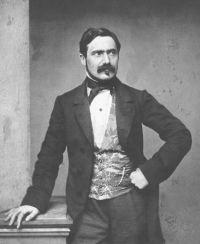
Portrait of Patrick Manson Patrick Manson Tropical Diseases (1919)

Even if the utmost care, intelligence, and honesty succeed in excluding individuals actually suffering from cholera, or likely within a reasonable time to suffer from cholera, there is yet no guarantee that the germ of the disease may not be introduced. Koch and others have shown that sometimes the dejecta even of individuals apparently in good health and who have not suffered, or who may not subsequently suffer from choleraic disease, may yet contain, and for some time continue to contain, the cholera vibrio.
Source: Wikisource

Get perspective with Kwize: daily news enlightened by great literature