 Hermann Hesse,
Demian
(1923)
Hermann Hesse,
Demian
(1923)
“ I like music, but only the kind you play, absolute music, where one feels that someone is trying to fathom heaven and hell. ”
Hermann Hesse,
Demian
(1923)
“ I like music, but only the kind you play, absolute music, where one feels that someone is trying to fathom heaven and hell. ”
 Friedrich Nietzsche,
HUMAN, ALL TOO HUMAN, 'A Book For Free Spirits' Part I
(1909)
Friedrich Nietzsche,
HUMAN, ALL TOO HUMAN, 'A Book For Free Spirits' Part I
(1909)
“ Absolute music" is either form in itself, at a primitive stage of music in which sounds made in tempo and at varying volume gave pleasure as such, or symbolism of form speaking to the understanding without poetry after both arts had been united over a long course of evolution and the musical form had finally become entirely enmeshed in threads of feeling and concepts. Men who have remained behind in the evolution of music can understand in a purely formalistic way the same piece of music as the more advanced understand wholly symbolically. ”
 Henry Edward Krehbiel,
How to Listen to Music, 7th ed
Henry Edward Krehbiel,
How to Listen to Music, 7th ed
“ When we conceive of an art-work composed of such elements, and foregoing the adventitious helps which may accrue to it from conventional idioms based on association of ideas, we have before us the concept of Absolute music, whose content, like that of every noble artistic composition, be it of tones or forms or colors or thoughts expressed in words, is that high ideal of goodness, truthfulness, and beauty for which all lofty imaginations strive. ”
D. M. Strong, The Metaphysic of Christianity and Buddhism…
“ Many people assign to music a power, exceeding that of all other arts, of sublimating the emotions of the human heart. Altering somewhat the form of the definition of Poetry as given by Theodore Watts, in his article on the subject in the Encyclopædia Britannica, one might say that absolute music is the non-concrete and artistic expression of the human mind in emotional and rhythmical sounds. ”
 Jessie E. Sampter,
The Seekers
Jessie E. Sampter,
The Seekers
“ I said, “it seems the most perfect of arts, because it is in itself harmony, the very word we associate with this idea of completeness. I don’t know much of the laws of musical composition, but I know they are the laws of rhythm and harmony, the laws of all motion. Of course, it is figurative to speak of the music of the stars, and yet in a sense their motion is music, because it follows the laws of music. Music is the least definite of all arts, yet the most real and near. It arouses our emotions as nothing else can do.” ”
Paul Rosenfeld, Musical Portraits : Interpretations of Twenty Modern Composers
“ It has become a formidable engine of steel and gold, vibrant with mad and unexpected things. Patterns leap and tumble out of it. Violin music launches swiftly into space, trumpets run scales, the tempi move with the velocity of express trains. It has become a giant, terrible bird, the great auk of music, that seizes you in its talons and spirals into the empyrean. ”
 Daniel Gregory Mason,
The Appreciation of Music - Vol…
Daniel Gregory Mason,
The Appreciation of Music - Vol…
“ Contrast in rhythm, in melody, in harmony, and in style (as exemplified in the use of polyphonic style in the finale) abounds. There is never a dull moment, yet interest is never secured at the expense of unity. Above all, the virility, profundity, and earnestness of the expression, surprise us; there is here none of the detachment, the cool remoteness, of classic art; every note throbs with personal feeling—music has left the innocence and transparent gaiety of childhood behind it, and begun to speak with the deeper and more moving, if less serene, accents of maturity. ”
 Vernon Lee,
Laurus Nobilis: Chapters on Art and Life
Vernon Lee,
Laurus Nobilis: Chapters on Art and Life
“ It must be shaped, and strung, and kept carefully in tune; no easy matter in surroundings little suited to delicate instruments and delicate music. Possessing it, we possess, in the only true sense of possession, the whole world. For going along our way, whether rough or even, there are formed within us, singing the beauty and wonder of what is or what should be, mysterious sequences and harmonies of notes, new every time, answering to the primæval everlasting affinities between ourselves and all things; our souls becoming musical under the touch of the universe. ”
Edward J. O'Brien, The Forgotten Threshold: A Journal of Arthur Middleton
“ It is absolutely true that only music may shape woods and fountains and the beauty of souls, for it is the only medium of expression which is pure. Pure music is the true white magic, as black magic is music mixed with clay by human hands. ”
Garrett Putman Serviss, A Columbus of Space
“ We have it, and we feel it, in pictures, in flower gardens, and in landscapes; only with us it is a frozen music. Living music exists on the earth only in the form of sonorous vibrations because we have not developed our sense of the harmony of colors except when they lie dead and motionless before us. ”
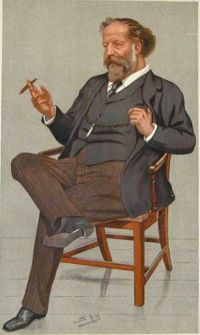 J. Comyns Carr,
Some eminent Victorians: Personal recollections in the world of art and letters
(1908)
J. Comyns Carr,
Some eminent Victorians: Personal recollections in the world of art and letters
(1908)
“ Borrowing as by right from all the arts, and pressing into its service all that has been won in the region of form and colour to enforce its own message of the spirit, it is nevertheless inevitable that to music it must remain the heaviest debtor, for its chosen vehicle of rhythmic language approaches most nearly to the abstract instrument of the musician. ”
 E. T. A. Hoffmann,
Weird Tales, Vol. 2 (of 2)
E. T. A. Hoffmann,
Weird Tales, Vol. 2 (of 2)
“ No art, I believe, affords such strong evidence of the spiritual in man as music, and there is no art that requires so exclusively means that are--purely intellectual and ætherial. The intuition of what is Highest and Holiest--of the Intelligent Power which enkindles the spark of life in all Nature--is audibly expressed in musical sound; hence music and song are the utterance of the fullest perfection of existence--praise of the Creator! ”
Daniel Gregory Mason,
Contemporary Composers
“ Thought, emotion, all that we call the spiritual side of music, expresses itself not through sonorous or harmonic effects, primarily sensuous in appeal, but through melody and rhythm and their interplay and elaboration in so-called thematic development. In truly great music we remember, not such and such a bit of tone-color, not this or that sonority, but the soaring or tender curve of the themes, their logical yet ever new unfolding, their embodiment, in the whole composition, of richest variety with completest final unity. ”
Daniel Gregory Mason,
Contemporary Composers
“ Our final question, then, resolves itself to this: Are there in the music of our day, known or unknown to the majority, any such vital "thoughts," based on principles that a discerning criticism may see even now to have "triumphed and begun to penetrate the world"? Is there music being written to-day which is modern, not through its pampering to jaded sense or dulled intelligence, but through its intuition and expression of the deeper emotional experience and spiritual aspiration of our time? Is there music, in short, not only seductive to the ear but beautiful to the mind? ”
 Kenneth Grahame,
The Golden Age
(1904)
Kenneth Grahame,
The Golden Age
(1904)
“ the pure, absolute quality and nature of each note in itself are only appreciated by the strummer. For some notes have all the sea in them, and some cathedral bells; others a woodland joyance and a smell of greenery; in some fauns dance to the merry reed, and even the grave centaurs peep out from their caves. Some bring moonlight, and some the deep crimson of a rose's heart; some are blue, some red, while others will tell of an army with silken standards and march-music. ”
Lilian Staveley, The Golden Fountain
“ Since coming into this new way of living, the more I come into contact with music the more I sense a mysterious connection between melody—the soul—and her origin. Alone out of all the sciences and arts, music has no foundation upon anything on earth. There is no music in nature until the soul, come to a perfect harmony within herself, brings out the hidden harmony in all creation, and, turning it to melody within herself, returns it to her Lord in song, whether by outward instrument or inward love. ”
Henry Fleetwood, The Secret of Life, Death and Immortality
“ The purling of the brooks, are but other notes by which nature sings her song of love. “All one’s life is music if one touches the notes rightly and in tune.”Musical vibrations are full of healing power. Their effect upon mind and body soothing and vitalizing beyond description, and producing every emotion of which we are capable. It is the key that will unlock for us the deep secrets of the universe. Its universal language enables the composer to reveal his thoughts to an audience, by notes, tones, rhythms, cadences, which are but different rates of vibration. ”
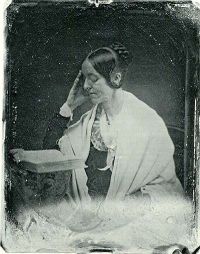 Sarah Margaret Fuller,
Papers on Literature and Art
(1846)
Sarah Margaret Fuller,
Papers on Literature and Art
(1846)
“ Of course we claim for music only a greater rapidity, fullness, and, above all, delicacy of utterance. All is in each and each in all, so that the most barbarous stammering of the Hottentot indicates the secret of man, as clearly as the rudest zoophyte the perfection of organized being, or the first stop on the reed the harmonies of heaven. But music, by the ready medium, the stimulus and the upbearing elasticity it offers for the inspirations of thought, alone seems to present a living form rather than a dead monument to the desires of Genius. ”
Thomas Carlyle, Sartor Resartus, and On Heroes…
“ A musical thought is one spoken by a mind that has penetrated into the inmost heart of the thing; detected the inmost mystery of it, namely the melody that lies hidden in it; the inward harmony of coherence which is its soul, whereby it exists, and has a right to be, here in this world. All inmost things, we may say, are melodious; naturally utter themselves in Song. The meaning of Song goes deep. Who is there that, in logical words, can express the effect music has on us? ”
Various, The Continental Monthly, Vol. 4…
“ The desire to increase the limits of art, to multiply its delicious emotions, will infallibly lead those who cultivate this ethereal study to frequent reunions, in order that they may produce the Beautiful in more fulness, obtain a greater variety of effect and tone, cradled, as it must ever be in music, in the bosom of the strictest unity.Music has its own trinity, composed of Rhythm, Melody, and Harmony. Rhythm is the pulse of time ”
George T. Ferris, The Great German Composers
“ On the one side we have the claim that music is the all-sufficient law unto itself; that its appeal to sympathy is through the intrinsic sweetness of harmony and tune, and the intellect must be satisfied with what it may accidentally glean in this harvest-field; that, in the rapture experienced in the sensuous apperception of its beauty, lies the highest phase of art-sensibility. ”
 Georg Wilhelm Friedrich Hegel,
The Philosophy of Fine Art, volume 3…
Georg Wilhelm Friedrich Hegel,
The Philosophy of Fine Art, volume 3…
“ Inasmuch as, therefore, musical expression has for its content the inward life itself, the ideal significance of fact and emotion, and a tone-world which, at least in art, does not proceed to spatial configuration, and in its sensuous existence is wholly evanescent, it follows that music directly penetrates with its movements to the ideal habitat of all the fluctuations of soul-life. ”
 Aubertine Woodward Moore,
For Every Music Lover
Aubertine Woodward Moore,
For Every Music Lover
“ Our scale intervals are the slowly gained triumphs of the human mind. Modern music did not emerge from the darkness of the past until harmony, as we know it, came into active being.Both melody and harmony are controlled by rhythm. It is the master force of the musical organism. Before man was the ebb and flow of nature had its rhythm. On this elementary rhythm, the one model music finds in nature, the inventive mind of man has builded the wonderfully impressive art rhythms existing in the masterpieces of music. ”
The German Classics of the Nineteenth and Twentieth Centuries…
“ I can no longer separate myself from it, but with impetuous rapture I must reproduce it in all modulations, and, in the final moment, I triumph over the musical idea—and that, you see, is a symphony! Yes, music is truly the mediator between the spiritual and the sensuous world. ”
W. H. Hadow, Studies in Modern Music, Second Series
“ It will thus be seen that the manner in which we are impressed by Music is enormously complex. First, there is the sensuous appeal, the different characteristics of timbre and tone, of rich harmony and full orchestration, of all those devices which are usually described in metaphors of taste and colour. Second, and inclusive of the first, is the emotional appeal, the exhilaration of rapid movement, the gravity of stately chords and broad diatonic melody, the restlessness of broken rhythm and frequent modulation, the shades of surprise which follow upon a sudden change or an unexpected crisis. ”
 John Ruskin,
The Stones of Venice, Volume 3…
John Ruskin,
The Stones of Venice, Volume 3…
“ The great power of music over the multitude is owing, not to its being less but more sensual than color; it is so distinctly and so richly sensual, that it can be idly enjoyed; it is exactly at the point where the lower and higher pleasures of the senses and imagination are balanced; so that pure and great minds love it for its invention and emotion, and lower minds for its sensual power. ”
The Art of Music, Vol. 02 (of 14…
“ And so in the nineteenth century men came to feel that beautiful music cannot be merely contemplated and admired, but must be lived with and felt. Accordingly composers of this period emphasized continually the sensuous in their music, developing orchestral colors, dazzling masses of tone, intense harmonies and biting dissonances, delicate half-lights of modulation, and the [Pg 221] deep magic of human song. The change in attitude from music as a thing to be admired to music as a thing to be felt is perhaps the chief musical fact of the early nineteenth century. ”
Georg Wilhelm Friedrich Hegel,
The Philosophy of Fine Art, volume 3…
“ Thirdly, and finally, it is the melody, by virtue of which on these foundations of a beat characterized by rhythmical vitality and of distinctions and movements of harmony itself that the realm of tones is unitedly discharged in a spiritually free mode of expression, and conducts us thereby to the final main section of our subject, which will undertake to consider music in its concrete unity with the spiritual content it is intended to express in beat, harmony, and rhythm. ”
De Witt H. Parker, The Principles of Aesthetics
“ It is, of course, obvious that our analysis has confined itself to the barest elements of the musical experience. Our music to-day, with its many-voiced harmonies, with its procession of chords instead of single tones, with its modulation into related keys, has an infinite wealth and complexity defying description. A large part of the astonishing effect of music is derived from the fact that in a brief space we seem to hear and absorb so much: the careers of multitudinous lives compressed into an instant. ”
Daniel Gregory Mason,
The Romantic Composers
“ They become as wild flowers plucked to languish indoors, as seaweeds taken from their natural setting of liquid coolness. Or again, the particular expressions of music may be compared to the strings of an instrument, of which the sounding board is plastic beauty; without its sympathetic reinforcement the strings, strike them as we may, give forth a scarcely audible murmur; with it, there is [Pg 39] clear and powerful sonority. So the most ingenious music is dull and dead if it lack the vitality of organic form, but if it be beautiful it will make its way directly to the heart. ”
The Art of Music, Vol. 02 (of 14…
“ An emotion which shakes nations it can concentrate into a few burning lines. [Pg 275] It is never conscious that it is great art; it takes no thought for the means; it is only interested in expressing its message as powerfully and as simply as possible. In doing this it hits upon the phrases that are at the foundation of our musical system, at the cadences which block in musical architecture upon the structure from which all conscious forms are derived.This popular art, as we have said, has revivified music again and again. ”
Various, Continental Monthly , Vol. 6, No…
“ If so, there must be some fault among ourselves, for music is a pure gift from God, the only earthly [Pg 114] pleasure promised us in heaven. Such imputation would indeed be a libel upon the almost infinite variety in the character of music, and its power of consecration to the very loftiest ends. Ah! there we fear is the rub. The character of music! That seems to have been forgotten. If all these melodies be adapted to their original aims, can they be suited to new ones so different? Is there really in musical form, rhythm, melody, and harmony, no capacity for any real expression? ”
The German Classics of the Nineteenth and Twentieth Centuries…
“ Then he will agree with me that music is the sole incorporeal entrance into a higher world of knowledge which, to be sure, embraces man, but which he, on the other hand, can never embrace. Rhythm of the spirit is necessary to comprehend music in its essence; music imparts presentiments, inspirations of divine science, and what the spirit experiences of the sensuous in it is the embodiment of spiritual knowledge. ”
Daniel Gregory MasonAubertine Woodward MoorePaul RosenfeldThomas Whitney SuretteO. B. Boise John Sullivan DwightAchmet-Marie de Servin d'HéricourtDe Witt H. ParkerPaul Leopold Rosenfeld
 James HunekerGeorge T. Ferris
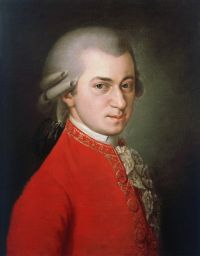 Wolfgang Amadeus MozartEdward Baxter PerryJames Weldon Johnson
 W. S. B. Mathews
 Walter Raymond SpaldingE. T. A. HoffmannW. J. HendersonCarl EngelW. H. Hadow