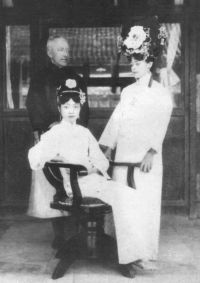
“ Each family possesses an ancestral "hall," where are kept the tablets of every defunct member of the family, before which incense sticks are burnt daily, and where once or twice a year all the members of the family within reach attend to lay offerings before the tablets in a spirit of reverence. Should a man disgrace his family he is often repudiated as a member, and at his death no tablet will be placed for him in the ancestral hall. The consequence is that his descendants cannot present themselves for the 20 competitive examinations upon which all official position depends. ”
Ancestral hall
Definition and stakes
The theme of “ancestral hall” has been addressed by authors such as Charlotte Perkins Gilman, Sir Henry Arthur Blake, Yan Phou Lee, | editor and Sir Reginald Fleming Johnston. It is often associated with terms like architecture, house, Indian, building and pueblo.
Quotes about “ancestral hall”
 Charlotte Perkins Gilman,
The Yellow Wallpaper
“ The Yellow Wallpaper By Charlotte Perkins Gilman It is very seldom that mere ordinary people like John and myself secure ancestral halls for the summer. A colonial mansion, a hereditary estate, I would say a haunted house, and reach the height of romantic felicity—but that would be asking too much of fate! ”
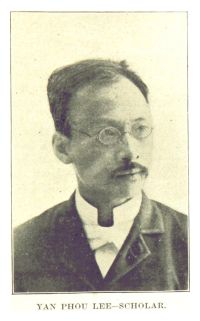 Yan Phou Lee,
When I was a boy in China
“ Schools are held either in a private house or in the hall of a temple. The ancestral temples which contain the tablets of deceased ancestors are usually selected for schools, because they are of no other use and because they are more or less secluded, and are generally spacious. In a large54 hall, open on one side towards a court, and having high ceilings supported by lofty pillars, besides the brick walls, you may see in the upper right-hand corner a square wooden table, behind which is the wooden chair ”
 Lewis Henry Morgan,
Houses and House-Life of the American Aborigines
“ Upon this rhapsody it will be sufficient to remark that halls were entirely unknown in Indian architecture. Neither a hall, as that term is used by us, has ever been seen in an Indian house, nor has one been found in the ruins of any Indian structure. An external corridor has occasionally been found in ruins of houses in Central America. ”
Paul M. Hollister, Famous Colonial Houses (1921)
“ Forget that the ceiling is blistered, that two panes are gone from the side windows, and that night-blooming lodgers have kicked the haunches off the carved steeds of Phoebus Apollo on the door. A century ago a slave would have swung wide the portal with great ceremony, and you would have mounted the winding stair to an upper hall which was notable for its elegance; today you find it dingy, uninspiring and forlorn. Not a ghost in sight anywhere. ”
 Mary Harrod Northend,
Colonial Homes and Their Furnishings
“ They demanded hallways of spacious dimensions, and into favor then came the broad and lofty [Pg 58] hall, embodying in its construction the highest development of the colonial type. Quite through the center of the house this hall extended, from the pillared portico and stately entrance door, with its fan lights and brazen knocker, to another door at the rear, through the glazed upper panels of which tantalizing glimpses could be obtained of tall hollyhocks and climbing roses growing in the old-fashioned garden just without. ”
Various, The Atlantic Monthly, Volume 12…
“ Arrived at the village, they filed into the great central lodge, within whose dusky precincts were gathered the magnates of the tribe. Council-chamber, forum, banquet-hall, dancing-hall, palace, all in one, the royal dwelling could hold half the population in its capacious confines. Here the French made their abode. Their armor buckled, their arquebuse-matches lighted, they stood, or sat, or reclined on the earthen floor, with anxious eyes watching the strange, dim scene, half lighted by the daylight that streamed down through the hole at the apex of the roof. ”
 Samuel Rawson Gardiner,
A Student's History of England…
“ Domestic Life.—The huts of the villagers clustered round the house of the lord. His abode was built in a yard surrounded for protection by a mound and fence, whilst very great men often established themselves in burhs, surrounded by earthworks, either of their own raising or the work of earlier times. Its principal feature was the hall, in which the whole family with the guests and the thegns of the lord met for their meals. ”
 Kate Sanborn,
Old Time Wall Papers
“ Seldom has a house a more splendid history, or romantic origin, than this relic of feudal splendor and colonial hospitality. The house is approached from the lodge-gate through an avenue shaded by rows of ancient trees. The entrance hall is thirty-three feet wide, and is decorated with the identical paper brought from Holland at the time the house was built, having the appearance of old fresco-painting. ”
Bartlett Burleigh James, Women of England
“ After the middle of the twelfth century, it is easier to study the domestic manners of the people. We can, for instance, obtain very precise information as to the style of the dwellings in which they lived. There was a general uniformity in the houses, however they might vary in particulars. In the twelfth century, the hall continued to be the main part of the dwelling. Adjoining it at one end was the chamber, while at the other end might be found the stable. ”
Mary Harrod Northend,
Historic Homes of New England
“ In the main building are two rooms, one on either side of the hall. At the right is the large living-room, and back of it the dining-room, both [Pg 257] of which are filled with treasures,—wonderful old pieces that have been in the family since its earliest days, each having its individual story.On the left are the double drawing-rooms and showing an elliptical arch that has a frieze motif with dentation ornamentation and reeded pilasters. The dividing arch is gracefully ended in the cornice. This is a feature in many colonial homes and is generally echoed in other rooms of the house. ”
John Herbert Aloysius Bone, The Atlantic Monthly (1866)
“ The residences of all the great and wealthy possessed one general character. The central point and most important feature was the great hall, adjoining which in most houses a "parlour," or talking-room, had recently been built. A principal chamber for the ladies of the household was generally placed on the ground-floor, with an upper chamber, or "soler," over it. In the larger establishments additional chambers had been clustered around the main building, increasing in number with the wants of the household. ”
Mary Harrod Northend,
Colonial Homes and Their Furnishings
“ In the better class of houses of this period, the hallway sometimes extended the width of the dwelling, opening at the rear on to the yard space. This type was the forerunner of the stately attractive hall that came into vogue in the last half of the eighteenth century, and continued in favor during the first years of the nineteenth century, with the advent of the wooden and brick mansion. ”
Lewis Henry Morgan,
Houses and House-Life of the American Aborigines
(1877)
“ The elevated platform of earth as a house-site is an element in Indian architecture which reappears in a conspicuous manner in the solid pyramidal platforms upon which the great stone structures in Yucatan and Central America were erected, and which sprang from the defensive and the communal principles in living. This latter principle required large houses for the accommodation-of a number of families in the Lower Status of barbarism, and large enough in some cases, when the people were in the Middle Status, to accommodate an entire tribe. ”
 Edith Nesbit,
The Red House
(1902)
“ The walls of the marble hall are thick, and the windows look to the northeast, so that even when the sun is turning the garden to fine gold, and the westerly rooms to a burning, fiery furnace, the hall remains cool as a cave. ”
Arnold Wright, Early English Adventurers in the East (1917)
“ The old Founder's Hall, which was the cradle of the mighty British Indian Empire, went the way of many other famous buildings in the Great Fire of London, but the tradition remains, and this stuffy little alley will always be a hallowed spot to all Britons who find inspiration in the memories of the past. ”
Thomas Wright, A History of Domestic Manners and Sentiments in England During the Middle Ages
“ Among the rich, a stable did not form part of the house, but its site was often occupied by the kitchen, which was almost always placed close to the hall. Among the higher classes other chambers were built, adjacent to the chief chamber, or to the hall, though in larger mansions they sometimes occupied a tower or separate building adjacent. ”
Lewis Henry Morgan,
Houses and House-Life of the American Aborigines
(1877)
“ These slightly-constructed apartments opened towards the central fire like stalls, thus defining an open central area around the fire-pit, which was the gathering place of the inmates of the lodge. This fire-pit was about five feet in diameter, a foot deep, and encircled with flat stones set up edgewise. A hard, smooth, earthen floor completed the interior. Such a lodge would accommodate five or six families, embracing thirty or forty persons. It was a communal house, in accordance with the usages and institutions of the American aborigines, and growing naturally out of their mode of life. ”
Lewis Henry Morgan,
Houses and House-Life of the American Aborigines
(1877)
“ The houses of the different tribes, in ground-plan and mechanism, will be considered and compared, in order to show wherein they represent one system. A common principle, as before stated, runs through all this architecture, from the "long-house" of the Iroquois to the "pueblo houses" of New Mexico, and to the so-called "palace" at Palenque, and the "House of the Nuns" at Uxmal. It is the principle of adaptation to communism in living, restricted in the first instance to household groups, and extended finally to all the inhabitants of a village or encampment by the law of hospitality. ”
 Isabella L. Bird,
Journeys in Persia and Kurdistan…
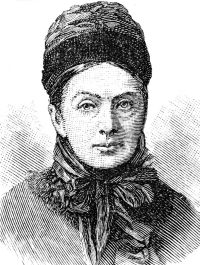
“ On entering the house by an archway, where the heavily-bossed door stands always open, a busy scene is 290 to be witnessed in the hall, which is roughly paved with irregular slabs of stone. On the rude stone settle men are sitting or sleeping, or a carpenter is using it as his bench, or a sheep is being cut up on it. ”
Various, Graham's Magazine, Vol. XLI, No…
“ The bell, communicating with the mansion connected with the fortress, rung, and the chief, with his prisoner, passed slowly in to an inner court, leaving the squaw standing without.The glare of light, the sound of music, mingled with the tones of the human voice in merry laughter and light conversation reached her ear, and startled the wretched girl with wonder. The Indian, with the utmost tranquillity and with slow and important steps, led the way toward this portion of the large and heavy mass of gloomy masonry, which, with its tall chimneys, loomed up before them. ”
Harold Bayley, Archaic England
“ In the old time every Wood and Grove, Field and Meadow, Hill and Cave, Sea and River, was tenanted by tribes and communities of the great Fairy Family, and at least one of its members was a resident in every House and Homestead where the kindly virtues of charity and hospitality were practised and cherished. ”
Lewis Henry Morgan,
Houses and House-Life of the American Aborigines
(1877)
“ HOUSES OF INDIAN TRIBES NORTH OF NEW MEXICO. The growth of the idea of house architecture in general is a subject more comprehensive than the scope of this volume But there is one phase of this growth, illustrating as it does the condition of society and of the family in savagery and in barbarism, to which attention will be invited. It is found in the domestic architecture of the American aborigines, considered as a whole, and as parts of one system. As a system it stands related to the institutions, usages, and customs presented in the previous chapters. ”
Lewis Henry Morgan,
Houses and House-Life of the American Aborigines
“ Although the Spaniards numbered about four hundred, and their allied Indians about a thousand, they found accommodations in a single joint tenement house of the Aboriginal American model. Attention is called to this fact, because we shall find the Village Indians, as a rule, living in large houses, each containing many apartments, and accommodating five hundred or more persons. ”
Lewis Henry Morgan,
Houses and House-Life of the American Aborigines
“ The house architecture of the Northern tribes is of little importance, in itself considered; but, as an outcome of their social condition and for comparison with that of the Southern Village Indians, it is highly important. ”
 Ekai Kawaguchi,
Three Years in Tibet
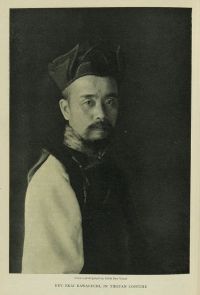
“ The structure as a whole is in good repair. The front hall opens to an inner courtyard, paved with stone, thirty-six feet by thirty, where the priests of the inferior orders gather to dine and to read the scriptures, while the higher Lamas have the privilege of living inside the building. ”
 Wilhelmine von Hillern,
The Hour Will Come: A Tale of an Alpine Cloister…
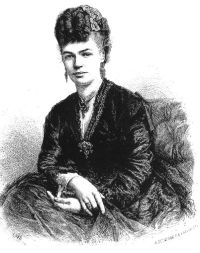
“ The whole brotherhood had assembled in the underground founder's hall, to offer up a special thanksgiving before the effigies of the founders. This hall was the most ancient part of the whole building, and in it a hundred years ago the brethren had performed their devotions until the convent-buildings were complete. ”
 Cuthbert Bede,
The further adventures of Mr. Verdant Green…
(1854)
“ Green's small sanctum to the right of the hall has been converted into a cloak-room, and is fitted up with a ladies'-maid and a looking-glass, in a manner not to be remembered by the oldest inhabitant. ”
Mary Harrod Northend,
Historic Homes of New England
“ The present mansion, remodelled, is to-day a famous landmark. It is considered an excellent example of a colonial home, with its pitched roof, its huge stone chimneys covered with mortar, its dormer windows, and its Georgian porch. One enters through the wide doors into a noble hallway extending entirely through the house, the woodwork showing fine panelling of white pine. The box stairs rise by easy treads to the wide landing, where a colonial window gives light to the apartment. ”
Lewis Henry Morgan,
Houses and House-Life of the American Aborigines
(1877)
“ While exceptional cases of single families living by themselves existed among all the tribes, it did not break the general rule of large households, and the practice in them of communism in living. These usages entered into and determined the character of their house architecture. In all parts of North and South America, at the period of European discovery, were found communal or joint-tenement houses, from those large enough to accommodate five, ten, and twenty families, to those large enough for fifty, a hundred, and in some cases two hundred or more, families. ”
 Amelia B. Edwards,
A thousand miles up the Nile
(1888)
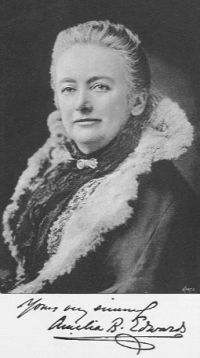
“ A great double doorway, a hall of columns and a double sanctuary are said to be yet perfect, though no longer accessible. The roofing-blocks of three halls, one behind the other, and a few capitals are yet visible behind the portico.What more may lie buried below the surface none can tell. We only know that an ancient city and a mediæval hamlet have been slowly engulfed; and that an early temple, contemporary with the Temple of Amada, once stood within the sacred inclosure. ”
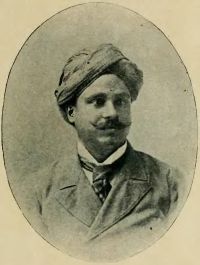 A. Vadivelu,
The Aristocracy of Southern India
(1903)
“ The central hall of the mansion with its lofty roof sustained by no pillars is hung with suits of armour. Passing through the entrance hall, we reach another hall, in the middle of the mansion, which contains excellent furniture and rare specimens of all kinds of novelty he was able to collect when he travelled in Europe. ”
Lewis Henry Morgan,
Houses and House-Life of the American Aborigines
(1877)
“ From what is now known of the necessary constitution of society among the Village Indians, it scarcely admits of a doubt that the great house in which he lived was occupied on equal terms by many other families in common with his own, all the individuals of which were joint proprietors of the establishment which their own hands had constructed. ”
Lewis Henry Morgan,
Houses and House-Life of the American Aborigines
(1877)
“ There are certain usages and customs of the Indian tribes generally which tend to explain their plan of life — their large households, their houses, and their house architecture. They deserve a careful consideration and even further investigation beyond the bounds of our present knowledge. The influence of American civilization has very generally broken up their old plan of life, and introduced a new one more analogous to our own. ”
 Elihu Burritt,
Walks in the Black Country and its Green Border-Land…
(1868)
“ Other artists are in training in the same school, painting on japanned tin-plate or metallized paper for their canvas. The Old Hall is the most interesting manufacturing establishment in the Black Country for its antecedents and associations, and well worth visiting for the beautiful ware it produces. ”
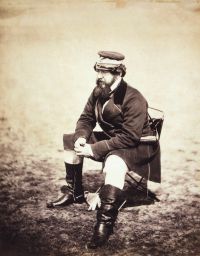 Sir William Howard Russell,
Pictures of Southern Life, Social…
“ The door of the chamber is open, and we are introduced into a lofty, well-lighted and commodious apartment, in which the Congress of the Confederate States holds its deliberations. A gallery runs half round the room, and is half filled with visitors—country cousins, and farmers of cotton and maize, and, haply, seekers of places great or small. ”