Angle (geometry)

Definition and stakes

Bernhard Marks,  Marks' first lessons in geometry

“ An angle at the circumference is measured by half the arc on which it stands.
Let B A D be an angle whose vertex is in the circumference of the circle whose centre is C; then will it be measured by half the arc B D.
For through the centre draw the diameter A E, and join the points C and B.
The exterior angle E C B is equal to the sum of the angles B and B A C.
Because the sides C A, C B, are radii of the circle, they are equal, the triangle is isosceles, the angles B and B A C opposite the equal sides are equal, and the angle B A C is half of both.
”
Source: Gutenberg

Bernhard Marks,  Marks' first lessons in geometry

“ If the angle Red were smaller, and the angle Green larger, would the adjacent angles still be equal to two right angles?
Then,—
Any two adjacent angles are equal to two right angles.
If we draw the straight line c d where the edges of the square corners come together, what kind of angles will a c d, d c b, be?
”
Source: Gutenberg

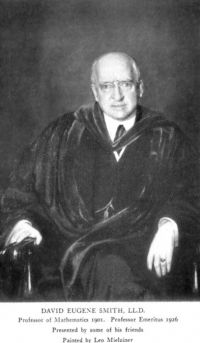
Portrait of David Eugene Smith David Eugene Smith,  The Teaching of Geometry

“ A few illustrations, as of an open book, the wall and floor of a room, and a swinging door, serve to make the concept clear, while a plane at right angles to the edge shows the measuring plane angle. So manifest is this [Pg 299] relationship between the dihedral angle and its measuring plane angle that some teachers omit the proposition that two dihedral angles have the same ratio as their plane angles.
Theorem. If two planes are perpendicular to each other, a straight line drawn in one of them perpendicular to their intersection is perpendicular to the other.
”
Source: Gutenberg

Get perspective with Kwize: daily news enlightened by great literature