“ The word curricle made Charles Musgrove jump up that he might compare it with his own; the servant in mourning roused Anne’s curiosity, and the whole six were collected to look, by the time the owner of the curricle was to be seen issuing from the door amidst the bows and civilities of the household, and taking his seat, to drive off. “Ah!” cried Captain Wentworth, instantly, and with half a glance at Anne, “it is the very man we passed.” ”
Curricle
Definition and stakes
The curricle, a lightweight two-wheeled carriage usually pulled by a single horse, appears in literature as both a symbol of social mobility and a narrative tool. Authors such as Jane Austen portray it as an emblem of refinement and status, as seen in Persuasion and Northanger Abbey, where its presence stimulates social interaction and observation.
Meanwhile, naturalists like William Henry Hudson and John James Audubon examine the "curlew," a bird, in their works, emphasizing its migratory patterns and ecological significance. These diverse perspectives—spanning social critique to natural history—illustrate the curricle’s dual relevance in both human and natural contexts, connecting cultural and environmental themes.
Quotes about “curricle”
 E. W. Hornung,
The Rogue's March
(1896)
E. W. Hornung,
The Rogue's March
(1896)
“ Their eyes never met. Daintree jumped down and led Claire on his arm through the roses. Fawcett came up, the curricle was gone, and Tom stood alone in the drive, watching the ladies go upstairs within, followed by their maid and Daintree; and after that he stood watching the staircase until Daintree ran down it and had him by both hands. “You dear good fellow—you have thought of everything!” he cried. “You couldn’t have done more if you’d been the happy man yourself; and I shall never forget it—especially the flowers!” ”
 Jane Austen,
Northanger Abbey
(1817)
Jane Austen,
Northanger Abbey
(1817)
“ A very short trial convinced her that a curricle was the prettiest equipage in the world; ”
Oliver Vernon Aplin, The Zoologist (1899)
“ Barren open stretches on the undulating downs, as open and exposed as possible, are the haunts the Curloos chose; for there the bird's long legs and watchful eye enable him to guard against a surprise. The spot they select on our hills may be a vast field, partly under plough and partly derelict arable land, fallen back to poor condition, or "tumbled down," as they say, sweeping smoothly down to the foot of the hills in gentle basin-like slopes. Here on the short bare grey-green herbage, strewn with grey-and-white flints, the great down Hares sit out in perfect safety. ”
 William Henry Hudson,
British birds
(1921)
William Henry Hudson,
British birds
(1921)
“ They appear to know just when this occurs, however far from the shore they may be, and, rising and calling to each other, set out on their return, to arrive at the exact time when feeding may begin. It is during these journeys to and fro between the sea and the moors that the curlew looks at his best when, seen at a moderate distance, he passes in small flocks, disposed in the form of a wedge, or letter V, his sharp-pointed wings and long, ibis-like beak clearly outlined against the blue sky. To most lovers of nature and wild bird life the voice of the curlew is his principal attraction. ”
 John James Audubon,
Ornithological biography, Vol. 3…
John James Audubon,
Ornithological biography, Vol. 3…
“ The Long-billed Curlew spends the day in the sea-marshes, from which it returns at the approach of night, to the sandy beaches of the sea-shores, where it rests until dawn. As the sun sinks beneath the horizon, the Curlews rise from their feeding-grounds in small parties, seldom exceeding fifteen or twenty, and more usually composed of only five or six individuals. The flocks enlarge, however, as they proceed, and in the course of an hour or so the number of birds that collect in the place selected for their nightly retreat, sometimes amounts to several thousands. ”
 Arthur Ransome,
Pond and Stream
Arthur Ransome,
Pond and Stream
“ As we row on down the lake, watching the reflection of the boat rocking in the ripples, and the reflections of the hills and the trees on the shore of the lake we sometimes hear a long whistling cry, and a curlew swings high over our heads from one side of the valley to the other, like a pendulum-bob without a string, his long curved beak stretched out far before him. ”
Various, Birds and Nature, Vol. 12 No. 2…
“ Though the natural home of the curlews is the muddy shores and grassy lowlands adjacent to bodies of water the Long-billed species also frequents drier places at a distance from water, and even breeds in the uplands. Here their food consists of worms, insects and berries. When fattened with such food their flesh is tender and lacks the stronger flavor that is present when they have fed exclusively on the animal food of the marshes of the sea shore. It is interesting to watch the Curlew upon the beach as it gracefully moves from point to point in search of food. ”
W. H. Maxwell, The Field Book: or, Sports and pastimes of the United Kingdom
“ In winter they depart to the sea-side, where they are seen in great numbers, and then live upon the worms, marine insects, and other fishy substances which they pick up on the beach and among the loose rocks and pools left by the retiring tide. The flesh of the curlew has been characterised by some as very good, and of a fine flavour—by others as directly the reverse; the truth is, that, while they are in health and season, and live on the moors, scarcely any bird can excel them in goodness; but when they have lived some time on the sea shore, they acquire a rank and fishy taste.—Bewick. ”
 Ivana Brlic-Mazuranic,
Croatian Tales of Long Ago
Ivana Brlic-Mazuranic,
Croatian Tales of Long Ago
“ But Curlylocks wanted to ride faster still. She bent down and pinched the Black’s right ear. The horse started, reared, and then bolted straight ahead, leaving behind the rest of the horses, the meadow and all, as he flew away like the wind with Curlylocks into the wide, wide world.Curlylocks thoroughly enjoyed her lightning ride. The Black went like the wind, by field and by river, by meadow and mountain, over dale and hill. “Good gracious! what a lot of things there are in the world!” thought Curlylocks, full of delight as she looked at all the pretty sights. ”

“ But to the drowsy intelligence of Curly they represented only warmth and softness and protection against the cold humidity of the night. After several unlucky efforts, at last he conquered gravity so far as to climb over a wheel and pitch forward upon the best and warmest bed he had fallen upon in many a day. Then he became instinctively a burrowing animal, and dug his way like a prairie-dog down among the sacks and blankets, hiding himself from the cold air as snug and safe as a bear in his den. For three nights sleep had visited Curly only in broken and shivering doses. ”
 Gilbert White,
The Natural History of Selborne
Gilbert White,
The Natural History of Selborne
“ I wonder that the stone curlew, charadrius oedicnemus, should be mentioned by the writers as a rare bird: it abounds in all the champaign parts of Hampshire and Sussex, and breeds, I think, all the summer, having young ones, I know, very late in the autumn. Already they begin clamouring in the evening. They cannot, I think, with any propriety, be called, as they are by Mr. Ray, ‘circa aquas versantes’; for with us, by day at least, they haunt only the most dry, open, upland fields and sheep walks, far removed from water. What they may do in the night I cannot say. ”
 Louis Becke,
"Five-Head" Creek; and Fish Drugging in the Pacific
Louis Becke,
"Five-Head" Creek; and Fish Drugging in the Pacific
“ As I watched it steadily increasing the first voices of the night began to call—a 'possum squealed from the branches of a blue gum in the creek, and was answered by another somewhere near; and then the long, long mournful wail of a curlew cried out from the sunbaked plain beyond. Oh, the unutterable sense of loneliness that at times the long-drawn, penetrating cry of the curlew, resounding through the silence of the night amid the solitude of vast Australian plains, causes the solitary bushman or traveller to feel! ”
Henry Eliot Howard, Territory in Bird Life
“ The Curlew, when surprised, utters a cry with which most of us, I suppose, are familiar; but when with lowered head it drives away another individual from the feeding ground, it gives expression to its feelings by a low, raucous sound, which again is different from its cry when a Common Gull steals the arenicola that has been drawn out of the mud with such labour. ”
 Charles Dixon,
British Sea Birds
Charles Dixon,
British Sea Birds
“ In some districts where little beach is exposed during high-water, the Curlews will retire some distance inland, but return with remarkable punctuality as soon as the tide begins to ebb. Shingle banks and islands are also often visited between tides. Curlews when feeding are very restless birds, running and walking about the beach, seemingly in a very careless and unsuspecting manner, but sentinels are ever on the watch to sound the warning note, which sends the big long-billed speckled birds hurrying away to safer haunts. The Curlew feeds both by day and by night ”
 J. Lewis Bonhote,
Birds of Britain
J. Lewis Bonhote,
Birds of Britain
“ The Curlew is an abundant resident throughout the United Kingdom. In the winter it is essentially a shore-bird, moving about in large flocks, which may be found in the meadows and pasture-lands near the coast; these flocks journey to the shore twice daily to feed on the mud or rocks left bare by the ebbing tide. In April it leaves the coast to nest on the heath-covered moors, and though it breeds in larger numbers in Scotland it is well distributed in the north and west of England and Ireland. ”
Gilbert White,
The Natural History of Selborne
“ My Sussex friend, a man of observation and good sense, but no naturalist, to whom I applied on account of the stone curlew, oedicnemus, sends me the following account: ‘In looking over my Naturalist’s Journal for the month of April, I find the stone curlews are first mentioned on the seventeenth and eighteenth, which date seems to me rather late. They live with us all the spring and summer and at the beginning of autumn prepare to take leave by getting together in flocks. ”
F.L.S. John Watson, Poachers and Poaching
“ As we proceed, a splash comes from the river, and some large-winged fly has been sucked under. The night food comes on, and the reach boils. Water-rats, voles, and shrews are busy among the stones searching for insect larvæ, or gnawing the stalks of water-plants. The wafting of wings overhead betokens a curlew flying through the darkness to its feeding ground. The peculiarly lonely wail of the summer-snipe comes down stream, and a teal stretches her neck low over the sand. ”
 George Bird Grinnell,
Jack the Young Trapper: An Eastern Boy's Fur Hunting in the Rocky Mountains
George Bird Grinnell,
Jack the Young Trapper: An Eastern Boy's Fur Hunting in the Rocky Mountains
“ Flocks of tiny shore birds tripped lightly over the soft mud of the banks, and brown and black long-billed curlews stalked over the grassy prairie. Many of these birds were evidently breeding, and displayed great anxiety when the visitors approached their nests. The curlews especially were demonstrative, and flew about close above the men's heads, uttering loud, shrill cries.On a little knoll near one of the lakes, Hugh and Jack sat down and adjusted the glasses to study the birds that were floating on the water. ”
William Henry Hudson,
British birds
(1921)
“ During a greater part of the year the curlew is a shore-bird, seeking its food on the sand-flats which become covered at high water. When the tide overflows the flats the birds go inland, often to a distance of several miles from the sea, and wait there until the tide turns. ”
Various, Birds and Nature, Vol. 12 No. 2…
“ During the breeding season, in particular, its harsh cries of alarm resound when the safety of its nest or young is threatened.”The Long-billed Curlew spends but little time in home building. Its nest consists of a layer of grass placed in any suitable saucer shaped hollow on the ground.The downy young resemble the adult bird but little. In color they are a pale brownish yellow modified by a trace of sulphur yellow, the under parts being somewhat darker. ”
John James Audubon,
Ornithological biography, Vol. 3…
“ As I have nothing of any importance to add, I shall present you with a few extracts, from Wilson and Nuttall, both of whom have had opportunities of observing this species. “The Short-billed Curlew,” says the former, “arrives in large flocks on the sea-coast of New Jersey early in May, from the south, frequents the salt-marshes, muddy shores, and inlets, feeding on small worms and minute shell-fish. They are most commonly seen on mud-flats at low water, in company with various other waders; and at high water roam 284 along the marshes. They fly high, and with great rapidity. ”
Roger Pocock, Curly: A Tale of the Arizona Desert
“ I sat on my tail to think, feeling lonesome then, looking east toward Texas and wondering if my poor old mother was still alive. Westward the sun was setting, and that way lay the great Pacific Ocean, bigger than all the plains, where the ships rode herd upon their drove of whales—I wanted to see that too. But then I looked south-east, the way I had come, through valleys of scrub and cactus; there, somewheres beyond the hills, was my little ranch, and all the good pasture away to Holy Cross. My heart was crying inside me, but I didn't know what I wanted until I thought of Curly. ”
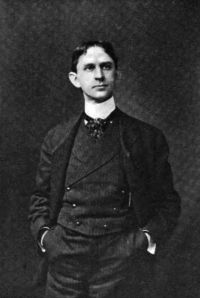 Albert Bigelow Paine,
The Hollow Tree and Deep Woods Book
Albert Bigelow Paine,
The Hollow Tree and Deep Woods Book
“ Man, who was working in the next field, heard him and came running. When Curly heard Mr. Man coming he thought, 'Now he'll take me home and make me a great pig, just as he did the little runt pig.' But Mr. Man didn't. 'Here, you rascal!' he said, what are you doing under my gate? I'll fix you.' Then he picked up a long, scratchy stick and commenced to beat Mr. Curly, first on one side and then on the other, till he squealed and howled so loud that you could hear him almost a mile. ”
Thomas Hepburn, The Zoologist (1902)
“ Common Curlew (Numenius arquata) .—There were flocks of Curlews on the coast of Walney Island and at Ravenglass. Boot. There were here several pairs of breeding birds about the hills. One pair which I watched for some time had young which could fly quite well. The old birds flew round at a safe distance, very often settling on opposite side of me, keeping just out of sight over the rise of the hill, calling to each other with a soft musical whistle all the time. At another spot a pair were particularly noisy and bold, coming quite close to me, and whistling loudly. ”
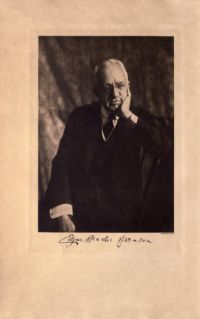 Edgar Beecher Bronson,
The Red-Blooded Heroes of the Frontier
Edgar Beecher Bronson,
The Red-Blooded Heroes of the Frontier
“ I've had him four years, had him out all through Victoria's raid of the Gila, and he's a safer night guard than any ten men you can string around camp: nothing can approach he won't nail or tell you of. With Curly, a night-camp surprise is impossible."Whatever cross Curly represented was a mystery. Two-thirds the height and weight of a mastiff, he had the broad narrow pointed muzzle of a bear, and a shaggy reddish-black coat that further heightened his resemblance to a cinnamon, with great gray eyes precisely the color of his master's, and as fierce. ”
John James Audubon,
Ornithological biography, Vol. 3…
“ The Long-billed Curlews are in general easily shot, but take a good charge. So long as life remains in them, they skulk off among the thickest plants, remaining perfectly silent. Should they fall on the water, they swim towards the shore. ”
George Paul Goff, Nick Baba's Last Drink and Other Sketches
“ There are perhaps a few more trees—some oaks, and we observed a tree with its crimson and yellow autumn foliage, backed by a clump of pines, looking beautiful against the dark green, like sunlight illumining a gloomy spot.After winding through the channel for a few hours, we enter Currituck Sound. This shallow sea takes its name from a tribe of Indians which once owned the adjacent lands. It is quite a large sheet of water, though not deep, about fifty miles long, and nearly ten at the widest part. It is dotted with small, low, sedgy islands, marshes and swamps. ”
Bothwell; or, The Days of Mary Queen of Scots…
“ The currach was fast, high and dry, upon a sandy beach; on one side, the broad and glassy river was flowing past; on the other, were the green and waving woods of Rosse. [*] An old man, with long flowing garments, and a beard of snow that floated in the passing wind, approached; and in his bent form, and the cross-staff on which he leant, she recognised St. Serf of the Isle, and hurried to meet him, and implore his blessing on her babe. ”
Alfred Newton, 1911 Encyclopædia Britannica (1911)
“ So soon as the young are able to shift for themselves, both they and their parents resort to the sea-shore or mouths of rivers, from the muddy flats of which they at low tide obtain their living, and, though almost beyond any other birds wary of approach, form an object of pursuit to numerous gunners. While leading this littoral life the food of the curlew seems to consist of almost anything edible that presents itself. ”
 Howard Roger Garis,
Curly and Floppy Twistytail (The Funny Piggie Boys…
Howard Roger Garis,
Curly and Floppy Twistytail (The Funny Piggie Boys…
“ But if you will let go of the big apple you can easily run away from the fox, for he is old, and not a good runner. Drop the apple.""No, indeed!" cried Curly. "I want the biggest one I can find!" So he held tightly to the apple, and also to the cornmeal, and on he ran, but the fuzzy fox was getting nearer and nearer, and almost had him."I've got you!" suddenly snapped the fox. "I'll have roast pork and apple sauce tonight all right!" and he was just going to grab Curly and the apple and bag of meal, when out from the bushes jumped Uncle Wiggily Longears, the old gentleman rabbit. ”
