“ The Scotsman who handles the big drum hits it first on one side and then on the other, and each time whirls his free drumstick like a windmill. He is not perhaps a musical virtuoso, but there can be no question about his ability as a juggler. ”
Drumstick
Definition and stakes
The theme of “drumstick” has been addressed by authors such as Henry Ruffin, John Gregory Bourke and Ramakrishna Paramahamsa. It is often associated with terms like drum, drummer, instrument, musical and rhythm.
Quotes about “drumstick”
 John Gregory Bourke,
The Medicine-Men of the Apache…
John Gregory Bourke,
The Medicine-Men of the Apache…
“ The drum is nearly always improvised from an iron camp kettle, partially filled with water and covered with a piece of cloth, well soaped and drawn as tight as possible. The drumstick does not terminate in a ball, as with us, but is curved into a circle, and the stroke is not perpendicular to the surface, but is often given from one side to the other. ”
Ramakrishna Paramahamsa, The Gospel of Râmakrishna (1907)
“ Drums are made with the skin which is thus merci-lessly beaten, sometimes with the hand and sometimes with the drumstick. It is only when out of its entrails are made strings for the bows used for carding cotton that the troubles of the poor creature are over. ”
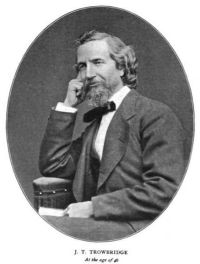 J. T. Trowbridge,
The Drummer Boy
J. T. Trowbridge,
The Drummer Boy
“ Frank, who was writing a letter to his mother, on his knapsack, jumped up with alacrity, hid his paper, and ran out to see what was wanted. "This way, Manly," said the sergeant. "Here's the man that's to give you lessons. Go with him." The teacher was a veteran drummer, with a twinkling gray eye, a long, thick, gray mustache, and a rather cynical way of showing his teeth under it. He had some drumsticks thrust into his pocket, but no drum. ”
 Beatrice Grimshaw,
In the Strange South Seas
Beatrice Grimshaw,
In the Strange South Seas
“ It is carved and ornamented with sinnet, and topped with a piece of bladder; it seems to have been hollowed out of a big log, with considerable labour. The skill of the drummers is really remarkable. No drumsticks are used, only fingers, yet the sound carries for miles. While drumming, the hands rise and fall so fast as to lose all outline to the eye; the drummer nods and beats with his foot in an ecstasy of delight at his own performance; the air is full of the throbbing, rhythmical, intensely savage notes. ”
Clark Wissler, The Social Life of the Blackfoot Indians
“ The counters are about 38 cm. long, of plain wood sharpened at one end for sticking up in front of the players. The drumsticks are short clubs of no definite form. Each side takes a pair of hiding sticks and selects a man to do the hiding and one to do the guessing, according to their known skill. ”
The Güegüence; A Comedy Ballet in the Nahuatl-Spanish Dialect of Nicaragua
“ A MARIMBA PLAYER AND HIS INSTRUMENT. "Two long drumsticks, with balls of India rubber at their heads, are in the hands of the player, who strikes double notes at every touch of the wooden claviature, with the resounding jicaras underneath. The sound of this instrument is charming, clear, limpid in its tones, like the intonation of a harp string of wire. The Indians produce the justest and sweetest double notes, and blend a rattling tune together in very [xxx] harmonious chords. Their talent for playing this instrument by ear is astonishing ”
Esther Singleton, The orchestra and its instruments (1917)
“ Wooden balls as large as a fifty-cent piece are used for certain effects; ordinary street drumsticks for very fine crisp rolls, as required by Elgar in his Variations; and the sponge sticks for delicate work. ”
 Charles Dickens,
The Uncommercial Traveller
Charles Dickens,
The Uncommercial Traveller
“ Wonderful poultry of the French-Flemish country, why take the trouble to be poultry? Why not stop short at eggs in the rising generation, and die out and have done with it? Parents of chickens have I seen this day, followed by their wretched young families, scratching nothing out of the mud with an air—tottering about on legs so scraggy and weak, that the valiant word drumsticks becomes a mockery when applied to them, and the crow of the lord and master has been a mere dejected case of croup. ”
The Art of Music. Vol. 01 (of 14…
“ The drum, roughly speaking, is the oldest musical instrument. It is of great interest to us inasmuch as it still holds a place of honor in the modern orchestra. It is the king of the group of percussion instruments whose object it is, not to produce a tone, but an accent.No tribe of savages has been discovered but what is possessed of a drum of some sort. The most usual form of construction of the primitive drum has been that of a section of tree trunk, hollowed out, and covered with skin at each end. Certain trees, such as the bread-fruit tree or the bamboo, render this peculiarly feasible. ”
 Lafcadio Hearn,
Two years in the French West Indies
Lafcadio Hearn,
Two years in the French West Indies
“ The sound of the drum itself, well played, has a wild power that makes and masters all the excitement of the dance—a complicated double roll, with a peculiar billowy rising and falling. The creole onomatopes, b'lip-b'lib-b'lib-b'lip, do not fully render the roll;—for each b'lip or b'lib stands really for a series of sounds too rapidly filliped out to be imitated by articulate speech. The tapping of a ka can be heard at surprising distances; and experienced players often play for hours at a time without exhibiting wearisomeness, or in the least diminishing the volume of sound produced. ”
 Nathaniel Bright Emerson,
Unwritten Literature of Hawaii…
Nathaniel Bright Emerson,
Unwritten Literature of Hawaii…
“ Musicians inform us that the drum—exception is made in the case of the snare and the kettle drum—is an instrument in which the pitch is a matter of comparative indifference, its function being to mark the time and emphasize the rhythm. Page 143 There are other elements, it would seem, that must be taken into the account in estimating the value of the drum. Attention may be directed first to its tone-character, the quality of its note which touches the heart in its own peculiar way, moving it to enthusiasm or bringing it within the easy reach of awe, fear, and courage. ”
Sven Anders Hedin, Trans-Himalaya: Discoveries and Adventurers in Tibet…
“ The drummers beat their instruments slowly and in strict time, accompanied by the clash of the cymbals, the weird, prolonged blasts of the trumpets, and the more agreeable notes of the flutes. But now and then the time is accelerated, the beats of the drum follow one another more and more closely, and the claps of the clashing basins pass into one continuous resonance. The musicians seem to stimulate one another, and there is a great crescendo; there is more than enough noise to deafen one, so it is useless to attempt to speak to one’s neighbour. ”
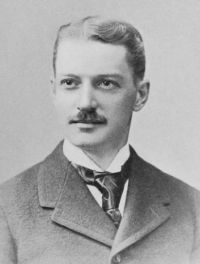 Henry Kelsey Devereux,
"The spirit of '76": Some recollections of the artist and the painting
(1926)
Henry Kelsey Devereux,
"The spirit of '76": Some recollections of the artist and the painting
(1926)
“ On the right of the old man marches a boy, hardly in his teens, whose drum keeps time to the beat of the other. His face is upturned to the old man, as though he were his grandfather, as if to question perhaps the route or the danger ahead, but still with a look of rapt inspiration. No shade of fear lurks in his calm eyes, while the ‘rub-a-dub’ of his little drum sounds as clear and distinct as the heavier roll of the aged drummer. ”
Robert Wood Williamson, The Mafulu: Mountain People of British New Guinea
“ The maker of a drum must climb up the tree from the wood of which he is about to make it, and there, until the drum is finished, he must remain sitting among the [213] branches, or, if these are inconvenient for the purpose, he may erect a scaffold around the trunk of the tree, with a platform on the top of it, and work upon that. Whilst working, he must always keep the upper or tympanic end of his drum facing the wind, the idea of this being that the wind gets into the drum, and makes it musical. ”
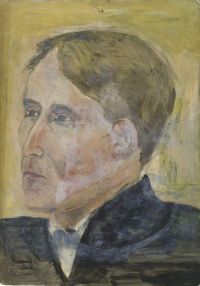 Arthur Waley,
The Nō Plays of Japan
Arthur Waley,
The Nō Plays of Japan
“ During the dance this drum rhythm speeds up to a felt time, and at moments of great stress, as when an avenging ghost swims on with a spear, a third drum, played with sticks, comes in with rapid regular beats, louder and softer. Sometimes when the beats are not so followable, but anyway quicker in succession, I seem to make out that they must be involving themselves in some business of syncopation, or the catching up and outstripping of a slow beat by a quicker one. ”
“ This drum had been heard from before. "It's put away," he mumbled; hastily adding, "That's a snare drum, anyway. What we need is a bass drum!"The mere thought of a drum was annoying to his father, who declared in a menacing tone: "I hereby warn you that if I ever find a drum on the premises, snare, bass, kettle or any other kind, I'll kick a hole through it! Now don't forget that!""Kettle? Did you say kettle?" Sube asked eagerly. "What's a kettle drum?" [Pg 77] "Never mind what it is," retorted his father. "The less you know about drums, the better off you'll be." ”
 D. H. Lawrence,
The Plumed Serpent
(1926)
D. H. Lawrence,
The Plumed Serpent
(1926)
“ The men in the crowd began to subside, sitting and squatting on the ground, with their hats between their knees. And now it was a little sea of dark, proud heads leaning a little forward above the soft, strong male shoulders.Near the wall was a clear circle, with the drum in the centre. The drummer with the naked torso stood tilting his drum towards him, his shoulders gleaming smooth and ruddy in the flare of light. Beside him stood another man holding a banner that hung from a light rod. ”
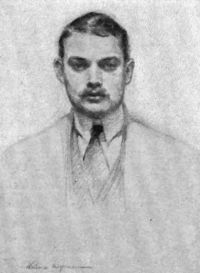 Guy Wetmore Carryl,
Zut, and Other Parisians
Guy Wetmore Carryl,
Zut, and Other Parisians
“ There was a chance for glory, bon sang! But to be a drummer—a drummer one metre seventy in height, with flaming red hair and a freckled face—a drummer who was called Little Tapin; and to have, for one's most important duty, to drum the loungers out of a public garden! ”
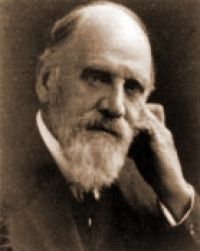 Sir Francis Darwin,
Springtime and Other Essays
Sir Francis Darwin,
Springtime and Other Essays
“ Anyone who has seen the band of the Life Guards must have admired (as I do) the splendid personage who plays the kettle-drums. These are not of the ordinary drum-form, being hemispherical instead of cylindrical, and having but a single membrane. They have a right to be called musical instruments since their pitch is alterable: [96d] I have often admired p. 97the drummer in an orchestra tuning his instrument at a change of key. One sees him leaning over his children like an anxious mother until he gets his large babies into the proper temper. ”
Ferdinand Werne, Expedition to discover the sources of the White Nile… (1849)
“ A drummer close to him is beating very skilfully, from time to time, on his long wooden kettle-drum, and answers quite doughtily the roll of one of our drummers. Another is blowing a wooden trumpet, in which the mouth-piece, or the hole at the upper end, is like that of a flute. ”
A. M. T. Jackson, Folk Lore Notes. Vol. I—Gujarat
“ Sometimes the beating of drums and cymbals is alone resorted to for expelling an evil spirit from the person of a patient. It is believed that this process is effectual in proportion to the degree of the intensity of the noise created.65 The patient is asked to sit facing the east. The Bāval or Vāghri i.e., the drummer, sits in front of him, and not only beats the drum as loudly as he can, but also sings hymns at the top of his voice in honour of his favourite goddess. In the meanwhile, the bhuvā, who is also in attendance, begins to be possessed, and discloses the fact by convulsive fits. ”
J. G. Wood, The uncivilized races of men in all countries of the world… (1875)
“ Some of these lifeguards were very skilful in beating the drum, and, when a number were performing on a row of suspended drums, the principal drummer always took the largest instrument, and was the conductor of the others, just as in a society of bellringers the chief of them takes the tenor bell. For any one, except a native, to sleep in a Weezee village while the drums are sounding is perfectly impossible, but when they have ceased the place is quiet enough, as may be seen by Captain Grant’s description of a night scene in Wanyamuezi. ”
 Edward Bellamy,
The Duke of Stockbridge — CHAPTER SEVENTHTHE FIRST ENCOUNTER
(1900)
Edward Bellamy,
The Duke of Stockbridge — CHAPTER SEVENTHTHE FIRST ENCOUNTER
(1900)
“ And instantly the roll of the drum deafened the ears of the people, utterly drowning the imperious tones of the selectman, and growing louder and swifter from moment to moment, as the long unused wrists of the drummer recalled their former cunning. ”
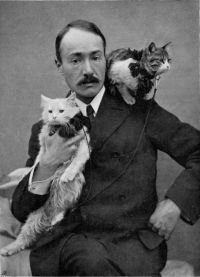 Arnold Henry Savage Landor,
In the forbidden land
(1898)
Arnold Henry Savage Landor,
In the forbidden land
(1898)
“ The drummer beats his drum whimsically—fast and slow alternately, with no rule—just as it pleases his fancy, and the dancer always keeps time with him in all his frenzies and eccentricities, so that his movements are sometimes so slow as to be barely noticeable, and at others so rapid that his arms and legs can no longer be distinguished. ”
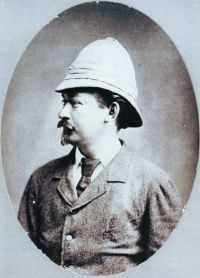 Emil Holub,
Seven years in South Africa Volume 2…
(1881)
Emil Holub,
Seven years in South Africa Volume 2…
(1881)
“ The skin of the drum is pierced, and a short stick inserted into the opening, with another stick fixed transversely at its end, the whole instrument being a cylinder of about a foot to a foot and a half long. Their sound, which cannot be compared to anything much better than the creaking of new boots, is made by rubbing the stick with a piece of wet baobab-bast twisted round the hand of the performer. They are rarely brought into use except on occasions when the inhabitants are celebrating the return from a successful lion or leopard hunt with music and dancing. ”
Edward Harrison Barker, Wanderings by Southern Waters, Eastern Aquitaine
“ Every time the drum begins to rattle he flourishes his tail, and when each little ceremony is over he moves on to a fresh place with a jaunty air, as if he were aware that all this drumming and fuss were especially intended for his entertainment. ”
A. F. Mockler-Ferryman, The Life of a Regimental Officer During the Great War…
“ The first drummer took off his coat, and delivered twenty-five lashes, when he was relieved by a second drummer, who delivered the same number, the drum-major standing by with a cane ready to strike the drummer if the lashes were not administered with sufficient strength. And these drummers were all trained to the work, by flogging the fleece off a sheep's skin, both with the right hand and with the left, so that alternate drummers should inflict the punishment from opposite sides of the triangle. ”
Sir Francis Darwin,
Rustic Sounds, and Other Studies in Literature and Natural History
“ In Luca della Robbia’s work a single snare-cord is shown instead of four to six catgut lines as in modern drums and this is also true of the Provençal instrument. So that both the characteristics that seemed strange to me in Luca’s tabor survive in Provence.p. 110It may not be generally known that the French for the snare of a drum is timbre; this is the original meaning of the word, and its familiar use to mean the characteristic tone of a musical sound is later. According to Darmstetter the word ‘timbre’ is own brother to ‘tambour,’ both being derived from a low Latin form of tympanum. ”
 William J. Long,
Wood-folk comedies
William J. Long,
Wood-folk comedies
“ There is a stir beyond him; from behind a yellow birch a hen-grouse appears and glides on, pretending to be merely passing this way; while the drummer pretends not to see her or to be interested in anything save his own performance. So it seems to me, watching the play through the branches of a low fir. Thunder-maker drums again, as if his mate were yet to come; while the audience moves coyly away, picking at a seed here or there, till she enters the shadowy underbrush. There she hides and remains motionless, where she can see without being seen. ”
Johannes Scheffer, The History of Lapland
“ The drummer first lifts up the drum by degrees, then beats softly about the Index, till it begins to stirr, and when it is removed some distance from its first place to either side, he strikes harder, till the Index points at something, from whence he may collect what he sought for. They take care also that as well he that beats the drum, as those that are present at the ceremony, should be upon their knees. ”
Delavan S. Miller, Drum Taps in Dixie: Memories of a Drummer Boy…
“ In the drummer boys’ quarters, drums were used for writing stands and card playing tables, while often a checkerboard would be sketched on the head of the drum and for men buttons would be used, and with plenty of rations we managed to be quite comfortable except when on picket. ”
A. H. Keane, Man, Past and Present
“ In one measure they abuse the men of another company, stigmatising them as fools and cowards; then the rhythm changes, and the gallant deeds of their own company are extolled. All this, and much more, is conveyed by the beating of drums, and the native ear and mind, trained to select and interpret each beat, is never at fault. The language of drums is as well understood as that which they use in their daily life. Each chief has his own call or motto, sounded by a particular beat of his drums. ”
“ An essential part of the drum is the double row of teeth cut on a metal edge attached to one of the outer rims of the drum. These are called indices and are of different pitch, say 648 and 432, corresponding to one or other of the scrolls. Each tooth is numbered consecutively, all round the rim; and the indices represent the total number of scrolls which can be printed, since the pitch of each tooth permits the drum to revolve just the width of the scroll pulley. A pawl or scotcher is arranged so as to engage in each tooth and stop the drum when required. ”
