Fore rigging

Definition and stakes

Baron Walter Runciman Runciman,  Windjammers and Sea Tramps

“ I wonder now that more of them did not come to grief because of the stupid aversion many of the skippers had to allowing them to pass through what is known as the lubber hole—that is, a hole in the main-and fore-tops leading to the top-mast rigging. Occasionally both men and boys would lose their hold and fall on the rail, and be smashed to pieces. ”
Source: Gutenberg

G. L. Blake,  Yachting, Vol. 2

“ As to the rigging, the stays'l carries a boom and the sheet travels on a 'horse,' the jibsheets run aft, and the mizzen-sheet is made fast to a cleat on the under side of the mizzen-boom; thus the helmsman can put her about single-handed if he please. In smooth water he puts the helm down, and, when she fills on the other tack, shifts the jib. In a short sea, if she is likely to lose way in stays, he puts the helm down, slips a loop over it, then hauls on the mizzen-sheet till the sail is fore and aft, when she goes about with certainty. ”
Source: Gutenberg

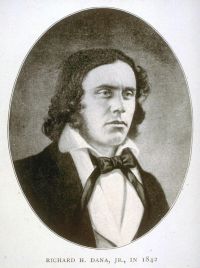
Portrait of Richard Henry Dana Richard Henry Dana,  The Seaman's Friend

“ The lifts should be single, and fitted with an eye over the yard-arm, and lead through a single block at the mast-head, and set up by a gun or luff tackle purchase, with the double block hooked to a thimble or turned in at the end, and the lower block to an eye-bolt in the deck. Instead of brace-blocks on the fore and main yards, brace-pennants fitted over the yard-arm with an eye are neater. The latest and neatest style of rigging lower yards is to have a strong iron band with eyes and thimbles round each yard-arm, close to the shoulder ”
Source: Gutenberg

Get perspective with Kwize: daily news enlightened by great literature