Germ cell

Definition and stakes

Gerald R. Leighton,  Embryology: The Beginnings of Life

“ When a male germ-cell or sperm unites with a female germ-cell or ovum, within the female body, fertilisation of the ovum takes place, and this gives rise to the fertilised germ-cell from which is to arise first the germ-cells or direct descendants of itself, and secondly the embryo in which these germ-cells will come to lie. This happens by the repeated and continued division of the fertilised germ-cell, a division which constitutes growth, and which under suitable conditions of nourishment and protection and exercise will ultimately produce a human being. ”
Source: Gutenberg

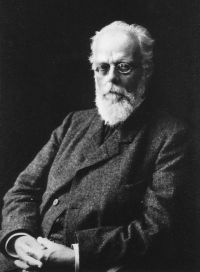
Portrait of August Weismann August Weismann,  Essays Upon Heredity and Kindred Biological Problems

“ Under the former theory the germ-cells are no longer looked upon as the product of the parent’s body, at least as far as their essential part—the specific germ-plasm—is concerned: they are rather considered as something which is to be placed in contrast with the tout ensemble of the cells which make up the parent’s body, and the germ-cells of succeeding generations stand in a similar relation to one another as a series of generations of unicellular organisms, arising by a continued process of cell-division. ”
Source: Gutenberg

Portrait of August Weismann August Weismann,  Essays Upon Heredity and Kindred Biological Problems

“ We are thus brought back to the fundamental question as to how the germ-cells arise in the organism. Is it possible that the nucleoplasm of the germ-cell, with its immensely complex molecular structure, potentially containing all the specific peculiarities of an individual, can arise from the nucleoplasm of any of the body-cells,—a substance which, as we have just seen, has lost the power of originating any new kind of cell, because of the continual simplification of its structure during development? ”
Source: Gutenberg

Get perspective with Kwize: daily news enlightened by great literature