“ This enamelled glass is important for more than one reason. It is undoubtedly, as a group, the most magnificent and decorative that we meet with in the whole course of our history. Technically, again, the interest of the group is supreme, for this application of solid enamels, translucent or transparent, to the surface of glass, was a new departure, and it preceded, as far as we know, the use of any material of the kind in the decoration of porcelain and fayence. ”
Glass (material)
Definition and stakes
The theme of “glass (material)” has been addressed by authors such as Edward Dillon, Walter Rosenhain, Lewis F. Day, Christopher Whall and J. Sydney Lewis. It is often associated with terms like lead, metal, light, painting and sand.
Quotes about “glass (material)”
“ The island owes its chief renown to its glass-works. It was a famous discovery to make glass that should vie with crystal in clearness. Since then the nimble wit of the workmen and the never-resting care to find something new have led them to apply to the material a thousand various colours and shapes without number. Hence the calices, the flasks, the canthari, the ewers, the candelabra, the animals of every race, the horns, the beads (segmenta) , the bracelets, etc. ”
“ Again, even on the artistic side, it is not with every branch of the varied applications of glass that we shall be occupied in this work. By an anomaly of the English language, whose vocabulary for matters connected with the arts is so strangely deficient, we have come to understand by the term ‘glass,’ when used without further explanation, what is called in the trade ‘hollow ware,’ the verrerie of the French; in other words—vessels of glass. The term may also be extended to include various minor applications of the material—beads, small ornaments, etc., what the French call verroterie. ”
“ Of quite another nature is the pâte de verre, a substance somewhat of the nature of a glass frit, which has 360 been made use of by the French sculptor, M. Henri Cros, in the modelling of polychrome reliefs and friezes. I say ‘modelling,’ for this strange material can apparently be worked like wax or plaster at one stage of its preparation. When cold it is of so tough a nature that a nail may be driven into it. ”
“ Properties and Composition of Glass Christopher Merret, our earliest English writer on glass, sets down the properties of the material under twenty-six heads, ‘by which we may easily differentiate it from all other bodies.’ From these I will select some four or five which will be sufficient for our purpose. Thus, of glass, he says: ‘’Tis a concrete of salt and sand or stones. ’Tis artificial. It melts in a strong fire. When melted ’tis tenacious and sticks together.... ”
 Edward Burnett Tylor,
Researches into the Early History of Mankind and the Development of Civilization
(1878)
“ Glass has been mentioned by the side of stone, as a material for making sharp instruments of; and it may seem at first sight an unreasonable thing to make the use of a production which belongs to so advanced a state of civilization as glass, evidence of a Stone Age. But savages have so unanimously settled it, that glass is a kind of stone peculiarly suitable for such purposes, that where a knife of glass, or a weapon armed with it, is found, it may be confidently set down as the immediate successor of a stone one. ”
J. Sydney Lewis, Old Glass and How to Collect it
“ Instead of the beautiful clarity and perfect transparency we are accustomed to associate with glass, there is often a streakiness or cloudiness visible in the material, together with numerous bubbles and flaws. If the striations are horizontal, the glass is of an earlier type than if they are perpendicular. The sides of the bowl are often irregular, and the stems are often clumsy, uneven, badly balanced, and altogether disproportionate in point of size to an eye accustomed to the slenderer style of modern glassware. An important point is the junction between the bowl{24} and the stem. ”
Léon Arnoux, British Manufacturing Industries…
“ All the accidents which have happened to tempered glass, which have been recorded in the newspapers, can be accounted for on the principle which I have just endeavoured to explain, for there must be instability, where the bonding material of the internal particles of the glass is in different states of hardness ”
Walter Rosenhain, Glass Manufacture
“ The Mechanical Properties of Glass are of considerable importance in many directions. Although glass is rarely used in such a manner that it is directly called upon to sustain serious mechanical stresses, the ordinary uses of glass in the glazing of large windows and skylights depend upon the strength of the material to a very considerable extent. ”
Lewis F. Day, Windows: A Book About Stained & Painted Glass
“ He has produced very beautiful and jewel-like effects by means of this chipping, though the material lends itself best to a more barbaric style of design than the artist has usually been content to adopt. He has appreciated, no one better, the quality of glass, but not the fact that so characteristic a material as he adopts must rule the design. The attempt to get pictorial, atmospheric, or other naturalistic effects by means of it, soon brings you to its limitations. At the rendering of flesh it comes to a full stop. ”
Perry F. Nursey, Popular Science Monthly (1875)
“ What may be the ultimate result of the introduction of this invention in practice it is difficult to foresee, so wide-spread, so universal does its application seem. Not only is it desirable to render durable such articles as are at present made from glass, but to satisfy a want long felt in every department of art, science, and manufacture, of such a material as toughened glass ”
Lewis F. Day, Windows: A Book About Stained & Painted Glass
“ It is by their aid we get those mosaics of pot-metal, the depth and richness of which to this day, with all our science of chemistry, we cannot approach by any process of enamelling. Moreover, though merely constructional leads, taking a direction contrary to the design, may at times disturb the eye, (they scarcely ever disturb the effect) they add to the richness of the glass in a way its unlearned admirers little dream. ”
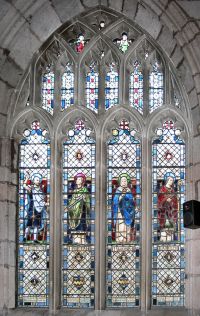 Hugh Arnold,
Stained Glass of the Middle Ages in England and France
“ Only one who has worked in glass, and seen his work grow from a map-like combination of white and coloured glass to the finished glass painting, knows the power the enamel gives him of controlling, softening, and enriching his effects of colour. The power it gives of suggesting form is only one, and not the most important, of its functions, and it was as vital to the work of the twelfth and thirteenth as of the fifteenth century. ”
Lewis Foreman Day, 1911 Encyclopædia Britannica, Volume 12… (1911)
“ The ruder and more archaic design gives in fullest measure the glory of glass—for the loss of which no quality of painting ever got in glass quite makes amends. The pictorial effects compatible with glass design are those which go with pure, brilliant and translucent colour. The ideal of a “primitive” Italian painter was more or less to be realized in glass: that of a Dutch realist was not. It is astonishing what glass painters did in the way of light and shade. ”
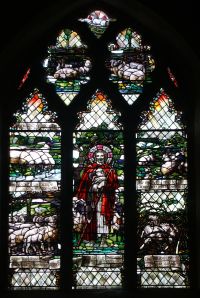 Christopher Whall,
Stained Glass Work: A text-book for students and workers in glass
“ As to the slab-glasses—"Early-English," "Norman," or "stamped-circles"—which are chiefly affected by this question, the texture and surface upon which their special character depends is sometimes a very useful resource in work seen against, or partly against, background of trees or buildings; while against an entirely "borrowed" light perhaps, sometimes, it can almost dispense with any painting. The grey shadows that come from the background play about in the [Pg 228] glass and modify its tones, doing the work of painting, and doing it much more beautifully. ”
Christopher Whall,
Stained Glass Work: A text-book for students and workers in glass
“ But now, take a matting brush, with a film so thin that it is hardly more than dirty water; put it on the back of the glass (so as not to wash up your outline) ; badger it flat, so as just to dim the glass less than "ground [Pg 104] glass" is dimmed;—and you will find your outline look almost the same at each distance. It is the pure light that plays tricks, and it will play them through a pinhole.And now, finally, let us say that you may do anything you can do in the painting of glass, so long as you do not lay the colour on too thick. ”
J. Sydney Lewis, Old Glass and How to Collect it
“ Points to be considered are the colour of the metal, the perfection of the twist, its opacity, and the character of the foot. The colour and weight of the glass are probably the best criteria. The forgeries are generally light, and the beautiful mellow tone of the real old English glass is replaced by a cold white tint or even a tinge of green. The twist is often more translucent than in the genuine pieces, and is frequently imperfectly produced, becoming looser as it descends, the loosening being particularly pronounced just before its junction with the foot. ”
“ CONTEMPORARY GLASS The history of glass in the nineteenth century is mainly concerned with improvements in mechanical processes, by means of which it is now possible to turn out a perfectly clear white glass in large quantities at greatly reduced cost. ”
Walter Rosenhain, Glass Manufacture
“ A perfect piece of glass, having smooth surfaces and no internal regularities, allows the rays of light falling upon it to pass through undeflected in direction, and merely changed in colour, according to the tint of the glass in question. On looking at the glass, external objects can be quite clearly seen, and much of the interest and mystery of the glass itself is lost. ”
Sara Ware Bassett, The Story of Glass
“ Although glass-making is an old story to us scarce a day passes that some one does not visit us to whom the process is entirely new; and it certainly is interesting if a person has never seen it. Suppose we begin at the very beginning. In this bin, or trough, you will see the mixture or batch of which the glass is made. It is composed of red lead and the finest of white beach sand. The lead is what gives the inside of the trough its vermilion color. ”
Christopher Whall,
Stained Glass Work: A text-book for students and workers in glass
“ Working in this way all things are lawful; you may even put a thin film of "matt" over any piece to lower it in tone and give it richness, or to bring out with emphasis some quality of its texture. Some bits will have lovely streaks and swirling lines and bands in them—"reamy," as glass-cutters call it—or groups of bubbles and spots, making the glass like agate or pebble; and a gentle hand will rub a little matt or film over these, and then finger it partly away to bring out its quality, just as a jeweller foils a stone. ”
Hugh Arnold,
Stained Glass of the Middle Ages in England and France
“ The Quality of Glass and the Colours Used.—At first these differ little from those used in the previous period, but as the fourteenth century proceeds, the rich intense reds and blues, with their "streakiness," their endless variety of tone and texture, which makes each piece of glass a jewel with an individuality of its own, and needing no enrichment, give way to glass of a thinner, flatter quality. ”
“ The glass of which they are made tends to decompose to a white porcelain-like mass, without further injury to the surface, a fact which would point to its containing a certain amount of lead and perhaps of tin. 58 Here, for the first time in the history of glass, we come across the name of the manufacturer—we can hardly say the artist. It is, indeed, as might be expected, to the moulded ware that we are indebted for the most important of the scanty inscriptions that have been found on Roman glass ”
Christopher Whall,
Stained Glass Work: A text-book for students and workers in glass
“ Now the side you first looked at is the side to cut on, and the side to paint on, and it is the side placed inwards when the window is put up.The reason is this. Glass is made into sheets by being blown into bubbles, just as a child blows soap-bubbles. If you blow a soap-bubble you will see streaks playing about in it, just like the wavy streaks you notice in the glass. ”
Christopher Whall,
Stained Glass Work: A text-book for students and workers in glass
“ The way you distribute your colour matters very much. Some in washes, some in splashes, some in spots, some in stripes. What will "not do" in one way will often be just right in the other: yes, and the very way you treat your glass when all is chosen and placed together—matt in one place, film in another, chequering, cross-hatching, clothing the raw glass with texture and bringing out its nature and its life. ”
Christopher Whall,
Stained Glass Work: A text-book for students and workers in glass
“ A window of ancient glass needs releading. The lead has decayed and the whole is loose and shaky. The ancient glass has worn very thin, pitted almost through like a worn-out thimble with little holes where the alkalis have worked their way out. It is as fragile and tender as an old oil-painting that needs to be taken off a rotten canvas and re-lined. If you examine a piece of old glass whose lead has had time to decay, you will find [Pg 316] that the glass itself is often in an equally tender state. ”
“ There is a choice collection of fragments of millefiori and banded glass in the British Museum, [25] and a still larger one in the Industrial Museum at Vienna. 52 A broken fragment of glass will indeed often tell us more than a complete vase. We can, for example, see from it whether the pattern passes continuously through the whole thickness of the glass, or whether it has been inlaid, or perhaps pressed into the surface when hot. In one case we have a process that reminds us of mosaic work; in the other there is some approach to a champlevé enamel, only with a base of glass instead of metal. ”
“ But for the most part—above all after the end of the century—the facetting runs wild; sometimes it covers the whole surface, and even where there are no facets the ground is marked out by rectangular divisions. The decoration as a whole is mechanically executed. But even this machine-made work is better than the cheap imitations of later days produced by pressing the glass into moulds of metal. ”
“ Many buy up broken glass and make with it the best work.’ [196] If you wish, continues Mathesius, to obtain white and pure glass, it is essential to use only well dried wood, for green wood makes the glass opaque and blackish. The metal should be cooled more than once and remelted, the glass-gall being carefully skimmed off each time. ”
Sir J. H. Yoxall, Collecting Old Glass, English and Irish
“ HUNTING GOBLET, DOME FOOT If you place near each other, upon a white damask cloth, a glass of Charles II date, a William and Mary glass, a George III glass, and a Victorian glass, you will notice a darkening and then a whitening in tint (though not a brightening) as your eye travels from the oldest glass to [16] the most modern. By “tint” or “tinge” I do not mean “colour,” in the sense of red or green or blue; I will deal with coloured glass later on. By “tint” or “tinge” I mean the shade of leaden, darkish hue in the metal from which the glass article was blown or moulded. ”
Mrs. Marcet, Conversations on Chemistry, V. 1-2
“ It is by no means an easy operation to make perfect glass; for if the sand, or flint, from which the siliceous earth is obtained, be mixed with any metallic particles, or other substance, which cannot be vitrified, the glass will be discoloured, or defaced, by opake specks. ”
William Bingley, Useful Knowledge: Volume 1. Minerals
“ Large plate glass for looking-glasses is made by suffering the mass, in a state of complete fusion, to flow upon a casting table, with iron ledges. These confine the melted matter, and, as it cools, a metallic roller is passed over it, to reduce it to an uniform thickness. ”
Various, Popular Science Monthly (1889)
“ The so called antique glass, in both white and colors, is made precisely like the ordinary sheet window glass, except that the surface of the glass is made full of minute blow-holes, which produce almost an aventurine effect, and add greatly to its brilliancy. ”
Lewis F. Day, Windows: A Book About Stained & Painted Glass
“ You will not get the qualities of glass. Within the last two or three years there seems to have been very considerable improvement in the purity, translucency, and depth of enamel colours. How far they are lasting remains to be proved. Anyway, brilliant as they are, they have not by any means the intensity of pot-metal glass, and it does not seem, humanly speaking, possible that a film of coloured glass upon a sheet of white can ever compete in strength and volume with colour in the body of the glass itself. ”
Related terms
Authors who wrote about “glass (material)”
Edward DillonWalter RosenhainLewis F. DayChristopher WhallJ. Sydney LewisLéon ArnouxSir J. H. YoxallHugh ArnoldHarry James Powell, Walter Rosenhain and Alexander NesbittLewis Foreman Day Charles Hitchcock SherrillCharles WinstonSara Ware BassettPerry F. NurseyCarleton John Lynde
 Robert HookeJohn Rudolph GlauberJohn PlattsVarious
 Montague Glass
Christopher WhallJ. Sydney LewisLéon ArnouxSir J. H. YoxallHugh ArnoldHarry James Powell, Walter Rosenhain and Alexander NesbittLewis Foreman DayCharles Hitchcock SherrillCharles WinstonSara Ware BassettPerry F. NurseyCarleton John LyndeRobert HookeJohn Rudolph GlauberJohn PlattsVariousMontague Glass