“ The Invasive Species Council shall provide national leadership regarding invasive species, and shall: (a) oversee the implementation of this order and see that the Federal agency activities concerning invasive species are coordinated, complementary, cost-efficient, and effective, relying to the extent feasible and appropriate on existing organizations addressing invasive species, such as the Aquatic Nuisance Species Task Force, the Federal Interagency Committee for the Management of Noxious and Exotic Weeds, and the Committee on Environment and Natural Resources ”
Invasive species
Definition and stakes
The theme of “invasive species” has been addressed by authors such as Charles Darwin, Frederic E. Clements, Alfred Russel Wallace, Charles Lyell and Nathaniel Southgate Shaler. It is often associated with terms like insect, habitat, animal, bird and succession.
Quotes about “invasive species”
“ The first edition of the Management Plan shall include a review of existing and prospective approaches and authorities for preventing the introduction and spread of invasive species, including those for identifying pathways by which invasive species are introduced and for minimizing the risk of introductions via those pathways, and shall identify research needs and recommend measures to minimize the risk that introductions will occur. ”
Biosecurity Law of the People's Republic of China (2020)
“ The state strengthens prevention of and response to invasive alien species and protects biodiversity. The competent department of agriculture and rural affairs of the State Council, in collaboration with other relevant departments of the State Council, shall formulate a directory of invasive alien species and the management procedures. ”
Frederic E. Clements, Research methods in ecology (1905)
“ Invasion takes place by the penetration of single individuals or groups of individuals. This will depend in the first place upon the character of the disseminule. It is evident that, no matter how numerous the achenes may be, the invasion of those anemochorous species with comate or winged seeds or one-seeded fruits will be of the first type, while all species in which the disseminule is a several or many-seeded fruit or plant, as in hooked fruits, tumbleweeds, etc., will tend to produce a group of invaders. ”
Frederic E. Clements, Research methods in ecology (1905)
“ When invasion is scattered, factor instruments can not be used to advantage, but where the invading line is well marked, or where extra-formational areas occur, a knowledge of the physical factors is a great aid.An invasion that has been completed can not be studied in the manner indicated. A method of comparison must be used, in order to determine the original home of the invaders. For this an exact knowledge of the contiguous formations and of the abundance of the species common to all is a prerequisite. ”
Frederic E. Clements, Research methods in ecology (1905)
“ This movement may concern an individual, a species, or a group of species. From the nature of invasion, which contains the double idea of going into and taking possession of, it usually operates between contiguous formations, but it also takes place between formational zones and patches. More rarely and less noticeably, there may be invasion into a remote vegetation, as a result of long carriage by wind, water, birds, railroads, or vessels. ”
Frederic E. Clements, Research methods in ecology (1905)
“ From the latter statement, it follows that invasion occurs only when a species migrates to a new place, in which it germinates, matures, and reproduces. Maintenance by annual invasion simply, in which the plants of each year disappear completely, can not then be regarded as invasion proper. On the other hand, though such instances are rare, it is not necessary that the invaders produce fruit, provided they are able to maintain themselves, or to increase by propagation. ”
Frederic E. Clements, Research methods in ecology (1905)
“ By far the greater amount of invasion is of this sort, as may readily be seen from the fact that migration varies inversely as the distance, and ecesis may decrease even more rapidly than the distance increases. The significant feature of continuous invasion is that an outpost may be reinforced every year, thus making probable the establishment of new outposts from this as a center, and the ultimate extension of the species over a wide area. The comparatively short distance and the regular alternation of migration and ecesis render invasion of this sort very effective. ”
Frederic E. Clements, Research methods in ecology (1905)
“ Species which invade stable vegetation temporarily have been termed adventive by A. DeCandolle. Permanent invasion occurs when a species becomes permanently established in a more or less stable formation. It is characteristic of the great majority of invaders found in the grassland and forest stages of successions.Plants which have arisen within a formation or have been a constituent part of it since its origin are indigenous. Contrasted with these are the species which have invaded the formation since it received its distinctive impress: these are derived. ”
Frederic E. Clements, Research methods in ecology (1905)
“ In the same way, a forest formation on account of its diffuse light is a barrier to poophytes; and a swamp, because of the amount and character of the water-content, sets a limit to both hylophytes and poophytes. Formations, such as forests, thickets, etc., sometimes act also as direct obstacles to migration, as in the case of tumbleweeds and other anemochores, clitochores, etc. A marked effect of vegetation in decreasing invasion arises from the closed association typical of stable formations and of social exclusive species. ”
Frederic E. Clements, Research methods in ecology (1905)
“ It is entirely independent of the number of invaders, which, as we have seen, depends upon seed-production, mobility, distance, occupation, etc., but is based solely upon mode of arrangement, and will be found to underlie the primary types of abundance, copious, and gregarious. In this connection, it should also be noted that the contingencies of migration, especially the concomitant action in the same direction of two or more distributive agencies, often results in the penetration of a group of individuals belonging to two or more species. ”
Keith E. Evans, Cavity-Nesting Birds of North American Forests
“ Habitat, cavity requirements, and foods are described for 85 species of birds that nest in cavities in dead or decadent trees. Intensive removal of such trees would disastrously affect breeding habitat for many of these birds that help control destructive forest insects. Birds are illustrated in color ”
 Herbert Spencer,
The Principles of Biology — Chapter III.9
(1898)
Herbert Spencer,
The Principles of Biology — Chapter III.9
(1898)
“ Even where migration does not bring it face to face with new competitors or new enemies or new prey, it inevitably experiences new proportions among these. Further, an expanding species is almost certain to invade more than one adjacent region. Spreading both north and south, or east and west, it will come among the plants and animals, here of a level district and there of a hilly one—here of an inland tract and there of a tract bordered by the sea. ”
Frederic E. Clements, Research methods in ecology (1905)
“ The effective conversion of migration into invasion is greatest when the movement is continuous, and least when it is discontinuous, since, in the latter, species are usually carried not only out of their particular habitat but even far beyond their geographical area, and the migration, instead of being an annual one with the possibility of gradual adjustment, may not recur for several years, or may, indeed, never take place again. ”
 Alfred Russel Wallace,
The Geographical Distribution of Animals…
Alfred Russel Wallace,
The Geographical Distribution of Animals…
“ But the dispersal of insects requires to be looked at from another point of view. They are, of all animals, perhaps the most wonderfully adapted for special conditions; and are so often fitted to fill one place in nature and one only, that the barriers against their permanent displacement are almost as numerous and as effective as their means of dispersal. Hundreds of species of lepidoptera, for example, can subsist in the larva state only on one species of plant ”
 Jean-Henri Fabre,
More Hunting Wasps
Jean-Henri Fabre,
More Hunting Wasps
“ When its depredations cover a somewhat extensive group, how does the insect manage to recognize the genera, the species composing her allotted portion and to distinguish them from the rest with an assured vision which the inventory of her burrows proves never to be at fault? ”
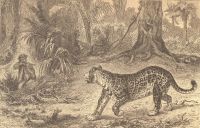 Thomas Belt,
The Naturalist in Nicaragua
Thomas Belt,
The Naturalist in Nicaragua
“ It follows also, from the same reasoning, that old and widespread types are more likely to be preserved in fresh-water areas than on land or in the sea, for the destruction of wide-ranging species is effected more by the competition of improved varieties than by physical causes ”
 John Arthur Thomson,
The Outline of Science — Part II
John Arthur Thomson,
The Outline of Science — Part II
“ The terrestrial haunt has been invaded age after age by contingents from the sea or from the freshwaters. We must recognise the worm invasion, which led eventually to the making of the fertile soil, the invasion due to air-breathing Arthropods, which led eventually to the important linkage between flowers and their insect visitors, and the invasion due to air-breathing Amphibians, which led eventually to the higher terrestrial animals and to the development of intelligence and family affection. ”
John H. Robinson, Our Domestic Birds: Elementary Lessons in Aviculture
“ Indeed, the wild birds are much more valuable to us in the wild state than they would be if domesticated.In nature species prey upon each other—the lowest forms of life upon inorganic and decayed matter, the higher forms upon the lower, the larger creatures upon the smaller, the savage upon the defenseless. Fertile lands not only produce luxuriant vegetation but teem with insect life, which, if not kept in check, would soon destroy that vegetation. In tropical and semitropical regions there are mammals, some of them quite large, which feed upon insects. ”
Alfred Russel Wallace,
The Geographical Distribution of Animals…
(1876)
“ Vegetation would certainly be considerably affected, and through this the insect tribes. We have seen how closely the life of the higher animals is often bound up with that of insects; and thus a set of changes might arise that would modify the numerical proportions, and even the forms and habits of a great number of species, would completely exterminate some, and raise others from a subordinate to a dominant position. And all these changes would occur differently on opposite sides of the strait, since the insular climate could not fail to differ considerably from that of the continent. ”
Alfred Russel Wallace,
Island Life — Chapter XII.
(1895)
“ If we add to this the dependence of so many insects on local conditions of climate and vegetation, and their liability to be destroyed by insectivorous birds, we shall see that, although there may be a greater probability of insects as a whole reaching the islands, the chance against any particular species arriving there, or against the same species arriving frequently, is much greater than in the case of birds. ”
 Walter Rothschild,
Extinct Birds
(1907)
Walter Rothschild,
Extinct Birds
(1907)
“ Again we find that the introduction of domestic creatures or others kept as pets has brought diseases which may prove fatal to the indigenous fauna. Another means by which man causes immense destruction, is by destroying the natural habitat of various species. ”
 Theodore Roosevelt,
Seventh State of the Union Address
(1907)
Theodore Roosevelt,
Seventh State of the Union Address
(1907)
“ The Biological Survey has ascertained and gives wide publicity to the fact that at least 43 kinds of birds prey upon this destructive insect. It has discovered that 57 species of birds feed upon scale-insects—dreaded enemies of the fruit grower. ”
George P. Marsh, The Earth as Modified by Human Action
“ We do not know the limits of this agency, and many of the insects habitually regarded as unqualified pests, may directly or indirectly perform functions as important to the most valuable plants as the services rendered by certain tribes to the orchids. I say directly or indirectly, because, besides the other arrangements of nature for chocking the undue multiplication of particular species, she has established a police among insects themselves, by which some of them keep down or promote the increase of others; for there are insects, as well as birds and beasts, of prey. ”
George P. Marsh, The Earth as Modified by Human Action
“ The comparative immunity of the American native forests from attacks by insects is perhaps in some degree due to the fact that the European destructive tribes have not yet found their way across the ocean, and that our native species are less injurious to living trees. On the European lignivorous insects, see Siemoni, Manuale d'Arte Forestale, 2d edizione, pp. ”
E. W. Burgess, Introduction to the Science of Sociology
“ Effective invasion is predominantly local. It operates in mass only between bare areas and adjacent communities which contain species capable of pioneering, or between contiguous communities which offer somewhat similar conditions or contain species of wide range of adjustment. Invasion into a remote region rarely has any successional effect (effect tending to transform the character of a plant community) , as the invaders are too few to make headway against the plants in possession or against those much nearer a new area. ”
 Nathaniel Southgate Shaler,
Domesticated animals
Nathaniel Southgate Shaler,
Domesticated animals
“ The lesson which may be drawn from the experience above stated is to the effect that it is necessary to have a protected field of sufficient area, and in the proper conditions to keep the balance of life which arises from the exchange of relations between species in their normal state. Even in ideal reservations where all invasions are excluded, we should have to expect that from time to time certain forms would disappear, their place perhaps being taken by new species which would arise. ”
Joseph Corry, Observations Upon the Windward Coast of Africa
“ Indolent, and incapable of resisting the smallest insects, they are hunted by various species from place to place, and not one pair in millions get into a place of safety, to fulfil the laws of nature and propagation. ”
 William Berryman Scott,
A history of land mammals in the Western Hemisphere
(1913)
William Berryman Scott,
A history of land mammals in the Western Hemisphere
(1913)
“ This spread is purely unconscious and is due to the pressure of increasing numbers upon the means of [144] subsistence, each new generation ranging farther and farther from the original home of the species and continuing so to extend until some insuperable obstacle is encountered. When a sea-barrier is removed by upheaval and the newly formed land rendered habitable for mammals through the invasion of plants, the interrupted process is resumed and an interchange of species between the areas thus connected is brought about. ”
Thomas Alfred Coward, Bird Haunts and Nature Memories… (1922)
“ Even those species which are game robbers whenever they have the chance—merlin, eagle, peregrine, sparrowhawk, raven, and crow—kill far more birds and mammals in which the keeper has no interest than his own special pets. Thus, the destruction of predatory species undoubtedly helps the increase of the kinds preyed upon, but as species depends upon species in both animal and vegetable world, any interference with the normal numbers causes a dislocation which is beyond all calculation. ”
Various, Popular Science Monthly (1908)
“ Exception, however, should be made in regard to certain migratory and omnivorous species, such as the grasshoppers and crickets, whose invasions seem to exist during all time and without any correlation with cultural conditions. ”
Charles Morris, Man And His Ancestor: A Study In Evolution
“ Other species survived by a retreat to more tropical regions, to return after the invasion had spent its force. Still others may have survived by adapting themselves to the changed conditions, emerging as new species or well-marked varieties. ”
“ Now, to secure rare and beautiful living specimens of butterflies and moths for the crystal flying-cage was a serious and delicate job. Such tropical insects could not survive the journey of several months from the wilds of Australia, India, Asia, Africa, or the jungles of South America—nor could semi-tropical species endure the captivity of a few weeks or even days, when captured in the West Indies, Mexico, or Florida. ”
 Charles Darwin,
On The Origin of Species
(1859)
Charles Darwin,
On The Origin of Species
(1859)
“ Moreover, each species on the confines of its range, where it exists in lessened numbers, will, during fluctuations in the number of its enemies or of its prey, or in the seasons, be extremely liable to utter extermination ”
 John Ball,
Notes of a naturalist in South America
John Ball,
Notes of a naturalist in South America
“ Attention has not, I think, been sufficiently directed to the fact that the chief limit to the spread of each species is fixed by the prevalence of the enemies to which it is exposed, and that plants carried to a distant region will, as a general rule, enjoy advantages which in the course of time they are likely to lose. ”
O. A. Johannsen, Handbook of Medical Entomology
“ Even near the coast, where the migratory species are dominant, there are the local species which demand attention and which cannot be reached by any measures directed against the species of the salt marshes. The most important of local measures consist in the destruction of breeding places by filling or draining ponds and pools, clearing up of more temporary breeding places, such as cans, pails, water barrels and the like. ”
Related terms
Authors who wrote about “invasive species”
Charles DarwinFrederic E. ClementsAlfred Russel Wallace Charles LyellNathaniel Southgate ShalerHerbert SpencerVarious
 Thomas Henry HuxleyGeorge P. MarshKeith E. EvansTheodore RooseveltWalter RothschildJoseph CorryE. W. BurgessWilliam Berryman ScottJohn H. RobinsonThomas BeltJean-Henri Fabre
 Robert W. ChambersCharles Morris