Nitric acid

Definition and stakes

Edward Huntington Williams,  A History of Science — Volume 4

“ This liquid combined with a solution of potash to form common nitre, which "detonated with charcoal, sparkled when paper impregnated with it was burned, and gave out nitrous fumes when sulphuric acid was poured on it." In other words, the liquid was shown to be nitric acid. Now, since nothing but pure air had been used in the initial experiment, and since air is composed of nitrogen and oxygen, there seemed no room to doubt that nitric acid is a combination of nitrogen and oxygen. ”
Source: Gutenberg

1911 Encyclopædia Britannica (1911)

“ Nitrous acid, HNO2, is found to some extent in the form of its salts in the atmosphere and in rain water. The pure acid has not yet been obtained, since in the presence of water it decomposes with formation of nitric acid and liberation of nitric oxide: 3HNO2 =HNO3+2NO+H2O. Its salts may be obtained in some cases by heating the corresponding nitrates, but the method does not give good results. Sodium nitrite, the most commonly used salt of the acid, is generally obtained by heating the nitrate with metallic lead ”
Source: Wikisource

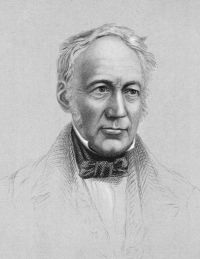
Portrait of Andrew Ure Andrew Ure,  A Dictionary of Arts, Manufactures and Mines

“ Nitric acid is usually made on the small scale by distilling, with the heat of a sand-bath, a mixture of 3 parts of pure nitre, and 2 parts of strong sulphuric acid, in a large glass retort, connected by a long glass tube with a globular receiver surrounded by cold water. By a well regulated distillation, a pure acid, of specific gravity 1·500, may be thus obtained, amounting in weight to about two-thirds of the nitre employed. To obtain easily the whole nitric acid, equal weights of nitre and concentrated sulphuric acid may be taken ”
Source: Gutenberg

Get perspective with Kwize: daily news enlightened by great literature