“ O let us be graciously endowed by Thee with knowledge, understanding, and discernment. Blessed art Thou, O Lord, gracious Giver of Knowledge.' The intellect was to be turned to the service of the God from whom intelligence emanated. ”
Saber
Definition and stakes
The saber, a curved backsword historically used by cavalry, developed from medieval arms into a symbol of both martial skill and intellectual endeavor. Its design, combining practicality and craftsmanship, reflected the dual aspects of warfare and philosophy. Writers such as Bahá'u'lláh and the Brothers Grimm examined themes of knowledge and wisdom, with the latter's story of the "Sack of Wisdom" highlighting the saber's symbolic role as a carrier of enlightenment.
At the same time, ʻAbdu'l-Bahá stressed the pursuit of knowledge as a means to achieve spiritual clarity, echoing the saber's function as an instrument honed for accuracy. Thus, the saber's legacy connects physical combat with the search for understanding, illustrating humanity's balance between action and insight.
Quotes about “saber”
Diana Fontaine Maury Corbin, A Life of Matthew Fontaine Maury (1888)
“ When I, a pioneer in one department of this beautiful science, discover the truths of Revelation and the truths of science reflecting light the one upon the other, how can I, as a truth-loving, knowledge-seeking man, fail to point out the beauty and rejoice in its discovery? ”
Jacob Grimm and Wilhelm Grimm, The Fairy Tales of the Brothers Grimm… (1909)
“ A voice from above answered: ‘Raise your eyes, I am sitting up here in the Sack of Wisdom, and in a short time I have learnt so much that the wisdom of the schools is as air compared to mine. Soon I shall be quite perfect, and shall come down and be the wisest of all mankind. I understand the stars and signs of the heavens, the blowing of the winds, the sand of the sea, the healing of sickness, the power of herbs, birds, and stones. ”
George Bush, Gold for Brass and Silver for Iron (1853)
“ Suppose, farther, that, as the conversation proceeded, and higher and more sacred topics were gradually broached, and inquiry pressed upon the borders of the world unseen, he should discover an equal familiarity with that as with the natural world, even to the minute details of its phenomena and laws—that the heaven and the hells, angels and devils, and everything of this class with which the human mind intensely yearns to be acquainted, were evidently within the compass of his amazing intelligence. ”
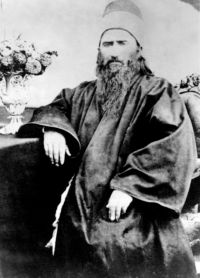 Bahá'u'lláh,
The Book of Ighan
(1915)
Bahá'u'lláh,
The Book of Ighan
(1915)
“ Shouldst thou make the mirror of heart pure and clear from the dust of prejudice, thou wilt comprehend all the symbols in the sayings of the perfect Word of Divinity in every Manifestation and be informed of the mysteries of Knowledge. But unless thou destroyest with the fire of Severance the veils of learning which are conventional among the servants, thou wilt not attain to the brilliant morn of the Ideal Knowledge. ”
by Thomas Taylor, A Dissertation on the Eleusinian and Bacchic Mysteries (1791)
“ The nous, intellect or spirit, pertains to the higher or intuitional part of the mind; the dianoia or understanding to the reasoning faculty, and the doxa, or opinion-forming power, to the faculty of investigation.—Plotinus, accepting this theory of mind, says: “Knowledge has three degrees—opinion, science, and illumination. ”
Matthew Henry, Commentary on the Whole Bible… (1700s)
“ Those that prudently seek knowledge shall certainly get knowledge, for God never said to such, Seek in vain, but, Seek and you shall find. If the ear seeks it, the heart gets it, and keeps it, and is enriched by it. We must get knowledge, not only into our heads, but into our hearts, get the savour and relish of it, apply what we know to ourselves and experience the power and influence of it. ”
 Origen,
The writings of Origen, Vol. 1…
(1869)
Origen,
The writings of Origen, Vol. 1…
(1869)
“ Let us apply this now to the case of those who have devoted themselves to the knowledge and wisdom of God, whose learning and diligence incomparably surpass all other training; and let us contemplate, according to the form of the similitude employed, what is the acquisition of knowledge, or what is its disappearance, especially when we hear from the apostle what is said of those who are perfect, that they shall behold face to face the glory of the Lord in the revelation of His mysteries. ”
Matthew Henry, Matthew Henry's Commentary on the Whole Bible… (1700s)
“ True wisdom, with its furniture and improvement, comes from him as the God of grace and the Father of every good and perfect gift. Shall we pretend to be wiser than God, when we have all our wisdom from him? Nay, shall we pretend to be wise above our sphere, and beyond the limits which he that gave us our understanding sets to it? ”
Elizabeth Palmer Peabody, Aesthetic Papers (1849)
“ And if the outer world is the vast dictionary and grammar of thought we speak of, then it is also an organ throughout of intelligence. Whose intelligence? By this question we are set directly confronting God, the universal Author; no more to hunt for him by curious arguments and subtle deductions, if haply we may find Him; but He stands expressed everywhere, so that, turn whichsoever way we please, we behold the outlooking of His intelligence. ”
 Philip Schaff,
Nicene and Post-Nicene Fathers…
(1885)
Philip Schaff,
Nicene and Post-Nicene Fathers…
(1885)
“ For as of the Son of God, considered as the Word, our word is an image, so of the same Son considered as Wisdom is the wisdom which is implanted in us an image; in which wisdom we, having the power of knowledge and thought, become recipients of the All-framing Wisdom ”
 ʻAbdu'l-Bahá,
Selections from the writings of ‘Abdu'l-Bahá
ʻAbdu'l-Bahá,
Selections from the writings of ‘Abdu'l-Bahá
“ It is incumbent upon thee to acquire the various branches of knowledge, and to turn thy face toward the beauty of the Manifest Beauty, that thou mayest be a sign of saving guidance amongst the peoples of the world, and a focal centre of understanding in this sphere from which the wise and their wisdom are shut out, except for those who set foot in the Kingdom of lights and become informed of the veiled and hidden mystery, the well-guarded secret. ”
 Valmiki,
The Yoga-Vasishtha Maharamayana of Valmiki…
Valmiki,
The Yoga-Vasishtha Maharamayana of Valmiki…
“ Know that to be the highest predicament, which is above the knowables, and is knowledge or intelligence by itself; which is beyond our thoughts and thinkables, and is the thinking principle or intellect itself. ”
“ Nay, whatsoever proceedeth from these Mines of divine Wisdom and these Treasuries of eternal knowledge is truth, and naught else but the truth. The saying: “Knowledge is one point, which the foolish have multiplied” is a proof of Our argument, and the tradition: “Knowledge is a light which God sheddeth into the heart of whomsoever He willeth” a confirmation of Our statement. ”
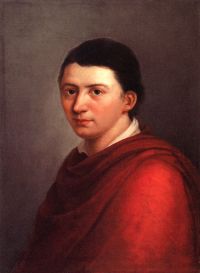 Friedrich von Schlegel,
The philosophy of life, and philosophy of language…
Friedrich von Schlegel,
The philosophy of life, and philosophy of language…
“ I observe, then, first of all, that when we speak of sense, soul, and spirit, as the successive terms in the growing capacity of the human consciousness for a higher knowledge and heavenly training, and for truth in general, but more especially for divine truth, then the general sense of truth, which such an hypothesis supposes, and which indeed is its essential foundation, must be understood as comprising all those other particular species, branches, or departments which we have already enumerated. ”
 Fredrika Bremer,
The Homes of the New World
(1853)
Fredrika Bremer,
The Homes of the New World
(1853)
“ The treasured results of metaphysical inquiry in past ages, since the injunction, ‘know thyself,’ first opened to the pupil and the philosopher a region of mystery and doubt, will pass to coming generations, enriched by the contributions of the present, and distinguished by the sunlight which our own gifted intellects are shedding on the science of mind. ”
Saint of Alexandria Clement, The writings of Clement of Alexandria… (1869)
“ Now, inasmuch as there are four things in which the truth resides—Sensation, Understanding, Knowledge, Opinion,—intellectual apprehension is first in the order of nature; but in our case, and in relation to ourselves, Sensation is first, and of Sensation and Understanding the essence of Knowledge is formed; and evidence is common to Understanding and Sensation. Well, Sensation is the ladder to Knowledge; while Faith, advancing over the pathway of the objects of sense, leaves Opinion behind, and speeds to things free of deception, and reposes in the truth. ”
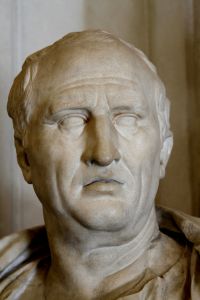 Marcus Tullius Cicero,
The Academic Questions, Treatise De Finibus…
(1891)
Marcus Tullius Cicero,
The Academic Questions, Treatise De Finibus…
(1891)
“ But, as they asserted that wisdom was the guardian and regulator of the entire man, being the companion and assistant of nature, they said that the especial office of wisdom was to defend the being who consisted of mind and body,—to assist him and support him in each particular. ”
Saint of Alexandria Clement, The writings of Clement of Alexandria… (1869)
“ But that which par excellence is termed knowledge, bears the impress of judgment and reason, in the exercise of which there will be rational cognitions alone, applying purely to objects of thought, and resulting from the bare energy of the soul. ”
 Brigham Young,
Journal of Discourses — Volume 1…
Brigham Young,
Journal of Discourses — Volume 1…
“ It is not the optic nerve alone that gives the knowledge of surrounding objects to the mind, but it is that which God has placed in man—a system of intelligence that attracts knowledge, as light cleaves to light, intelligence to intelligence, and truth to truth. ”
Matthew Henry, Matthew Henry's Commentary on the Whole Bible… (1700s)
“ He that teaches man knowledge, shall he not know? He not only, as the God of nature, has given the light of reason, but, as the God of grace, has given the light of revelation, has shown man what is true wisdom and understanding ”
 John of the Cross,
Ascent of Mount Carmel
John of the Cross,
Ascent of Mount Carmel
“ It must be known, then, that, speaking broadly and in general terms, all these four apprehensions may be called visions of the soul; for we term the understanding of the soul also its sight. And since all these apprehensions are intelligible to the understanding, they are described, in a spiritual sense, as ‘visible.’ And thus the kinds of intelligence that are formed in the understanding may be called intellectual visions. ”
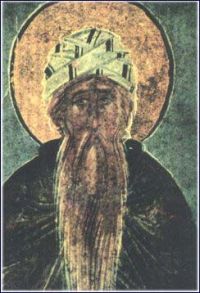 Isaac of Nineveh,
Mystic Treatises
(1923)
Isaac of Nineveh,
Mystic Treatises
(1923)
“ Do not in the way of those who are educated by teachers look at the words which in the way of test, are intended to elevate thy behaviour, in order that thy soul may be elevated by the height of sight that is in them. Distinguish the purport of the word in all the stories thou findest in the scriptures; so thou wilt be able to make thy soul deep so that it may dwell with the great wisdom that is in the waitings of enlightened men. ”
Various, The Atlantic Monthly (1858)
“ For him, and such as him,—for us, too, if we read wisely,—the toiling slaves of science, often working with little consciousness of the full proportions of the edifice they are helping to construct, have spent their busy lives. All knowledge asserts its true dignity when once brought into relation with the grand end of knowledge,—a wider and deeper view of the significance of conscious and unconscious created being, and the character of its Creator. ”
Saint of Alexandria Clement, The writings of Clement of Alexandria… (1867)
“ Those who are wise in mind have a certain attribute of nature peculiar to themselves; and they who have shown themselves capable, receive from the Supreme Wisdom a spirit of perception in double measure. ”
William A. Locy, Popular Science Monthly (1909)
“ Let us now ask: "What is the dominant note in intellectual life today?" Is it not a greater care to determine the truth? Is it not the investigating spirit? Is it not that spirit which we may designate generically as the scientific spirit? ”
 Josiah Royce,
The Sources of Religious Insight
Josiah Royce,
The Sources of Religious Insight
“ As a result we shall soon find that, just as our first statement of the insight of reason, if indeed it is a true statement, transforms our view of the sense in which the world is real, so a deeper study of the relations of insight to action transforms our first cruder notion of the reason itself, of its office in life, and of the truth that it reveals. ”
Various, The Southern Literary Messenger…
“ Are they not rife with all the useful reasoning—the philosophic intelligence—the happiness of application, that cultivated man could devise for the assistance of untutored intellect?From the logic of the sage we learn, by a spirit of imitation natural to human beings, to quicken our own powers of reasoning. The perspicuity of arrangement and expression, so admirable in our master, becomes gradually a part of our own style. ”
 Dorothea Beale,
Work and Play in Girls' Schools
Dorothea Beale,
Work and Play in Girls' Schools
“ For this, wisdom and self-denial and sympathy with the noblest and the best are to be sought, and above all with the One, the Infinite Wisdom revealed in Nature, in the world of thinking beings and in the self-conscious mind. ”
 Lew Wallace,
Ben-Hur: A tale of the Christ
(1880)
Lew Wallace,
Ben-Hur: A tale of the Christ
(1880)
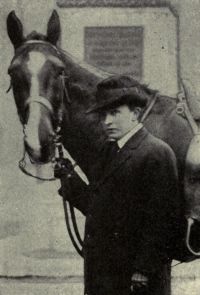
“ Finally, O my master, finally I came to be of your opinion—God was in it—and, like you, I asked, What can his purpose be? Intelligence is never wasted; intelligence like God's never stirs except with design. ”
 Will Levington Comfort,
The Public Square
(1923)
Will Levington Comfort,
The Public Square
(1923)
“ It was so in my training. We seek to silence all opinions, all half-truths, all thinking, in fact, in order to Know. We postulate, of course, a center of Spontaneous Knowledge, or Genius, above the mind. ”
ʻAli Muhammad Shirazi Bab, Selections From the Writings of the Báb
“ Men of wisdom, who had but a notion of the revelation of Thy glory, conceived a likeness of Thee according to their own understanding, and men of erudition, who had gained but a glimpse of the manifold evidences of Thy loving-kindness and glory, have contrived peers for Thee in conformity with their own imaginations. ”
 Samuel Taylor Coleridge,
Anima Poetæ
Samuel Taylor Coleridge,
Anima Poetæ
“ A "myriad-minded" sage, who has seen men and cities, who has read widely and shaped his thoughts in a peculiar mould, is pouring out his stores of knowledge, the garnered fruit of a life of study and meditation, for the benefit of an apt learner, a discreet and appreciative disciple. ”
 J. A. Giles,
Six Old English Chronicles
(1848)
J. A. Giles,
Six Old English Chronicles
(1848)
“ For wisdom shall decay and fall away from her wise men, and the understanding of her sages shall be concealed. Woe be unto you that are profound in heart, to conceal counsel from our Lord, whose works are in darkness, and they say, who seeth us? And who hath known us? ”
Brigham Young,
Journal of Discourses — Volume 13…
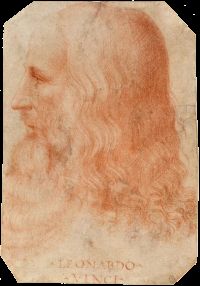
“ I find myself here on this earth, in the midst of intelligence. I ask myself and Wisdom, where has this intelligence come from? Who has produced and brought into existence, I will say, this intelligent congregation assembled here this afternoon? ”
 da Vinci Leonardo,
Thoughts on Art and Life
da Vinci Leonardo,
Thoughts on Art and Life
“ And as I have often thought over the cause of this fault, it seems to me that we must conclude that the spirit which directs and governs everybody is that which forms our intellect, or rather, it is our intellect itself. ”
Saint of Alexandria Clement, The writings of Clement of Alexandria… (1869)
“ As we have long ago pointed out, what we propose as our subject is not the discipline which obtains in each sect, but that which is really philosophy, strictly systematic Wisdom, which furnishes acquaintance with the things which pertain to life. And we define Wisdom to be certain knowledge, being a sure and irrefragable apprehension of things divine and human, comprehending the present, past, and future, which the Lord hath taught us, both by His advent and by the prophets. ”
 Samuel Johnson,
Lives of the English Poets : Prior…
Samuel Johnson,
Lives of the English Poets : Prior…
“ His frequent references to history, his allusions to various kinds of knowledge, and his images selected from art and nature, with his observations on the operations of the mind and the modes of life, show an intelligence perpetually on the wing, excursive, vigorous, and diligent, eager to pursue knowledge, and attentive to retain it. ”
Josiah Royce,
The Sources of Religious Insight
“ I reply that, in fact, all true insight is, to my mind, rational insight, upon one or another level of the development of our power to become rational beings. But you will remember that insight, as I defined it, also means knowledge which is intimate and manifold, as well as knowledge which views facts and relations in their unity. The words intuition and experience are often used to lay stress upon that aspect of our insight which either makes it intimate or else brings it into touch with many and various facts. ”
Friedrich von Schlegel,
The Philosophy of History, Vol…
“ Understanding is the faculty of apprehension—it penetrates into the inward essence of things, and discerns the manifestations of the divine or human mind in their several revelations and communications.—Thus the naturalist, whose eye searches into the inward life of nature—the statesman, who can fathom the most deep-laid plans of a hostile policy—the theologian, who can discover the most hidden sense of Scripture, may be said to possess in an eminent degree, the faculty of understanding. ”

“ Ah, but what, we must ask ourselves, of the great brain that conceived the idea, the foresight which told the exact moment when to put it into action, the cool courage which seized the moment—what of the grasp of affairs, the knowledge of men? ”
The Bible, Douay-Rheims, Complete (1999)
“ My son, if thou wilt attend to me, thou shalt learn: and if thou wilt apply thy mind, thou shalt be wise. 6:34. If thou wilt incline thy ear, thou shalt receive instruction: and if thou love to hear, thou shalt be wise. 6:35. Stand in the multitude of ancients that are wise, and join thyself from thy heart to their wisdom, that thou mayst hear every discourse of God, and the sayings of praise may not escape thee. 6:36. And if thou see a man of understanding, go to him early in the morning, and let thy foot wear the steps of his doors. ”
Friedrich von Schlegel,
The philosophy of life, and philosophy of language…
“ For nothing less than an internal light of intellectual brightness, or of the spirit made clear to itself, is that search after truth and knowledge, by which we discover the key-word and true signification of life, as a whole. ”
 Charles Kingsley,
The Good News of God
Charles Kingsley,
The Good News of God
“ If thou incline thine ear to wisdom, and apply thine heart to understanding; yea, if thou criest after wisdom, and liftest up thy voice for understanding; then shalt thou understand the fear of the Lord, and find the knowledge of God. ”
