“ The day school for the deaf is still sometimes regarded as an experiment, while its advocates insist that its success has been demonstrated. [189] Among school authorities in cities especially, pleas for the establishment of day schools are often listened to with favor, and there is frequently a tendency to give them at least a trial. General bodies interested in education or the public welfare are likewise inclined to countenance day schools, largely for the reason that they are opposed to the institution idea, and would place as many children as possible in the regular schools. ”
School for the deaf
Definition and stakes
Quotes about “school for the deaf”
“ Now education is offered to every deaf child, and to the poor and destitute the state provides all collateral necessaries as well, so that instruction may be denied to none.At present much the larger part of the deaf are educated in institutions. But alongside this plan there has grown, especially of late years, a day school system with the pupils living in their own homes, and the result is that in a number of states such schools have now been established. Their main field is recognized to be in large cities, and it is here that they are able to be of the greatest usefulness. ”
“ The special day school may be co-ordinated with, or made a part of, the state's educational system, standing on a level with its other schools. Deaf children here come to feel their place in the normal world, while [196] people in general become more ready to regard them in a proper manner. These children at the same time are not made strangers to their own family circles and communities; and certain ones, by a school nearer home and consequently more acceptable to their parents, may be reached who would otherwise possibly never enter an institution. ”
“ In the institution the children may be under intelligent supervision and direction their entire time, and they may be able to get, outside school hours, a part of the education which the hearing child so naturally acquires, for in an institution learning continues outside the classroom as well as within. The "picking up" of knowledge and bits of information, which the hearing child begins to make use of from the time he first hears human words, and the importance and value of which the general public cannot be expected to appreciate, is lost in the greatest measure to the deaf in the home. ”
John Dutton Wright, What the Mother of a Deaf Child Ought to Know
“ It should be possible for every taxpayer in every state who has a deaf child and who has not the means or the wish to place that child in a private school, to have the child educated in a free public school as completely by the speech method as his hearing children are educated by that method. He should not be compelled to send his child out of the state or else subject him to the influence of signs and finger spelling, with the probability that he will leave school a deaf mute. ”
Helen Keller,
The Story of My Life
“ I know that this idea will be vigorously combated by those who conduct schools for the deaf. To be sure, the deaf school is the only thing possible for children educated by the State. But it is evident that precisely what the deaf child needs to be taught is what other children learn before they go to school at all. When Miss Sullivan went out in the barnyard and picked up a little chicken and talked to Helen about it, she was giving a kind of instruction impossible inside four walls, and impossible with more than one pupil at a time. ”
“ It is thus quite evident, however large the true proportion of the deaf who attend the school may be, and whatever the proportion remaining a satisfactory period may be, that in practically every state there are a certain number of deaf children not in the schools who should be there, and that the offer of the state to provide an education for all its deaf children is not availed of as it should be. ”
Arnold Hill Payne, 1911 Encyclopædia Britannica (1911)
“ But it may be urged further that it is difficult, except in very large towns, to obtain a sufficient number of deaf children attending a day school to classify them according to their status, while it is more than one teacher can do to give sufficient attention to several children, each at a different stage of instruction from any other. Moreover, the deaf need more than mere school work; they need training in morals and manners, and receive much less of it from their parents than their hearing brothers and sisters. ”
Alfred Large, Encyclopædia Britannica, Ninth Edition (1878)
“ Doubtless, they would benefit somewhat by coming to a school for the deaf and dumb for a short time daily ; but as the deaf-mute population is so scattered, very few would be able to avail themselves of such a privilege. The only available remedy would be their attendance at ordinary schools for a stated time daily, where they would be disciplined and taught the girls to sew, knit, and write, and the boys to write and draw. By this suggestion it is not meant to affirm the possibility of educating deaf mutes along with hearing children. ”
John Dutton Wright, What the Mother of a Deaf Child Ought to Know
“ But the opportunities and obligations of the parents of deaf children to aid in their education by no means cease when the children enter school.Throughout the entire period of school life, and even after their children leave school, the parents can be of very great assistance to them. During the time that the school is in session, if the child is away from home, the parents should write not less than once a week, and oftener if possible. ”
John Dutton Wright, What the Mother of a Deaf Child Ought to Know
“ One of the most delightful things about a school for deaf children is the way all the other pupils welcome, pet, and look out for a newcomer. Every one makes much of him, and it would be hard indeed to be lonely long in the midst of so much attention and friendliness. ”
John Dutton Wright, What the Mother of a Deaf Child Ought to Know
“ The powerful influence of environment in those schools is against the acquisition of the speech and lip-reading habit.The mother who has faithfully followed the suggestions offered in the foregoing pages will be able to appreciate what she sees on visiting the schools, and will gain much more from such visits than one who is entirely inexperienced in the problem. Every mother should make it her business to visit at least one purely oral school, in order that she may make herself thoroughly intelligent on what may be expected of a deaf child. ”
“ The blind, it seems, are the worst sufferers, as they are in a minority, are often considered only a department or class in an institution designed primarily for the deaf, and consequently receive less attention than they should. [267] However, this arrangement has not been adopted as a deliberate policy on the part of the state: rather, it was begun when the school was young, pupils of both classes few, and one plant was thought adequate ”
“ Not only should the deaf child be required to attend school, but for reasons equally strong it should be seen that he remains at school a sufficient number of years, and a sufficient length of time each year. It is a difficult matter as it is to secure full attendance, but too often also the temptation is at hand for pupils to leave early to take up work on their own account, or because the school routine seems irksome ”
“ The eleven non-denominational schools may be [204] themselves divided into two classes: those which are really homes for very young deaf children, sometimes under the control of a society organized for the purpose; and those which are purely private enterprises, owned and directed by one or more individuals. Of the former there are four homes or kindergartens—the Sarah Fuller Home of Boston, the McCowen Homes of Chicago, the Home School near Baltimore, and the Home School of San Francisco. ”
John Dutton Wright, What the Mother of a Deaf Child Ought to Know
“ If no oral day or boarding school is available near at hand, the mother should have the far-sighted love that is unselfish, and the courage to part with her little five-year-old child during the months of the school year, and place him in some one of the distant schools where he can live and be taught in a purely oral environment. There are two alternatives to this, each of which is sometimes attempted, but both are undesirable. First the mother not infrequently attempts to have her child educated in the schools for hearing children. ”
“ Again, the attention that is given in an institution with a considerable number of pupils to the learning of a trade—accounting in strong measure for success in after life—means much more to a deaf child than it could to any other. In an institution there will usually be found larger equipment, fuller apparatus and more varied lines than in any but a very large day school ”
Various, Encyclopaedia Britannica, 11th Edition…
“ Some of the recommendations most worthy of notice were that deaf children from seven to sixteen years of age should be compelled to attend a day school or institution, part, or the whole, of the expense being borne by the local school authority; that technical instruction should be given, and that all the children should be taught to speak and lip-read on the “pure” oral method unless physically or mentally disqualified, those who had partial hearing or remains of speech being entirely educated by that method. ”
John Dutton Wright, What the Mother of a Deaf Child Ought to Know
“ The hearing child of eight who has never been in school and cannot read or write has, nevertheless, without conscious effort, mastered the two most important educational tasks in life. He has learned to speak and has acquired the greater part of his working vocabulary. In other words, although he has never been across the threshold of a school, his education is well advanced for his years and mental development."The situation of the uninstructed deaf child of eight is very different. ”
John Dutton Wright, What the Mother of a Deaf Child Ought to Know
“ Unfortunately, the idea is prevalent that any one can teach a little child, but that it takes experience to teach the older pupils. This is a disastrous fallacy. Young and inexperienced women are too often quite ready to assume the great responsibility of teaching a little deaf child. They rush in where angels might well fear to tread. Unfortunately, parents, and even school superintendents, are often too ready to permit them to do this dangerous thing. ”
John Dutton Wright, What the Mother of a Deaf Child Ought to Know
“ The best teachers can seldom, if ever, be induced to teach a single child in its home. Usually these teachers are more or less inferior. But even the best teacher in the world cannot do for a little deaf child in his home what she could accomplish for him in a well-organized and properly conducted school. ”
John Dutton Wright, What the Mother of a Deaf Child Ought to Know
“ On the other hand, the tendencies of the school-bred child are to be simple, natural, and childlike. His inclination to moodiness and suspiciousness is much less. He is happier. He becomes self-reliant, independent, and respectful of the rights of others. He is less petulant and more obedient. The wisest parents do not educate their hearing children at home, nor should they attempt it with a deaf child. ”
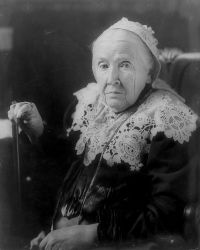
Julia Ward Howe,
Reminiscences, 1819-1899
“ His advice, privately sought and given, induced a number of parents to undertake themselves the education of their deaf children, or, at least, to have that education conducted at home, and under their own supervision. In after years such parents and children were forward in expressing their gratitude for the advice given and followed. The Horace Mann school in Boston, and the Clarke school in Northampton, attest the perseverance of the advocates of the new method of instruction, and their ultimate success. ”
Arnold Hill Payne, 1911 Encyclopædia Britannica (1911)
“ The ignoring of their expressed sentiments by those in authority is remarkable. In the case of school children it might fairly be argued that they are too young to know what is good for them, but with the adult deaf who have had to learn the value of their education by bitter experience in the battle of life it is otherwise. In Germany, the home of the “pure” oral method, 800 deaf petitioned the emperor against that method. In 1903 no fewer than 2671 of the adult deaf of Great Britain and Ireland who had passed through the schools signed a petition in favour of the combined system. ”
“ The proportion of children generally out of school is found by the Russell Sage Foundation to average 21.8 per cent in all the states, ranging from 7.3 to 44.7 per cent. Comparative Study of Public School Systems in 48 States, 1912. [535] In respect to the ages most common in the schools for the deaf, it has been found by Dr. Harris Taylor, of the New York Institution for Improved Instruction, that of 2,634 pupils in 38 schools for whom returns were made, 19.8 per cent were seven years of age; 17.3 per cent, eight; 10.9 per cent, six; 10.2 per cent, nine; and 9.6 per cent, ten. ”
J. Schuyler Long,
Gallaudet and his School
(1912)
“ The school here will probably be large enough to meet the needs of the country for many years to come and it should be made a national school. There is no reason it should not receive the same recognition as the public schools. Woolbridge—But how can we make Congress think so? Gal.—By convincing them that the education of the deaf is possible and a public duty. We could take a class of young pupils before Congress and show them. Seeing will be believing. ”
W. R. Roe, Anecdotes & Incidents of the Deaf and Dumb
“ A number of the pupils from the Institution at Derby were present at a meeting, when the head master was advocating its claims for support. At the close of the meeting a deaf and dumb young man came up and said, "I have been very pleased with what I saw the children do, they will soon be very clever. I hope the people will all help you; other people helped me to get a good education, now I must help others who are deaf and dumb to go to school. ”
W. R. Roe, Anecdotes & Incidents of the Deaf and Dumb
“ In the year 1810, when about four years old, she lost her sight and hearing from malignant sickness. At that time there was no school for deaf mutes. It was not until after she was turned nineteen years that she entered school, and she remained there between twenty and twenty-five years. During her long stay at the school her case always attracted particularly interesting attention on the part of visitors. In many ways she could render much service [Pg 56] in the daily work of the Institution. ”
Charles E. Flandrau,
The History of Minnesota and Tales of the Frontier
“ The school for the blind is entirely separate from that of the deaf and dumb, and is equipped with all the appliances of a modern special school of this character. It makes a specialty of musical instruction and industrial training, such as broom-making, hammock weaving, bead work and sewing. ”
Arnold Hill Payne, 1911 Encyclopædia Britannica (1911)
“ While it is gratifying to find that so much is being done in the way of educating this class of the community, the number of schools in most parts of the world is still lamentably inadequate. For instance, taking the school age as from seven to sixteen, which is now made compulsory by Act of Parliament in Great Britain, and assuming that 20% of the deaf population are of that age, as they are in England, there should be 40,000 deaf pupils under instruction in India alone, whereas there are but seventy-three. There are 200,000 deaf of all ages in India. ”
“ To refer to the institutions under consideration as "educational institutions", without any qualification, would not be in the interest of clearness of thought, and would either lead to confusion or to some qualifying phrases, because the deaf and the blind are certainly different enough from the normal child to be considered, for many purposes, in a separate class, and the institutions which educate and support them, it would seem to me, need some term by which they can be designated, which would distinguish them from the educational institutions designed for the normal child. ”