“ The garments worn by high personages in the embroidery, and meant to imitate a golden textile, were done in gold passing sometimes by itself, sometimes with coloured silk thread laid down alternately aside it, so as to lend a tinge of green, crimson, pink, or blue, to the imagined tissue of the robe, as if it were made of a golden stuff shot with the adopted tint. ”
Sliver (textile)
Definition and stakes
The theme of “sliver (textile)” has been addressed by authors such as Daniel Rock, Kate Heintz Watson and Arthur Hayden. It is often associated with terms like cotton, wool, silk, fabric and sleeve.
Quotes about “sliver (textile)”
Kate Heintz Watson, Textiles and Clothing
“ If the main stripe is cut at right angles with a second stripe, the textile appears more complicated and repose is lost. The same is true of checks, but no pattern is more distracting than large plaids, especially when used for waists, because the regularity of the design renders very conspicuous any inequalities in the shoulders or bust, and the great variety of colors detracts from the dignity of the dress. With small checks and narrow, self-colored stripes the effect is different, causing the texture to appear only shaded and not destroying the unity. ”
“ There are two pieces of the same textile scarlet, with one brede woven of narrow red stripes on a broad yellow stripe, the other border being a broad yellow stripe edged by a narrow scarlet one, both wrought up and down with needlework; the second piece of blue is figured all over in white embroidery with a pattern of netting, the meshes of which shut in irregular cubic shapes, and in the lines of the reticulation the mystic “gammadion” or “fylfot” is seen. ”
“ It is neither real weaving, nor true embroidery, but unites in its working those two processes into one. Though wrought in a loom and upon a warp stretched out along its frame, it has no woof thrown across those threads with a shuttle or any like appliance, but its weft is done with many short threads, all variously coloured, and put in by a kind of needle. It is not embroidery, though so very like it, for tapestry is not worked upon what is really a web—having both warp and woof—but upon a series of closely set fine strings. ”
Arthur Hayden, Chats on Cottage and Farmhouse Furniture
“ On the contrary, the designing of chintzes is an art of distinction, governed by canons which bear little 321 relationship to other decorative textile crafts. For where the silk-weaver is confined to solid patterns which will appear in his transverse threads, the printer of cloths can wander unrestrained into designs of wonderful intricacy and beauty: every colour in nature he can imitate, and no object is too delicate or too rich to stamp upon his cotton. ”
“ For the sake of expedition all the figures were sometimes at once shaped out of woven silk, satin, velvet, linen, or woollen cloth as wanted, and sewed upon the grounding of the article: the features of the face and the contours of the body were then wrought by the needle in very narrow lines done in brown silk thread. At times, even this much of embroidery was set aside for the painting brush, and instances are to be found in which the spaces left uncovered by the loom for the heads and extremities of the human figures are filled in with the brush. ”
“ Our young folks who sometimes amuse themselves by writing a name on paper, and while the ink is wet fold the sheet so that the word is shown again as if written backwards, get such a kind of scroll.In many Oriental silk textiles the warp is either of hemp, flax, or cotton; but this is so easily discoverable that it could hardly have been done for fraud’ sake. There is however a Saracenic trick, learned from that people, and afterwards practised by the Spaniards of the South, for imitating a woof of gold. ”
“ All the human figures, all the beasts, as well as the architecture, are outlined in thin leather or parchment once gilt, but now turned quite black. With the same leather, too, were studded the belts of the king and knight, and the spangles and golden enrichments of the ladies’ dress were of the same material. Saving here and there a few stitches of silk, everything else was of worsted, and that none of the finest texture. With such small means a good art-work was produced, as we see before us. ”
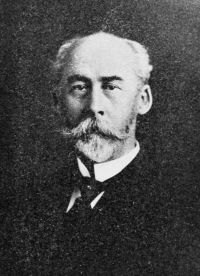 William Henry Holmes,
A Study of the Textile Art in Its Relation to the Development of Form and Ornament
“ A large class of embroideries are applied by like processes, but without reference to the construction of the foundation fabric, as they are also applied to felt and leather. Again, artificially prepared perforations are used, through which the fillets are passed. The results are much less uniformly geometric than where the fabric is followed; yet the mere adding of the figures, stitch by stitch or part by part, is sufficient to impart a large share of geometricity, as may be seen in the buckskin bead work and in the dentalium and quill work of the Indians. ”
Kate Heintz Watson, Textiles and Clothing
“ There is a dignity and restfulness in plain material which is never obtained by varied patterns. When a stripe is used to vary the material, the style of the textile is changed, elongated if the stripe is vertical, and widening if it is horizontal. ”
“ The Embroidered Apparel for an Amice; ground, crimson flos-silk, now faded; design, large and small squares, green, blue, and purple, filled in with gold, and modifications of the gammadion, in white or crimson silks. German, 14th century. 14 inches by 51⁄4 inches.This apparel is made out of three pieces, and stiffened with parchment; and is bordered by a narrow but effective lace of a green ground, [Pg 35] bearing circles of white and red, parted by yellow. The brown canvas upon which it is worked is very fine of its kind; and the gold, which is of a good quality, is of narrow tinsel strips. ”
“ Looking at it however through a glass and turning it about, we found it to have been unmistakably embroidered by the finger in such a way that the stitches for laying down upon the surface, and not drawing through the gold threads and thus saving expense, were carried right into the canvas lining at the back of this thin silk. After this same manner was really done, to our thinking, all the design, both before and behind upon that fine English-wrought chasuble, No. 673, p. 5.At the latter end of the thirteenth century our women struck out for themselves a new way of embroidery. ”
Business Administration: Theory…
“ If we take a step further and use three or four warp threads, say, of red, while the rest remain white, and do the same thing with the woof threads, we produce stripes and where these stripes cross one another there will be a little square of the solid color of the three or four threads, while the stripes elsewhere remain of the half-way tint.... In such weaving of patterns it is here assumed that the threads are dyed before the weaving is begun. The matter of printing colors upon calico, thin silk, or the like, is entirely apart from consideration of the textile fabric. ”
“ Piece of Purple Silk Embroidery in gold and silver; pattern of interlaced dragons, human figures, and birds. North German, 12th century. 81⁄2 inches by 71⁄4 inches.This small sample of needlework is as remarkable for the way in which it is wrought, as for the wild Scandinavian mythology which is figured on it.The usual process for the application of gold and silver in textiles and embroidery is to twine the precious metal about cotton thread, and thus weave it in with the shuttle or stitch it on by the needle. ”
William Henry Holmes,
Prehistoric Textile Fabrics Of The United States…
“ It is a remarkable fact that loosely woven examples of this kind of cloth are rarely, if ever, found among the impressions upon clay or in the fabrics themselves where preserved by the salts of copper or by charring. The reason of this probably is that the combination is such that when loosely woven the threads would not remain in place under tension, and the twisted and knotted varieties were consequently preferred. ”
“ Down the middle, before and behind, as far as the apparels, is let in a narrow piece of crochet-work like that upon the shoulders, but uninscribed. The two apparels at the feet—one before, the other behind—vary in their dimensions, one measuring 1 foot 1 inch by 1 foot 13⁄4 inches, the other, which is made up of fragments, 1 foot by 113⁄4 inches. Very elaborate and freely designed is the heraldic pattern on the rich stuff which forms the apparels. The ground is of silk, now faded, but once a bright crimson ”
“ Looking over very ancient manuscripts we often find between richly gilt illuminations, to keep them from harm or being hurt through the rubbings of the next leaf, a covering of the thinnest gauze, just as we now put sheets of silver paper for that purpose over engravings. It is not impossible that some at least of these may be shreds from the translucent textiles which found favour in the world for so long a time during the classic period. ”
“ These were heavily gilt and then cut into very narrow strips, to be used instead of the true golden thread.The gilding of fine silk and canvas in imitation of cloth of gold, like our gilding of wood and other substances, was also sometimes resorted to for splendour’s sake on temporary occasions; such, for instance, as some stately procession or a solemn burial service. Mr. Raine tells us he found in a grave at Durham, among other textiles, “a robe of thinnish silk; the ground colour of the whole is amber ”
William H. Dooley, Textiles, for Commercial, Industrial…
“ They invariably have a stripe. The ground shade of the better grade of men’s wear fabrics is generally composed of twist warp yarns, ranging from dark slate gray to light lavender gray. An endless variety of broad and narrow fine line effects is produced by expert manipulation and combination of weave and silk decorations, producing the pleasing effect required for this class of goods. The filling is nearly always black; but sometimes a dark slate is used.The cheaper grades are generally made of wool and cotton mixtures and twists, down to all cotton, in imitation of the better grades. ”
Eva March Tappan, Makers of Many Things
“ If the thread breaks, a tiny "faller," such as are used in cotton mills, falls down and stops the machine. The silk must now be twisted, subjected to two or three processes to increase its luster, and dyed,—and if you would like to feel as if you were paying a visit to a rainbow, go into a mill and watch the looms with their smooth, brilliant silks of all the colors that can be imagined. After the silk is woven, it is polished on lustering machines, singed to destroy all bits of free fibers or lint, freed of all threads that may project, and scoured if it is of a light color ”
A. E. Blanco, Piece Goods Manual
“ A silk selvedge thread or threads, or the initials of the manufacturer in silk, appearing on the selvedge of an all-wool fabric generally denotes a superior quality of fabric. The following, from a work dealing with cotton fabrics, shows the generally accepted value of selvedges as an indication of quality: "Advertising has educated the retail dealers and consumers to the fact that cotton warp goods with a white selvedge, the ground being of colour, are more to be depended upon not to crock than similar cloths of solid colour." ”
Butterick Pattern Company, The New Dressmaker (1921)
“ In heavier cotton and linen materials use seam-binding as a facing. The inner edge must be hemmed invisibly or stitched in place on wash materials. THE SLEEVES are considered by some people as the most difficult part of a costume. Great caution is necessary to keep them exactly alike, from the time the sleeves are cut until they are finished and sewed in the armhole. If not correctly cut and basted, one sleeve may be larger than the other. If they are not stitched in the armhole exactly alike, one may twist while the other hangs without a wrinkle. ”
Sarah Josepha Buell Hale, Mrs. Hale's Receipts for the Million
“ To keep Thread, Sewing-silk, &c.—In making up linen, thread is much preferable to cotton. Sewing-silk should be folded up neatly in wash-leather, and colored threads and cotton in paper, as the air and light are likely to injure them. Buttons, hooks and eyes, and all metal implements, when not in use, should be kept folded up, as exposure to the air not only tarnishes them, but is likely to injure them in a variety of ways. ”
A. E. Blanco, Piece Goods Manual
“ Printed Shirtings, like all other cotton fabrics, undergo a process of "singeing," "bleaching," and "calendering" prior to being printed. The first process removes the surface hairs, which form a sort of nap to the surface of the cloth, which if allowed to remain would interfere with the uniform application of the colours, and the other two processes further prepare the fabric for printing.Printed T-Cloth.—This fabric is an all-cotton plain-woven fabric, generally woven from poor-quality yarn, which, after leaving the loom, has been bleached and printed. ”
A. E. Blanco, Piece Goods Manual
“ The loose threads existing between the figures when the goods leave the loom are usually cut away, leaving a somewhat imperfect figure or spot with a bit of the figuring thread protruding at either extreme edge of the figure or spot. Lappet-figured fabrics are not Brocades.Lastings.—A plain twill or kindred weave fabric firmly woven from hard-twisted wool or cotton yarns. Smooth in appearance but having a somewhat hard handle, Lasting is a fine, durable, generally piece-dyed, material, of which there are several varieties, such as the Printed and the Figured. ”
William H. Dooley, Textiles, for Commercial, Industrial…
“ Plain cloth is the simplest cloth that can be woven. In this weave one series of threads (filling) crosses another series (warp) at right angles, passing over one and under one in regular order, thus forming a simple interlacement of the threads. This combination makes a strong and firm cloth, but does not give a close or a heavy fabric, as the threads do not lie as close and compact as they do in other weaves. In plain cloth, if not fulled or shrunk in the finish, the result is a fabric perforated with large or small openings according to the size or twist of yarn used. ”
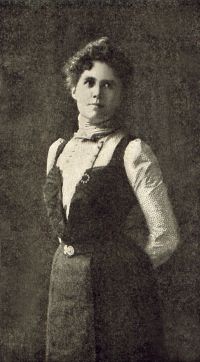 Helen Churchill Candee,
The Tapestry Book
“ The careful worker looks close and sees the warp exposed like fiddle strings here and there. She matches the colour of silk and wool to the elusive shades and covers stitch by stitch the bare threads, in perfect imitation of the loom’s way. [Pg 239] Sometimes the warp is gone. Then the work tests the best skill. The threads, the chaîne, must be picked up, one by one, and united invisibly to the new, and then the pattern woven over with the needle. It happens that large holes remain to be filled entirely, the pattern matched, the design caught or imagined from some other part of the fabric. ”
Kate Heintz Watson, Textiles and Clothing
“ Woolen cloth coming from the loom may be so [Pg 84] treated in the finishing room as to produce fabrics entirely different in appearance. One of the chief objects of the finishing is to give to the cloth as fine an appearance as possible to attract the buyer. Much of the fine finish disappears through wear, especially with inferior goods made from poor materials. The wearing quality of the goods is primarily dependent upon the strength and quality of the fibers of which it is made, so that the yarn of the filling and the warp should be examined when selecting materials. ”
M.A. William Davis, Hosiery Manufacture
“ The knitted fabric is essentially a weft fabric, the thread being inserted crosswise into the texture after the manner of filling so that the entire structure presents a horizontal appearance which is most evident with ground-coloured stripes when the different colours show themselves crosswise. This proves a serious limitation to the scope of the plain knitted texture, for the clothing trades have small use for horizontal effects as compared with vertical coloured stripes. ”
Kate Heintz Watson, Textiles and Clothing
“ The warp runs the long way of woven fabric or parallel with the selvage and it must be strong, elastic, and not easily parted by rubbing. To prepare the warp, two threads of raw silk are slightly twisted. Twist is always put into yarn of any kind to increase its strength. These threads are united and twisted together and this makes a strong thread capable of withstanding any reasonable strain in the loom and it will not roughen. For the woof or tram which is carried across the woven cloth on the shuttle, the thread should be as loose and fluffy as possible. ”
