“ Similarly a sound wave in air is reflected upon striking the surface of a body. If the wave strikes perpendicularly it returns along the line from which it comes, if, however, it strikes at some other angle it does not return along the same line, but as in other cases of reflected motion, the direction of the reflected wave is described by the Law of Reflected Motion as follows: The angle of reflection is always equal to the angle of incidence. This law is illustrated in Fig. ”
Wave (physics)
Definition and stakes
Quotes about “wave (physics)”
Horace Lamb,
1911 Encyclopædia Britannica
(1911)
“ If the medium be crystalline the velocity of propagation of plane waves will depend also on the aspect of the wave-front. For any given direction of the wave-normal there are in the most general case three distinct velocities of wave-propagation, each with its own direction of particle-vibration. ”
Various, The New Gresham Encyclopedia. Estremoz to Felspar
“ One of the chief difficulties is that in an ordinary elastic solid two types of waves can occur, one distortional, with the displacement of a particle perpendicular to the direction of transmission, and the other dilatational, with the displacement along the line of transmission, as in sound. Waves of light must be of the distortional kind, and the velocity of the other kind of wave may be quite different from the velocity of light. ”
Horace Lamb,
1911 Encyclopædia Britannica
(1911)
“ The result is in general that in the final stages the surface will be marked by a series of groups of waves of diminishing amplitude separated by bands of comparatively smooth water. The fact that the wave-velocity of a simple-harmonic train varies with the wave-length has an analogy in optics, in the propagation of light in a dispersive medium. In both cases we have a contrast with the simpler phenomena of waves on a tense string or of light waves m vacuo, and the notion of " group-velocity, " as distinguished from wave-velocity, comes to be important. ”
Horace Lamb,
1911 Encyclopædia Britannica
(1911)
“ Thus in the wave method the actual motion of the string is considered as the resultant of two wave motions, neither of which is of itself, and without the other, consistent with the condition that the ends of the string are fixed. Each of the wave motions is periodic with a wave-length equal to twice the distance between the fixed points, and the one set of waves is the reverse of the other in respect of displacement and velocity and direction of propagation ”
Jr. John W. Campbell, Invaders from the Infinite
“ If we can send out a spherical wave front, and have it lengthen rapidly as it proceeds, we will have a wave front that is, at all points, different. Any entering wave would, sooner or later, meet a wave that was half a phase out, no matter what the motion was, nor what the frequency, as long as it lies within the comparatively narrow molecular wave band. ”
1911 Encyclopædia Britannica, Volume 8 (1911)
“ If round the origin of waves an ideal closed surface be drawn, the whole action of the waves in the region beyond may be regarded as due to the motion continually propagated across the various elements of this surface. The wave motion due to any element of the surface is called a secondary wave, and in estimating the total effect regard must be paid to the phases as well as the amplitudes of the components. It is usually convenient to choose as the surface of resolution a wave-front, i.e. a surface at which the primary vibrations are in one phase. ”
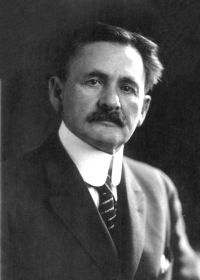
Albert Abraham Michelson,
Light waves and their uses
(1902)
“ Now, the velocity of wave propagation can be seen, without the aid of any mathematical analysis, to depend on the elasticity of the medium and its density; for we can see that if a medium is highly elastic the disturbance would be propagated at a great speed. ”
Horace Lamb,
1911 Encyclopædia Britannica
(1911)
“ Finally, it may be noticed that the conditions of wave-propagation without change of type may be investigated in another manner. If we impress on the whole medium a velocity equal and opposite to that of the wave we obtain a “steady” or “stationary” state in which the circumstances at any particular point of space are constant. Thus in the case of the vibrations of an inextensible string we may, in the first instance, imagine the string to run through a fixed smooth tube having the form of the wave. ”
Various, Scientific American Supplement…
“ Anything thus doubly periodic is a wave; and all waves, whether in air as sound waves, or in ether as light waves, or on the surface of water as ocean waves, are comprehended in the definition.What properties are essential to a medium capable of transmitting wave motion? Roughly we may say two—elasticity and inertia. Elasticity in some form, or some equivalent of it, in order to be able to store up energy and effect recoil; inertia, in order to enable the disturbed substance to overshoot the mark and oscillate beyond its place of equilibrium to and fro. ”
Sir J. A. Fleming, Waves and ripples in water, air… (1912)
“ A little examination of wave-motion shows us, therefore, that we always have at any instant associated with the material in which the wave is being propagated, both Energy of Strain and Energy of Motion. It can be shown that in a true wave of permanent type, the whole energy at any one moment is half energy of strain and half energy of motion, or, as it is called, half potential and half kinetic. ”
Sir J. A. Fleming, Waves and ripples in water, air… (1912)
“ As a wave progresses over the surface, wave-energy is continually being imparted to portions of the water in front, and it is transferred away from others in the rear. In the very act of setting a fresh particle of water in oscillation, the portions already vibrating must diminish their own motion. They may hand on the whole of their energy or only a part of it to their neighbours. This distinction is a very important one, and it determines whether a single act of disturbance shall create a solitary wave or wave-train in a medium. ”
Sir J. A. Fleming, Waves and ripples in water, air… (1912)
“ If the movement is rapid enough, the appearance of a wave moving along will be seen. [4] In all these exhibitions of wave-motion the movement of the particles is due to a common cause, but the moving particles do not control each other’s motion. There is no connection or tie between them. Suppose, however, that we suspend a series of heavy balls like pendulums, and interconnect them by elastic threads (see Fig. 7) , then we have an arrangement along which we can propagate a true wave. ”
Sir J. A. Fleming, Waves and ripples in water, air… (1912)
“ In free space æther waves of various wave-lengths all travel, as far as we know, at the same rate. This [256] equality in speed is, however, disturbed the moment the waves enter a transparent material substance such as glass. The velocity of propagation is then reduced in all cases, but it is generally more reduced for the shorter waves than for the longer ones; and as a consequence the rays of shorter-wave lengths are more bent or refracted than the rays of longer wave-length. ”
“ The answer of the wave theory to the objection now is, that light does bend round corners though only slightly and that the smallness of the bend is quite simply due to the extreme shortness of the light waves. The longer waves are, the more they bend round corners. ”
Sir J. A. Fleming, Waves and ripples in water, air… (1912)
“ A wave of compression is propagated along the slit, and the localities where the bars of light are compressed or expanded continually change their place. If we imagine the air in a tube to be divided into slices, represented by these bars of light, the motion of the model exactly represents the motion of the air in the tube when it is traversed by a series of sound waves. ”
“ When two exactly similar sets of waves are travelling in opposite directions over the same space, they produce no effects at certain points called nodes. These nodes are just half a wave-length apart. Their production can be understood by reference to Fig. 33. The dotted lines represent the two waves which are travelling in the direction indicated by the arrows. In A the time is chosen when the waves are exactly superposed, and the resultant displacement will be represented by the solid line. The points marked with a cross will be points at which the displacement is zero. ”
Horace Lamb,
1911 Encyclopædia Britannica
(1911)
“ The longer waves travel faster than the shorter, so that each wave is continually being drawn out in length, and its velocity of propagation therefore continually increases as it advances. If we fix our attention on a particular point of the surface, the level there will rise and fall with increasing rapidity and increasing amplitude. ”
Josiah Willard Gibbs,
Scientific Papers of Josiah Willard Gibbs
(1906)
“ In calculating the velocity of a system of plane waves of homogeneous light, regarded as oscillating electrical fluxes, in transparent and sensibly homogeneous bodies, whether singly or doubly refracting, we may assume that such a body is a very fine-grained structure, so that it can be divided into parts having their dimensions very small in comparison with the wave-length, each of which may be regarded as entirely similar to every other, while in the interior of each there are wide differences in electrical as in other physical properties. ”
Horace Lamb,
1911 Encyclopædia Britannica
(1911)
“ There are two distinct methods of investigating the motion of a uniform stretched string. One of these may be called the wave method, and the other the harmonic method. The wave method is founded on the theorem that in a stretched string of infinite length a wave of any form may be propagated in either direction with a certain velocity, V, which we may define as the “velocity of propagation.” ”
Albert Abraham Michelson,
Light waves and their uses
(1902)
“ Light gives precisely the same kinds of information, and hence it is only natural to infer that light also is a wave motion. We know, in fact, that it is so; but before giving the evidence to prove it, it will be well to make a little preliminary study of the chief characteristics of wave motion. FIG. 1 One of the difficulties encountered in studying wave motion is the rapidity of the propagation of the waves. A fairly moderate speed is attained by the waves propagated along a spiral spring. ”
Horace Lamb,
1911 Encyclopædia Britannica
(1911)
“ The potential energy of a system of sound waves is 1/2ks2 per unit volume. As in all cases of propagation in one dimension, the energy of a single progressive system is half kinetic and half potential. In the case of an unlimited isotropic elastic solid medium two types of plane waves are possible, viz. the displacement may be normal or tangential to the wave-fronts. The axis of x being taken in the direction of propagation, then in the case of a normal displacement ξ the traction normal to the wave-front is (λ+2μ) ∂ξ/∂x, where λ, μ are the elastic constants of the medium, viz. ”
Sir J. A. Fleming, Waves and ripples in water, air… (1912)
“ The physical effect we call light, and that which we have up to the present moment merely called electric radiation, are really identical in nature, and both consist in waves propagated through the space-filling æther, the only difference between them is in wave-length and wave-amplitude. ”
William George Hooper, Aether and Gravitation
“ Thus each atom being surrounded by other atoms may be looked on as the centre of a new wave system, so that every particle of the wave system is itself a centre of a new wave system which is transmitted in all directions. ”
Various, The Atlantic Monthly, Volume 02…
“ These three classes of waves, differing so immensely in magnitude and velocity, all agree in this,—that it is the wave that travels, and not the fluid or medium. The rapidity of the luminous wave is about nine hundred million times that of the sound-wave; hence we may suppose that the ether in which it moves is about as many times rarer or lighter than air, and the retina of the eye which it impresses as many times more delicate and sensitive than the drum of the ear. ”
Worthington Hooker, Science for the School and Family…
“ Waves.—Waves are generally formed by the friction of air upon water. Observe how they are formed. As soon as any portion of water is raised above the general surface it tends by gravity to fall to a level with the water around it, and in doing so the portion next to it is forced upward, forming another wave; and so one wave produces another, each one being smaller than the preceding, till at length the motion is wholly lost. This is always the process when the cause of the motion is a single impulse, as when a stone is dropped into the water. ”
Sir J. A. Fleming, Waves and ripples in water, air… (1912)
“ If two infinitely long sets of deep-sea waves, having slightly different wave-lengths, and therefore slightly different velocities, are superimposed, we obtain a resultant wave-train which exhibits a variation in wave-amplitude along its course periodically. ”
Sir J. A. Fleming, Waves and ripples in water, air… (1912)
“ Any medium which possesses these two qualities has, in virtue of explanations already given, the property of having waves created in it, and what we mean by an electric wave is a state of electric strain which is propagated through the æther with a velocity equal to that of light, just as an air wave consists of a state of compression which is propagated through the air with a velocity of 1100 feet a second. ”
William George Hooper, Aether and Gravitation
“ Not only, therefore, is the vibration in the wave front, but it is always transverse to the line of propagation, for the simple reason that the surface of the spherical shell or envelope is always at right angles to the radius vector or straight line which joins any centre to the surface of a spherical envelope. ”
John Wesley Powell,
Truth and Error — Chapter XI.
(1898)
“ We now know that waves, not fluids, are transmitted in the case of heat and light, and in a like manner gravity as deflection must be considered as wave action or vibration in some form. With these principles the instantaneous action of gravity is simple and self-evident, for speed is not transmitted, but only deflection is caused. ”
Sir J. A. Fleming, Waves and ripples in water, air… (1912)
“ Briefly speaking, any material or medium in or on which a true self-propagating wave-motion can be made must resist and persist. It must have an elastic resistance to some change or deformation, and it must have an inertia which causes it to persist in movement when once set in motion. These two qualities, or others equivalent to them, must invariably be present if we are to have a true wave produced in a medium. ”