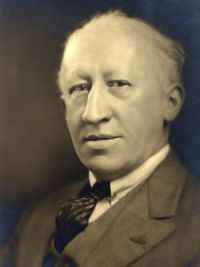
“ He did not use much of the folk-songs born of our fields and waters, woods and mountains, and the hearts of our forefathers who lived free and did not dream of smoky cities and stinking slums; though folk-song shaped and modified his melodies. In himself he had the spirit of Nature, and it made his music come forth as it makes the flowers blow. The very spirit of the earth seemed to find its voice through him, the spirit of storm and the spirit of fair weather that sports when sweet rains make a musical clatter among the leaves. ”
John F. Runciman
Biographical details
John F. Runciman (1866–1916), a distinguished musicologist and critic, examined the interaction between music, nature, and human emotion in his analyses. His works, including Purcell, Haydn, and Richard Wagner, Composer of Operas, explore how composers like Purcell infused natural forces into melodic expression, Wagner dramatized human passion and existential themes, and Mozart addressed mortality through striking musical contrasts.
Runciman’s writings reveal a profound engagement with the cultural and emotional impact of music, presenting it as both a reflection of and reaction to the human condition. His legacy lies in combining musical critique with philosophical and historical insight.
Quotes by John F. Runciman
John F. Runciman, Richard Wagner, Composer of Operas
“ Tristan is pure human passion—Tristan's soul is the antithesis of Lohengrin's. The Ring is, from beginning to end, a gorgeous spectacle, a glorification of the grandeur and loveliness of the earth, the splendour and beauty and strength of human life. Not even Wotan's renunciation takes away a jot from its note of praise of humanity—one might even say praise of the joy of living. Parsifal is a denial of the value and richness and worthiness of human life: the world is pushed away; and the hero attains perfect peace by shutting himself up in a monastery with no women to disturb him. ”
“ It occurs again and again, without wearying the ear; it keeps the atmosphere charged with mystery and suggestions of that far-away land where it is always dawn. It is the calm, refreshing, gently-rippling river; the cool, placid water sliding through many countries, with the swan as symbol and token of all that is strange and beautiful where it has its source. It is less a theme capable of purely musical development to form pattern after pattern of entrancing beauty, like the Grail or Montsalvat theme, than the equivalent in music of tender colour. ”
John F. Runciman, Old Scores and New Readings: Discussions on Music & Certain Musicians
“ Had Mozart seen death as Handel and Bach saw it, as the only beautiful completion of life, or even as the last opportunity given to men to meet a tremendous reality and not be found wanting, he might have written a sweetly breathed prayer for eternal rest, like the final chorus of the "Matthew" Passion, or given us something equal or almost equal to the austere grandeur of the Dead March in Saul. But he saw death differently, and in the opening bar of the "Requiem æternam" we have only sullen gloom and foreboding, deadly fear begotten of actual foreknowledge of things to come. ”
John F. Runciman, Richard Wagner, Composer of Operas
“ It is now one hundred years since Richard Wagner was born, thirty since he died. In every land he has his monument in one shape or another; his music-dramas can be heard all the world over; all the ancient controversies as to their merits or demerits have died down. The Bayreuth theatre, the outward and visible sign of his inner greatness, has risen to the point of its most splendid glory and lapsed into the limbo of tenth-rate things. ”
“ Mime is a malignant dwarf, in whose care Sieglinda, dying in childbirth, has left Siegfried. Years have passed, springs and summers and winters have come and gone; but Nature goes on in her imperturbable way, and Brunnhilda still lies wrapt in slumber on the mountain heights, the subject of awe-struck whispers amongst passing tribes. Mime tries in vain to piece the sherds of the sword together; Siegfried always smashes the new-made weapon at a single blow. The Wanderer, in his blue cloak, enters: it is Wotan, the heart-broken god, going wearily about the world awaiting what may happen. ”
“ In that year feudal Europe had not been shaken to the foundations by the French Revolution; few in Europe, indeed, and none in sleeping German Austria, dreamed that such a shaking was at hand, and that royal and ducal and lesser aristocratic heads, before the century was out, would be dear at two a penny. Those drowsy old courts—how charming they seem on paper, how fascinating as depicted by Watteau! Yet one wonders how in such an atmosphere any new plants of art managed to shoot at all. ”
John F. Runciman, Old Scores and New Readings: Discussions on Music & Certain Musicians
“ For instance, no one can ever forget the opening of "The Valkyrie"—the inside of Hunding's house built round the tree, the half-dead fire flickering, while we listen to the steady roar of the night wind as the tempest rushes angrily through the forest—nor the scene that follows, when through the open door we see all the splendours of the fresh spring moonlight gleaming on the green leaves still dripping with cold raindrops. The terror and excitement of the second act are vastly increased by the storm of thunder and lightning that rages while Siegmund and Hunding fight. ”
John F. Runciman, Richard Wagner, Composer of Operas
“ The superb vocal writing, the beauty and sheer strength of the orchestral parts, the gorgeous colouring, and the human passion blent with the sense of the green yet fiery spring, all go to make up a thing unique in opera. A tide of life rushes through it all; and the man's technical accomplishment was so fine and complete that he found immediate incisive expression for every shade of emotion, or complex blend of emotions, and every sensation. The jealous, savage ferocity of Hunding is there; Siegmund's and Sieglinda's despair, hope and final burst of ecstatic joy ”
“ It is the imminent presence of death that brings their love to light, as it is their love that takes them to death. They gaze upon one another, and rush into each other's arms. Brangaena, turning round, is horrified to see what her officiousness has accomplished. The music rolls on in a torrent of almost unendurable sweetness; the ship reaches land, and the curtain drops as Tristan and Isolda, oblivious of all but themselves and their passion, stagger in one another's arms, and the trumpets sound without as the King approaches to claim his bride. ”
John F. Runciman, Old Scores and New Readings: Discussions on Music & Certain Musicians
“ To whatever page of the score you turn, there is perfect beauty—after the first act not a great deal that is powerful or meant to be powerful, but melody after melody that entrances you merely as absolute music without poetic significance, and that seems doubly entrancing by reason of the strange, remote feeling with which it is charged, and its perpetual suggestion of the broad stream flowing ceaselessly from far-away Montsalvat to the sea. "Lohengrin" is a fairy-story imbued with seriousness and tender human emotion, and the music is exactly adapted to it. ”
John F. Runciman, Richard Wagner, Composer of Operas
“ Brünnhilda, let us always remember, stands for human love, affection—not love in the Tristan sense—but that love of which Goldsmith sang that He "loved us into being"; the love of human being for human being so strong that not for so many thousands a year as a judge, so many pitiable hundreds a year as a magistrate, immortality as an omnipotent ruler or a Wotan, will it perpetuate or permit a wrong on a human being. To win omnipotence Wotan has inflicted wrong upon wrong—wrong upon wrong on those he had created for his purpose, on those the fine part of his nature loved. ”
“ Pelham Humphries, an unmistakable genius, was carried away at twenty-seven; Henry Purcell, one of the mightiest of the world's masters of music, died at the age of thirty-seven, only two years older than his peer in genius, Mozart. Yet he left a glorious record, and his days must have been glorious. Men like Purcell do not create music such as theirs by blind instinct, as a cat catches mice. A mighty brain and mightier heart must have worked with passionate energy, the fires must have burnt at an unbroken white heat, to produce so much unsurpassable music in so short a time. ”
John F. Runciman, Old Scores and New Readings: Discussions on Music & Certain Musicians
“ But when the worst has been said, when one has writhed under the recollection of an adipose prima donna fooling with bear-like skittishness a German tenor whose figure and face bewray the lager habit, when one has shuddered to remember the long-winded idiotic dialogue, the fact remains firmly set in one's mind that one has stood before a gigantic work of art—a work whose every defect is redeemed by its overwhelming power and beauty and pathos. There has never been, nor does it seem possible there ever will be, a finer scene written than the dungeon scene. ”
“ And Haydn—we can fancy him, after brilliant evenings at Esterház standing, looking Viennawards on still nights, the starry immensity above him and the quiet black woods and waters around him—the gay lights of Vienna must have danced before his inner vision, and his soul must have risen in revolt, full of angry desire to be once again in the midst of the happy chattering tide of life in the great town. No other great composer could have stuck to his task as he did. Mozart would have forgotten his duties; Beethoven would purposely have neglected them. ”
John F. Runciman, Richard Wagner, Composer of Operas
“ The energy, superhuman energy, of the thing is amazing: the storm throbs in the forest: one feels the pulse of the storm-god; the sforzando shocks and shrieks add to the terrific wildness of the scene. Pitilessly, ever higher and higher, the wind shrieks, always to that beating bass, until, amid the clatter and screaming, we hear Donner, exulting in his mad strength and swinging his mighty hammer as he rides. The lightning crackles vividly in the orchestra, the thunder rolls, crashes and growls, and the thunder-god can almost be heard betaking himself off to continue his riot afar. ”
John F. Runciman, Old Scores and New Readings: Discussions on Music & Certain Musicians
“ Lohengrin, knight of the Grail, redeemer, yet with a touch of tragedy in his fate, drawn down the river in his magic boat by the Swan from a far mysterious land, a land of perpetual freshness and beauty, is an infinitely more poetic notion than the commonplace angel flapping clumsily down from heaven; and even if we feel it to be absurd that he should have to beg his wife to take him on trust, yet, after all, he takes his wife on trust, and he tells her at the outset that he cannot reveal the truth about himself. ”
“ At first he is obdurate, but she begs him to spare her that frightful disgrace, and to surround her with a wall of fire through which only a great hero will dare to pass. He yields, taking her godhood, her limited immortality, away from her, putting her to sleep, calling up the fire, and swearing that only a hero who has no fear of his spear shall pass through, and so the drama ends. Wotan has definitely renounced love. The moment at which he can renounce life rather than endure life without love has not yet come. The old Adam, the biological bias, the will to live, is strong in us all. ”
John F. Runciman, Richard Wagner, Composer of Operas
“ There is nothing uncanny in the music: we have that delight in the sheer force of the elements which we inherit from our earliest ancestors: the joy of nature fiercely at work which is echoed in our hearts from time immemorial. The shrilling of the wind, the hubbub, the calls of the Valkyries to one another, the galloping of the horses, form a picture which for splendour, wild energy and wilder beauty can never be matched.Technically, this Ride is a miracle built up of many of the conventional figurations of the older music. ”
“ It is the sadness that clings to forlorn things of an order that is dead and past: it tinkles in the harpsichord figurations and cadences; it makes one think of lavender scent and of the days when our great-grandmothers danced minuets. Purcell's music, too, is sad at times, but the human note reaches us blended with the gaiety of robust health and the clean young life that is renewed each year with the lengthening days. ”
“ In themselves they are a weariness to the flesh; if there were nothing but them to be found in Haydn, we should not go to Haydn. But there was a great deal more. There was a poetic content, a burden, if you like, a message, in his music, and it was different from anything that had been before or has been since.There is nothing of the gorgeous architectural splendours of Bach, nothing of Bach's depth nor high religious ecstasy. His passion, joy and sorrow are all milder than Beethoven's. He has little of Beethoven's grandeur nor feeling too deep for tears or words. ”
John F. Runciman, Old Scores and New Readings: Discussions on Music & Certain Musicians
“ There is indeed a strange, pathetic charm in the eighteenth century to which no one can be indifferent: it is a dead century, with the dust upon it, and yet a faint lingering aroma as of dead rose petals. But the old-world atmosphere of Byrde's music is, at least to me, something finer than that: it is the atmosphere of a world which still lives: it is remote from us and yet very near: for the odour of dead rose petals and dust you have a calm cool air, and a sense of fragrant climbing flowers and of the shade of full foliaged trees. ”
John F. Runciman, Richard Wagner, Composer of Operas
“ I doubt whether Wagner ever again in his life had such an ethereal moment: it is sheer fervour and sweetness, unmixed with the hot human passion of Tristan or the smoky philosophies of the Ring. To wish Senta had a reasonable cause for her ecstasy of self-immolation is, of course, to wish the Dutchman were not the Dutchman. In truth, we must take the scenes as they come without inquiring too curiously; the storm music which goes with the wanderer, and the moments of glorious splendour that come to the redeeming woman, are things worth living to have written and worth living to hear. ”
“ A century ago Haydn was as fresh and novel as Tschaikowsky is now, and as overwhelming a personality in the world of music as the mighty Wagner. But time equalizes and evens things, and in another hundred years all that is merely up-to-date in musical speech and phraseology will have lost its flavour and seductiveness; but the voice that is sincere, whether the word is spoken to-day or was spoken a century ago, will sound as clear as ever, and the one voice shall not be clearer nor more convincing than the other. ”
John F. Runciman, Old Scores and New Readings: Discussions on Music & Certain Musicians
“ But each is lacking in the human element, and without the human element no piece of music can be popular for long. The fame of Bach, Beethoven, Mozart, is still growing and will continue to grow, because every time we hear their music it touches us; while Weber, mighty though he is, will probably never be better loved than he is to-day, because his marvellously graphic picturesque music does not touch us—cannot, was not intended to, touch us; and the fame of Mendelssohn and the host of lesser men who did not speak with a human accent of human woe and weal wanes from day to day. ”
John F. Runciman, Richard Wagner, Composer of Operas
“ Wagner never ceases to make us feel that the drama passes amidst the wild mountains and woods: the drama is poignant enough in all conscience, and the scenery is an aid to it. We have the purely pictorial Wagner with the gathering storm—the voices calling amongst the clouds. The sinister growling of the approaching thunder is heard, and, still more sinister, the harsh notes of Hunding's horn; the orchestra rages louder and louder, Sieglinda mutters in her dream, the Valkyrie's call is heard encouraging Siegmund, the crash as the Sword is splintered, and then an awful silence. ”
“ In The Flying Dutchman Wagner had exploited the uncanny, the terror and mystery of gray winter seas; in Tannhäuser he turned to the conflict between the gross, lurid passions of man and the sane, pure side of his nature; and now, in Lohengrin, he was to give us an opera which for sheer sustained loveliness has only one parallel in his works—the Mastersingers. It is the most delicately beautiful thing he wrote; its freshness is the freshness that seems unlikely to fade with the passage of time. ”
“ Set the sheets on a piano and play: the music starts to life in full youthful vigour, as music from the soul of a young god should. It cannot and never will grow old; the everlasting life is in it that makes the green buds shoot. To realise the immortal youth of Purcell's music, let us make a comparison. Consider Mozart, divine Mozart. Mixed with the ineffable beauty of his music there is sadness, apart and different from the sadness that was of the man's own soul. ”
John F. Runciman, Old Scores and New Readings: Discussions on Music & Certain Musicians
“ It is sheer spectacle, but how magnificent compared with that older type of spectacle which chiefly consisted of brass bands and ladies insufficiently clothed! "Siegfried," on the other hand, contains no tragedy save the destruction of a little vermin. It is the most glorious assertion ever made of the joy and splendour and infinite beauty to be found in life by those who possess the courage to go through it in their own way, and have the overflowing vitality and strength to create their own world as they go. Siegfried is the embodiment of the divine energy that makes life worth living ”
“ On paper, on canvas, on wooden panels, it is very picturesque in its queer stately way, if very artificial. The sunlight seems always to bask on it. It reminds one of a perpetual summer Sunday afternoon in a small provincial town. But its voice speaks in its music, often bitterly sad and sweetly regretful, and there is little hint of sunshine or careless merrymaking there. Bach is steeped in cloister gloom, with frequent moments of religious ecstasy. Haydn is generally cheerful in a humdrum sort of way, but when his real feelings begin to speak, not even Mozart is sadder. ”
John F. Runciman, Richard Wagner, Composer of Operas
“ Mediæval Nuremberg, with its thousand gable-ends, its fragrant lime-trees and gardens, its ancient customs, its processions of the guilds and crafts, its watchman with his horn and lantern, calling the hour, its freshness and quaint loveliness by day and its sweetness on soft summer nights—it is these Wagner employed all his superb musico-pictorial art to depict; they are the background to the purely human element of the play, and at the same time they help to express that element. ”
“ More beautiful music for the theatre had been written, but never had such energy been put into it as we find in the Dutchman's damnation theme or the tumult of the bitter, angry sea. Any lazy man can, in time, fill up a score with sufficient notes for the trumpets, trombones and drums to produce a deafening uproar, but it took all the native force of a Wagner to fill, to inform, the thought itself with such energy that, looking at the score, the passages seem almost to leap out from the page, and, played on even a small piano, their effect is still overwhelming. ”
John F. Runciman, Richard Wagner, Composer of Operas
“ Let me repeat that the Mastersingers is notable for the endless flow of beautiful melodies, neither broken and scrappy nor, on the other hand, approaching monotony: there is infinite variety combined with magnificent breadth; for the nobility hidden under homeliness—a characteristic most marked in Sachs' music; for miraculous colouring now pitched in a low and tender key, now blazing as in the last finale; for the picture of Nuremberg in the old time, and for the vigour and fun with which the old life is depicted. ”
John F. Runciman, Old Scores and New Readings: Discussions on Music & Certain Musicians
“ What was it to the Dutchman's damned soul if all the women in the world swore to love him eternally, so long as he was unable to love one of them? The true Wandering Jew is not the unloved man, but the man who cannot love, who is destitute of creative emotion and cannot build up for himself a world in which to dwell, but must needs live in hell—a world that others make, a world where he has no place. Wagner knew this, and makes the Dutchman fall in love with Senta; and that only leaves the drama more than ever in a muddle. One wants a reason for his suddenly being able to love. ”
John F. Runciman, Richard Wagner, Composer of Operas
“ That is to say, my relative at once felt the magical truthfulness of Wagner's touch: the sweet, clear air, the sunlight; and that is the atmosphere Wagner wanted to establish at the beginning of this most magical of operas. Out of the blue sky comes the Montsalvat (not necessarily the Grail) motive; it descends with ever-gathering fulness, through key after key, until at last it culminates in a tremendous climax for the brass: then comes a wondrous cadence, falling slowly, as a mountain stream falls over slabs of smooth-worn mountain rock, until we get back to the original atmosphere. ”
John F. Runciman, Richard Wagner, Composer of Operas
“ The mountain-top is sunlit; Brünnhilda's horse Grani is contentedly at graze; Brünnhilda, covered with her shield, her spear by her side, sleeps, motionless. Siegfried comes over some rocks at the back of the stage, gazes around him in wonder, finally discovers Brünnhilda, and with a kiss awakens her. At first the godhood has not quite gone out of her, and "Woe! woe!" she cries, as she realises her fate. But womanhood is strong within her; she yields; hails Siegfried as the highest hero of all the world, and the opera ends.The music is nearly throughout the superb Wagner. ”
John F. Runciman, Richard Wagner, Composer of Operas
“ At this period of his life Wagner was by no means so economical as he afterwards became; he squandered his pearls with prodigal hands. In a few pages are enough melodies and themes to set up a Puccini—or for that matter a Strauss or an Elgar—for life. The blending of the death-theme with one of the love-themes, when Isolda speaks of love's goddess, "the queen who grants unquailing hearts ... life and death she holds in her hands," is one of the miracles of music—stern beauty made up of defiance of fate and careless voluptuousness. ”
John F. Runciman, Richard Wagner, Composer of Operas
“ It is the magic charm that reconciles him to us; it is this that makes us feel how he is conditioned, chained, cribbed, cabined and confined. In obedience to inexorable law he comes down the river, drawn by the swan; in obedience to the same inexorable law he is drawn away, as helplessly as a needle drawn by a magnet.The prelude opens with a series of chords, ascending, all on A. Handel might have done this: none of the Viennese composers could, or perhaps I should rather say, would, have done it. ”
John F. Runciman, Richard Wagner, Composer of Operas
“ Never did a more fiery impetuous stream flow from any composer: never was there, in a word, more inspired music. The profusion of the material is wonderful, and even more wonderful is the concentrated quality of that material. In the Ring and Parsifal—as in Lohengrin and Tannhäuser—there are longueurs; in Tristan there are none: not a bar can be cut; there is not a bar that does not hold us. In a paradoxical mood, or irritated, by being obstinately, wilfully, stupidly regarded as one of the trade setters of opera-texts, Wagner declared to Bülow that "one thing is certain, I am not a musician." ”
John F. Runciman, Richard Wagner, Composer of Operas
“ The artisans march past in their holiday clothes, each guild bearing its banner; the banners wave in the bright sunlight, and there is plenty of colour as well as of bustle and gaiety; but all is homely in style—there is not a noble person in the crowd—and the thing is carried through by the vividly imagined music, the energy and sparkle of it, the positive splendour of the orchestration. The various guild-choruses are full of humour, the many ridiculous things being saved from lapsing into mere horseplay and nonsense by the endless series of beautiful tunes. ”
John F. Runciman, Richard Wagner, Composer of Operas
“ The Rhinegold ends with a storm, the flash of lightning and the roar of thunder; in each Act of the Valkyrie there is a storm; the Third Act of Siegfried opens with a storm; there is one storm in the Dusk of the Gods. Wind screaming through the pines, the plash of rain, the driving of thunder-clouds—these are the pictorial inspiration of the Ring as surely as old Nuremberg is the pictorial inspiration of the Mastersingers. These Scandinavian gods are the divinities of river and wood and mountain, and Wagner made full use of them. ”
John F. Runciman, Richard Wagner, Composer of Operas
“ Eva steals out from her father's door, and at once the dramatic motive of the action deepens. We have had up to now the joy and beauty of the night, the aroma of the trees, and all the warmth of Sachs' artist's heart as he dwells on Walther's song of spring: now the human element comes in and is reflected in the music. Eva wants to know whether there is any hope for Walther or any chance of help from Sachs, and she tries to find out without fully disclosing the secret of her love. ”
John F. Runciman, Richard Wagner, Composer of Operas
“ The Mastersingers is a long song, and the first act the first verse of it. Such a profusion of melodies has never been scattered over one act of an opera—not songs simply pleasing to the ear, but constituting subjects surcharged with feeling and capable of unfolding, as the opera goes on, into fresh forms of the rarest beauty and splendour. We cannot lay our finger on a superfluous bar, not one that can be cut without badly injuring the whole work. ”
John F. Runciman, Richard Wagner, Composer of Operas
“ In a letter to Liszt Wagner says he would not have undertaken the toil of completing so gigantic a work as the Ring but for his love of Siegfried, his ideal of manhood. It is as well, from one point of view, that his love of his ideal was so intense, for in consequence we have the Ring; but from another point of view it is not so well, for the youth Siegfried is the least lovable, perhaps the most inane and detestable character to be found in any form of drama. He is a combination of impudence, stupidity and sheer animal strength—mere bone and sinew; his courage comes from his stupidity. ”