Summary

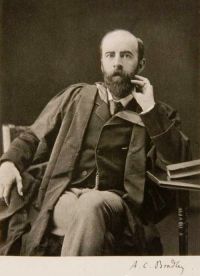
Portrait of A. C. Bradley A. C. Bradley Oxford Lectures on Poetry

The joy of life had always culminated for him in the love of women: he could say ‘no’ to none of them: of Octavia herself he speaks like a poet. When he meets Cleopatra he finds his Absolute. She satisfies, nay glorifies, his whole being. She intoxicates his senses. Her wiles, her taunts, her furies and meltings, her laughter and tears, bewitch him all alike. She loves what he loves, and she surpasses him. She can drink him to his bed, out-jest his practical jokes, out-act the best actress who ever amused him, out-dazzle his own magnificence. She is his play-fellow, and yet a great queen.
Source: Gutenberg

Portrait of A. C. Bradley A. C. Bradley Oxford Lectures on Poetry

Why should we concern ourselves with Shakespeare’s theatre and audience? The vast majority of his readers since the Restoration have known nothing about them, and have enjoyed his plays enormously. And if they have enjoyed without fully understanding, it was for want of imagination and of knowledge of human nature, and not from ignorance of the conditions under which his plays were produced. At any rate, such ignorance does not exclude us from the soul of Shakespearean drama, any more than from the soul of Homeric epic or Athenian tragedy; and it is the soul that counts and endures.
Source: Gutenberg

Portrait of A. C. Bradley A. C. Bradley Oxford Lectures on Poetry

In Romeo and Juliet, Hamlet, Othello, though in a sense we accept the deaths of hero and heroine, we feel a keen sorrow. We look back, think how noble or beautiful they were, wish that fate had opposed to them a weaker enemy, dream possibly of the life they might then have led. Here we can hardly do this. With all our admiration and sympathy for the lovers we do not wish them to gain the world. It is better for the world’s sake, and not less for their own, that they should fail and die.
Source: Gutenberg

Get perspective with Kwize: daily news enlightened by great literature