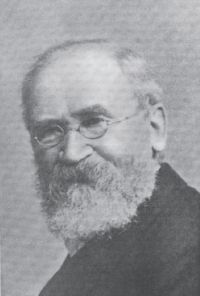
Andrew Martin Fairbairn

Andrew Martin Fairbairn

Summary

Portrait of Andrew Martin Fairbairn Andrew Martin Fairbairn The Cambridge Modern History, Volume 2… (1904)

In France, where the passion for unity is beginning to work like madness in the brain, Rabelais speaks in his mother tongue the praises of the new learning; Montaigne makes it the vehicle of the new temper and its cultured doubt; Clement Marot uses it to sing the Psalms of the ancient Hebrew race; John Calvin to defend and commend his strenuous faith; while Descartes, born in this century though writing in the next, states his method, defines his problem, and determines the evolution of modern philosophy, in the language of the people as well as in that of the learned.
Source: Wikisource

Portrait of Andrew Martin Fairbairn Andrew Martin Fairbairn The Cambridge Modern History, Volume 2… (1904)

It is born of the love that loses the sense of personal distinctness and identity in the joy, not of absolute possession, but of being possessed. Boehme says that the processes of nature conceal God, but the spirit of man reveals Him; and how can it reveal a God it does not know? But the spirit that has never seen and touched Deity has never known Him or been so one with Him as to know Him as he knows himself. Here lives the very soul of Luther and the essence of all his thought.
Source: Wikisource

Portrait of Andrew Martin Fairbairn Andrew Martin Fairbairn The Cambridge Modern History, Volume 2… (1904)

He believes that the universe needs no other governor than its Creator, whose word guides the whole and determines the nature, properties, and condition of each several thing. Pascal's famous definition of Deity, "a circle whose centre is everywhere and whose circumference is nowhere," is but an echo from Babelais. And he can, with the wisest of the ancients and the best of the moderns, speak of the "great Soul of the universe which quickens all things."
Source: Wikisource

Get perspective with Kwize: daily news enlightened by great literature