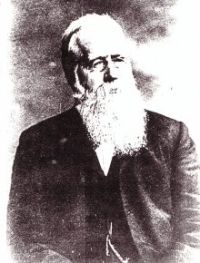
Andrew Seth Pringle-Pattison

Andrew Seth Pringle-Pattison

Summary

Portrait of Andrew Seth Pringle-Pattison Andrew Seth Pringle-Pattison Encyclopædia Britannica, Ninth Edition (1888)

He now proceeded to distinguish three moments in God, the first of which is the pure indifference which, in a sense, precedes all existence the primal basis or abyss, as he calls it, in agreement with Boehme. But, as there is nothing before or besides God, God must have the ground or cause of His existence in Himself. This is the second moment, called nature in God, distinguishable from God, but inseparable from Him. It is that in God which is not God Himself; it is the yearning of the eternal One to give birth to itself.
Source: Wikisource

Portrait of Andrew Seth Pringle-Pattison Andrew Seth Pringle-Pattison Encyclopædia Britannica, Ninth Edition (1888)

They must believe, therefore, that they have grasped the inmost principles of that nature: so much is involved, indeed, in the construction of an absolute system. But it is to be noted that, though there is much talk of God in such systems, the known universe—the world that now is—is nowhere transcended; God is really no more than the principle of unity immanent in the whole.
Source: Wikisource

Portrait of Andrew Seth Pringle-Pattison Andrew Seth Pringle-Pattison Encyclopædia Britannica, Ninth Edition (1888)

The eternal generation of the Son is equivalent to the eternal creation of the world. But the sensuous and phenomenal, as such, so far as they seem to imply independence of God, are mere privation and nothingness; things exist only through the presence of God in them, and the goal of creation, like its outset, is the repose of the Godhead.
Source: Wikisource

Get perspective with Kwize: daily news enlightened by great literature