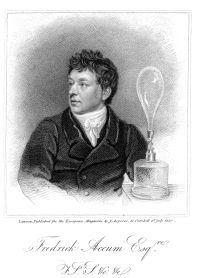
Friedrich Christian Accum

Friedrich Christian Accum

Summary

Portrait of Friedrich Christian Accum Friedrich Christian Accum Culinary Chemistry

A kitchen is, in fact, a chemical laboratory; the boilers, stew-pans, and cradle spit of the cook, correspond to the digestors, the evaporating basins, and the crucibles of the chemist. And numerous as the receipts of cookery are, the general operations (like the general process of chemistry) are but few. In some the object aimed at is, to extract the constituent parts of the food, so as to exhibit them in a separate state, or to combine them with other substances, to produce new compounds which differ widely from those from which they originated.
Source: Gutenberg

Portrait of Friedrich Christian Accum Friedrich Christian Accum Culinary Chemistry

The epicure or gormand is defined—a man having accidentally been able to study the different tastes of eatables, does accordingly select the best food and the most pleasing to his palate. His character is that of a practioner. The gourmet speculates more than he practises, and eminently prides himself in discerning the nicest degrees, and most evanescent shades of goodness and perfection in the different subjects proposed to him. He may be designated a man, who, by sipping a few drops out of the silver cup of the vintner, can instantly tell from what country the wine comes, and its age.
Source: Gutenberg

Portrait of Friedrich Christian Accum Friedrich Christian Accum Culinary Chemistry

In our own times, we have had writers of eminence who have attacked the use of a variety of food as a dreadful evil. “Should we not think a man mad,” says Addison, “who at one meal will devour fowl, flesh, and fish; swallow oil, and vinegar, salt, wines, and spices; throw down sallads of twenty different herbs, sauces of an hundred ingredients, confections, and fruits of numberless sweets and flavours?
Source: Gutenberg

Get perspective with Kwize: daily news enlightened by great literature