Summary

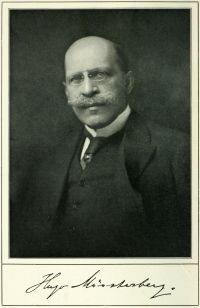
Portrait of Hugo Münsterberg Hugo Münsterberg Psychology and Social Sanity

But shame upon him who wants to educate youth toward the view that man as an animal is the true man! If we educate at all, we educate in the service of culture and civilization. All building up of the youthful mind is itself service to human progress. But this human progress is not a mere growth of the animal race. It has its total meaning in the understanding of man as a soul, determined by purposes and ideals. Not the laws of physiology, but the demands of logic, ethics, æsthetics, and religion control the man who makes history and who serves civilization.
Source: Gutenberg

Portrait of Hugo Münsterberg Hugo Münsterberg Psychology and Social Sanity

If society has the wish to force Sylvia to a decision in the opposite direction, only one way is open: to make the belief in the sacred value of virtue so deep and powerful that any mere reasoning and calculation loses its strength. But that is possible only through an education which relies on the instinctive respect and mystical belief. Only a policy of silence could have saved Sylvia, because that alone would have implanted in her mind an ineffable idea of unknown horrors which would await her when she broke the sacred ring of chastity.
Source: Gutenberg

Portrait of Hugo Münsterberg Hugo Münsterberg Psychology and Social Sanity

In the midst of the panic or in the midst of the heroic enthusiasm no one has kept his own characteristic mental features. The individual no longer judges for himself; he is carried away, his own heart reverberates with the feelings of the whole crowd. The mass consciousness is not an adding up, a mere summation, of the individual minds, but the creation of something entirely new. Such a crowd may be pushed into any paths, chance leaders may use or misuse its increased suggestibility for any ends. No one can foresee whether this heaping up of men will bring good or bad results.
Source: Gutenberg

Get perspective with Kwize: daily news enlightened by great literature