“ The railway termini on the north side of London have been kept as remote as Eastry had kept the railway-station from Wimblehurst, they stop on the very outskirts of the estates, but from the south, the South Eastern railway had butted its great stupid rusty iron head of Charing Cross station, that great head that came smashing down in 1905—clean across the river, between Somerset House and Whitehall. The south side had no protecting estate. ”
Charing Cross railway station
Definition and stakes
Quotes about “Charing Cross railway station”
Charles Francis Adams, Notes on Railroad Accidents
“ On one single exceptional occasion 1,111 trains, carrying 145,000 persons, were reported as entering and leaving this station in the space of eighteen hours, being rather more than a train a minute. Indeed it may well be questioned whether the world anywhere else furnishes an illustration so apt and dramatic of the great mechanical achievements of recent times as that to be seen during the busy hours of any week-day from the signal and interlocking galleries which span the tracks as they enter the Charing Cross or Cannon street stations in London. ”
Baron Godfrey Rathbone Benson Charnwood, Tracks in the snow (1906)
“ I arrived at Charing Cross station in good time for the night train, and found my luggage already there and registered, and my ticket taken. Our tickets taken, rather, for, protest as I might, I was escorted by Callaghan, indeed nursed (and I needed it) the whole way to Florence, and to the villa where my wife was staying. One item remains untold to complete for the present the account of the debt which I owe him. We had hardly left Charing Cross when his quick wits arrived at precisely that explanation of the telegram which in happy fact was true ”
William Dean Howells,
London Films
“ It is only an instance of the constant futility of the restoration which, in a world so violent or merely wearing as ours, must still go on, and give us dead corpses of the past instead of living images. Fortunately it cannot take from Charing Cross its preeminence among the London railway stations, which is chiefly due to its place in the busy heart of the town, and to that certain openness of aspect, which sometimes, as with the space at Hyde Park Corner, does the effect of sunniness in London. ”
Nathaniel Hawthorne,
Passages from the English Notebooks…
“ The streets that led from the station were poor and commonplace; and, indeed, a railway seems to have the effect of making its own vicinity mean. We noticed nothing remarkable until we got to the marketplace, in the centre of which there is a cross, doubtless of great antiquity, though it is in too good condition not to have been recently repaired. It consists of an upright pillar, with a pedestal of half a dozen stone steps, which are worn hollow by the many feet that have scraped their hobnailed shoes upon them. ”
A. P. Herbert,
The House by the River
“ Stooping suddenly, he saw the familiar letters of Stamford Brook dashing past at an astonishing speed. Surely—surely the train was stopping. The porters' room—the ticket collector—the passenger-shelter—the Safety First pictures—the advertisement of What Ho!—the other name-board of the station—the whole station—shot maddeningly past. The train rushed on to the intolerable remoteness of Turnham Green. Hell! John Egerton uttered an audible groan of vexation. Two non-stop trains running! It was unpardonable. He had not even thought to look at the non-stop labels on the train at Charing Cross. ”
Thomas De Quincey,
The English Mail-Coach and Joan of Arc
“ Thus have perished multiform openings for public expressions of interest, scenical yet natural, in great national tidings,—for revelations of faces and groups that could not offer themselves amongst the fluctuating mobs of a railway station. The gatherings of gazers about a laurelled mail had one centre, and acknowledged one sole interest. But the crowds attending at a railway station have as little unity as running water, and own as many centres as there are separate carriages in the train. ”
W. J. Dawson, The Quest of the Simple Life
“ One would suppose by the grudging way in which extra trains are put on to meet the needs of an increased population, that the railway company was a beneficent association, granting favours, instead of a trading concern in search of new business. The only real remedy for this kind of evil is that all the means of locomotion within a twenty-five miles radius of Charing Cross should be in the hands of one central authority. If a County Council is capable of superintending a tramway system, it should also be capable of superintending the suburban railway system for the public good. ”
Ian Hay, The Last Million: How They Invaded France…
“ The train usually waited two or three minutes in each station (instead of ten seconds as now) , and it required a full hour to travel from King’s Cross to Charing Cross. It was impossible to see to read a newspaper, so that passengers, to pass the time, used to rob, assault, and occasionally murder one another. With the coming of electric traction the old Underground was cleaned up and refurnished. At the same time, the Tubes were constructed away down in the [xxi] London clay, where there could be no interference from oozy gravel, or gas mains, or sewers. ”
Samuel Smiles, The Life of George Stephenson and of his Son Robert Stephenson
“ And thus, when a train starts on a journey of it may be hundreds of miles, it is signaled on from station to station, and "lives along the line," until at length it reaches its destination, and the last signal of "train in" is given. By this means an immense number of trains can be worked with regularity and safety. On the Southeastern Railway, where the system has been brought to a state of high efficiency, it is no unusual thing during Easter week to send 570,000 passengers through the London Bridge Station alone; and on some days as many as 1200 trains a day. ”
Isambard Brunel, The life of Isambard Kingdom Brunel…
“ In this respect public feeling has greatly changed, for now no railway is thought complete which has not a terminus in the heart of London; and it is considered an advantage for houses to be within easy reach of a railway station ”
David Ross Locke,
Nasby in Exile
“ The publics are required to be closed and they are closed. There are no side-doors, as in New York—there is no selling on the sly—they are closed. The only exception is at the railroad stations. The refreshment bars there are permitted to be kept open as long as trains arrive or depart, for the British Government recognizes the necessity of an Englishman having his grog till the prescribed hour for his getting into his bed. The thirsty soul who pants for beer after twelve goes to Charing Cross station, and buys a ticket to the first station out, which is “tuppence ha’penny,” or five cents. ”
Bradshaw's Monthly Railway and Steam Navigation Guide… (1843)
“ First. Mixed. Depart from. Mix. Mix. Stop. First. Mix. Mix. First. Mix. Mix. Mix. Mail. goods goods 1 Cls 1 Cls 2 Cls 3 Cls 0 w:Gosport railway station 1 35 . . . . 6 30 8 30 10 30 . . 12 30 2 30 . . 5 30 . ”
“ Lose time in the customary manner, and allow the train to arrive at the stated station half an hour late. Permit the passengers to descend and to enter the refreshment-rooms. The moment they are served, drive them back hurriedly into the carriages with the threat that if they are not immediately seated in their places they will be left behind. When the passengers are once more in their compartments, the carriage-doors should be securely locked, and the train can then remain waiting beside the platform for three-quarters of an hour. ”
“ Well, you run up it as fast as ever you can, and when you get to the top you will see the railway station right in front of you, and all you have to do is to ask if the train is in. There's only one train in and one train out at a little railway station like ours, so you can't miss your way. You will have to ask a porter, or any man you see, to show you the platform where the trains come in, and there you are. ”
baron de E. Mandat-Grancey, Paddy at Home ("Chez Paddy")
“ Thompson had appointed to meet me this morning in the Limerick station, from which we were to start together for his home at Shaunganeen, but as he was coming from the south, and I from Castle Connell, our trains did not fit in, and I had to wait nearly three-quarters of an hour. What can be done in a railway station, unless one dreams? ”
Various, Watson's Magazine, Vol. IV, No…
“ If they had to spend money providing accommodations for passengers, such “lawyers” as Hamp McWhorter and Tom Felder might lose fat corporation fees.No indeed; you couldn’t pass a bill requiring the railroads to treat our wives and daughters decently at the stations where they have to wait for trains. It would cost too much.Yonder sits an elderly lady on a pile of cross-ties. She is sick. She has been brought to the station to take an early train to the city where a specialist can be consulted about her case. It is cold. A heavy fog almost as bad as a drizzle of rain, hangs in the air. ”
Robert Lynd, The Pleasures of Ignorance
“ As a rule, however, nobody looks as if he liked being in a railway station or would stop there if he could go anywhere else. I trust the Ministry of Reconstruction will see to it that the railway stations of the country are rebuilt and vivified. One does not really wish to stop at any station at all except one's own station. ”
Various, Punch or the London Charivari, October 10…
“ Those who arrive early at the meet in the morning (but, as I have hinted, I am not one of these) stroll about the platform, I am told, talking of the rare old times when the 8.52 used to be the 8.51, pulling out their watches every now and then and saying to the station-master, "She's twenty-five seconds late," for all season ticket-holders have special permission from the railway company to put trains into the feminine gender. ”
Samuel Smiles, The Life of George Stephenson and of his Son Robert Stephenson
“ On the Metropolitan Line, 667 trains pass a given point in one direction or the other during the eighteen hours of the working day, or an average of 36 trains an hour. At the Cannon-street Station of the Southeastern Railway, 527 trains pass in and out daily, many of them crossing each others' tracks under the protection of the station signals. Forty-five trains run in and out between 9 and 10 A.M., and an equal number between 4 and 5 P.M. Again, at the Clapham Junction, near London, about 700 trains pass or stop daily ”
Charles L. Graves, Mr. Punch's History of Modern England…
“ Lord John Russell is welcome to them, if he likes.Every passenger in the second or third class is to be allowed to carry a dark lantern, or a penny candle, or a safety lamp, into the train with him, as the directors have kept the public in the dark quite long enough.No train is to travel slower than an omnibus, let the excursion be ever so cheap, or the occasion ever so joyful.Cattle are to be separated from the passengers as much as possible, as it has been found, from experiments, that men and oxen do not mix sociably together.No stoppage at a railway station is to exceed half an hour. ”
Henry Billings Brown,
Ex parte Lennon (166 U.S. 548)…
“ It is not necessary for us to decide whether an engineer may suddenly and without notice quit the service of a railway company at an intermediate station or between stations, though cases may be easily imagined where a sudden abandonment of a train load of passengers in an unfrequented spot might imperil their safety, and even their lives. ”
Various, Punch, or the London Charivari…
“ There were several people in the carriage, and they were talking about what they had done during the railway strike last year, and what they would do if such a thing happened again. I said I should like to be a station-master if possible, because they had top-hats and grew such beautiful flowers. Only four or five trains seem to stop at our station during the day, and if there was a strike I suppose the number would be reduced to one or two. And I thought it would be rather nice to spend the day wearing a top-hat and watering the nasturtiums in the little rock-gardens behind the platform. ”
Samuel Smiles, The Life of George Stephenson and of his Son Robert Stephenson
“ The remarkable safety with which railway traffic is on the whole conducted, is due to constant watchfulness and highly-applied skill. The men who work the railways are for the most part the picked men of the country, and every railway station may be regarded as a practical school of industry, attention, and punctuality. ”
William Eleroy Curtis,
Around the Black Sea
“ Inquiry disclosed the caution of the railway managers. When a train arrives at a station the conductor notifies the man in charge of the station ahead, and also the chief despatcher wherever he may be. He then waits for orders. The telegraph operator at the next station reports to the train despatcher that the track is clear, and the latter then, and not until then, gives orders for the waiting train to move. They take no chances. On a single track road one train only is given the right of way, regardless of side tracks, and everything else is held up until it is reported at the next station. ”
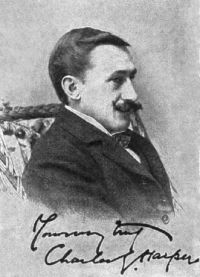
Charles G. Harper,
The Hastings Road and the "Happy Springs of Tunbridge"
“ No railway company builds a large station for the express purpose of serving one farmhouse, and this is simply another instance24 of that intelligent anticipation of events for which railway companies are now showing an unwonted aptitude. Time was when the companies would tardily provide station accommodation ten years or so after the appearance of a thronged suburb, and then only after being memorialised to do so ”
A. K. Astbury, British Railways (1951)
“ It is the busiest railway junction in the worid. More than two thousand five hundred trains pass through here every twenty-four hours – that is an average of two a minute all through the day and night. Actually, at the peak period, there is a train passing about every twenty seconds, and it has been worked out that about two thousand passengers ride through the station every minute during the morning and evening peak periods. ”
A. Fraser Robertson, The Boyhood of Great Inventors
“ GEORGE STEPHENSON. If a town, or even a village, is of any importance nowadays it is sure to have within it or alongside it a railway station, a place that brings it into touch with the great outside world. Some seventy-five years ago there were no railways or railway-stations in Great Britain, or anywhere else, and people were content to post or coach along roads behind horses. ”
Arthur H. Beavan, Tube, Train, Tram, and Car; or…
“ That the City and South London Railway is most useful and popular is shown by the number of passengers it has carried—some ninety millions since its opening—the returns for last year showing about eighteen millions, over a total route of about seven miles. For the convenience of travellers, it eventually will have subways, connecting its Lombard Street Station with the Bank Station of the Central London Railway, and it already has them from its new London Bridge Station to the London, Brighton, and South Coast Railway. ”
William Hemingway Mills, Railway Construction
“ The island-platform arrangement possesses many advantages for the exchange of passenger traffic. All the platforms are connected and on one level, and passengers, together with their luggage, can be quickly transferred from one train to another. One set of waiting-rooms, refreshment-rooms, etc., are sufficient, and are available for the passengers of all the four trains. A smaller number of station men are required for the work, as the staff can be more concentrated and better utilized than when there are separate platforms on opposite sides of the line. ”
Thomas Hughes,
Tom Brown's School Days
(1911)
“ Those of you who did so with their eyes open have been aware, soon after leaving the Didcot station, of a fine range of chalk hills running parallel with the railway on the left-hand side as you go down and distant some two or three miles, more or less, from the line. The highest point in the range is the White Horse Hill, which you come in front of just before you stop at the Shrivenham station. If you love English scenery, and have a few hours to spare, you can't do better, the next time you pass, than stop at the Farringdon-road or Shrivenham station and make your way to that highest point. ”
Walter Crane,
William Morris to Whistler
“ We fly over narrow streets, and complex webs and networks of railway lines, and thread our way through telegraph and telephone wires, myriad smoking chimney-pots, steaming, throbbing works of all kinds, sky signs, and the wonders of the parti-coloured poster hoardings—which [pg 209] pursue one into the station itself, flaring on the reluctant and jaded sight with ever-increasing importunity and iteration, until one recalls the philosopher who remarked "Strange that the world should need so much pressing to accept such apparently obvious advantages!" ”