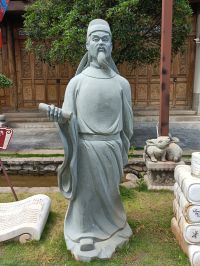
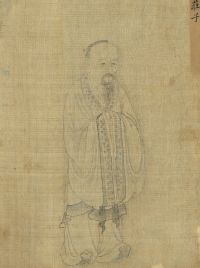
“ Luce instead reads both as historic reference, which seems an odd sentence structure to take given the rest of the text.↑ Emperor Tang Xuán Zōng (玄宗) 's Tiānbǎo (天寶) reign lasted from 742–756. Emperor Xuanzong (唐玄宗) (8 September 685—3 May 762) , also commonly known as Emperor Ming of Tang (唐明皇) , personal name Li Longji (李隆基) , known as Wu Longji (武隆基) from 690—705, was the seventh emperor of the Tang dynasty in China, reigning from 712—756. His reign of 43 years was the longest during the Tang Dynasty. In the early half of his reign he was a diligent and astute ruler. ”
Emperor Xuanzong of Tang
Definition and stakes
Quotes about “Emperor Xuanzong of Tang”
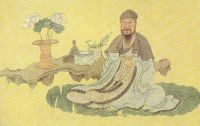
Bai Juyi,
The Song of Everlasting Regret
“ The regret of our parting will last forever and never end. Notes ↑ Han dynasty is a disguise to avoid literary inquisition. It is actually referencing to Tang dynasty. The Emperor Xuanzong of Tang, whose relationship to Yang Guifei brought to mind the Emperor Wu of Han's relationship to his concubine, Consort Li. Bai Juyi would have considered it unpoetic to refer to his subject directly.↑ Bai Juyi is referring to the story of how Emperor Wu of Han met Consort Li. ”
Luo Guanzhong, Translation:Romance of the Three Kingdoms…
“ The empress dowager cursed, "That scoundrel Dong is forcing a mother and her son, and heaven will not protect him! You are helping an evil tyrant, and your whole family shall certainly be wiped out!" Ru was furious, and grabbed the empress dowager with both hands, throwing her straight down the stairs. He ordered his soldiers to hang Consort Tang, and to kill the young emperor by pouring the poisoned wine down the his throat. He then reported back to Dong Zhuo. Zhuo ordered their bodies be buried outside of the city. ”
Richard Garnett, The Twilight of the Gods, and Other Tales
“ In the days of the Tang dynasty China was long happy under the sceptre of a good Emperor, named Sin-Woo. He had overcome the enemies of the land, confirmed the friendship of its allies, augmented the wealth of the rich, and mitigated the wretchedness of the poor. But most especially was he admired and beloved for his persecution of the impious sect of Lao-tsze, which he had well-nigh exterminated. It was but natural that such an Emperor should congratulate himself upon his goodness and worth; yet, as no human bliss is perfect, sorrow could not fail to enter his mind. ”
Bai Juyi,
The Song of Everlasting Regret
“ The soldiers of the imperial guard took this opportunity to proclaim that Yang Guozhong was planning treason along with the Tufan emissaries, and they killed him, along with his son Yang Xuan (楊暄) , the Ladies of Han and Qin, and the official Wei Fangjin. Chancellor Wei Jiansu was also nearly killed, but was spared at the last moment with severe injuries. The soldiers then surrounded Emperor Xuanzong's pavilion, and refused to scatter even after Emperor Xuanzong came out to comfort them and order them to disperse. ”
Various authors, Weird Tales (1950)
“ Wearing such a robe Tang Ling was indeed Emperor of Porcelain, the Son of Heaven. In such raiment would he paint his own portrait on the vase. And so he set to work. If he could achieve his desire, the slender graceful girl would be his. That the object he had set for himself could only be accomplished' by alchemy and a large measure of magic was of little purport. Had not the great Wu Tao-tzu in the golden age of Tang painted with such skill that scores of legends have grown up about him. ”
Henry Yule,
Hobson-Jobson — C
(1903)
“ When the Emperor Wu-ti, in consequence of Chang-Kien's information brought back from Bactria, sent envoys to find the route followed by the traders of Shuh (i.e. Sze-chuen) to India, these envoys were detained by Tang-Kiang, King of Tsen, who objected to their exploring trade-routes through his territory, saying haughtily: "Has the Han a greater dominion than ours?" ”
Bai Juyi,
The Song of Everlasting Regret
“ Mount Emei (峨嵋) , where the emperor was fleeing to, was so named because the peaks of Mount Emei do in fact resemble the feelers of a moth (蛾眉) . The feelers of a moth can also be a metaphor for the long and slender eyebrows of a beautiful woman.↑ On 15 July, 756 Emperor Xuanzong's procession reached Mawei Station (馬嵬驛, in modern Xianyang, Shaanxi) . The imperial guards were not fed and became angry at Yang Guifei's cousin Yang Guozhong. The emperor's general Chen Xuanli (陳玄禮) also believed that Yang Guozhong had provoked this disaster and planned to accuse him ”
Various, Encyclopaedia Britannica, 11th Edition…
“ Some years later, with the help of adherents in Yun-nan and Kwei-chow, he tried to regain the throne, but his army was scattered, and he was taken prisoner and strangled. Gradually opposition to the new régime became weaker and weaker, and the shaved head with the pig-tail—the symbol of Tatar sovereignty—became more and more adopted. In 1651 died Ama Wang, the uncle of Shun-chi, who had acted as regent during his nephew’s minority, and the emperor then assumed the government of the state. ”
H. G. Wells,
A Short History of the World
“ Millions of people indeed were leading orderly, graceful and kindly lives in China during these centuries when the attenuated populations of Europe and Western Asia were living either in hovels, small walled cities or grim robber fortresses. While the mind of the west was black with theological obsessions, the mind of China was open and tolerant and enquiring. One of the earliest monarchs of the Tang dynasty was Tai- tsung, who began to reign in 627, the year of the victory of Heraclius at Nineveh. He received an embassy from Heraclius, who was probably seeking an ally in the rear of Persia. ”
W. A. P. Martin, The Awakening of China
“ In the two preceding reigns the sovereign had always consulted the public good rather than family interest—a form of monarchy which the Chinese call elective, but which has never been followed, save that the Emperor exercises the right of choice among his sons irrespective of primogeniture. The man who bears the odium of having departed from the unselfish policy of Yao and Shun is this same Ta-yü. He left the throne to his son and, as the Chinese say, "made of the empire a family estate." ”
Luo Guanzhong, Translation:Romance of the Three Kingdoms…
“ Xu Chu said, "Give me 50,000 crack troops, and I'll bring back the heads of both Liu Bei and Lü Bu as a gift to Your Excellency." Xun Yu said, "Your Excellency, General Xun is brave, but is not thinking strategically. We've only recently established our capital at Xu. We shouldn't prematurely cause a ruckus by using the military. I have a plan that I call 'two tigers fight each other over food.' Right now, Liu Bei is in charge of Xuzhou and is awaiting instructions from the emperor. You could petition the emperor to officially appoint Bei as the governor of Xuzhou. ”
Philip Lake, Richard Lydekker, Augustine Henry, Herbert A. Giles, George Jamieson, Henry Yule, Friedrich Hirth, Robert K. Douglas, Ignatius V. Chirol, Laurence Binyon, Charles J. Holmes and Lionel Giles, 1911 Encyclopædia Britannica (1911)
“ But even before she sickened and died—of grief, it was officially stated, at the loss of her imperial spouse—the dowager-empresses had solved the question of the succession by placing Kwang-su on the throne, a measure which was not only in itself arbitrary, but also in direct conflict with one of the most sacred of Chinese traditions. The solemn rites of ancestor-worship, incumbent on every Chinaman, and, above all, upon the emperor, can only be properly performed by a member of a younger generation than those whom it is his duty to honour. ”
Various, Encyclopaedia Britannica, 11th Edition…
“ It appears that the anti-Confucian spirit which paved the way towards the final extinction of Wu-wang’s dynasty received its chief nourishment from the Tatar element in the population of the northern and western boundary states. Among these Ts‘in was the most prominent. Having placed itself in the possession of the territories of nearly all of the remaining states, Ts‘in made war against the last shadow emperor, Nan-wang who had attempted to form an alliance against the powerful usurper, with the result that the western part of the Chóu dominion was lost to the aggressor. ”
Frank Owen, The Scarlet Hill — Part II: The Pear Garden (1941)
“ Why the whole brittle pomp and majesty of government might falter. Without the pageantry of Imperial functions, the prestige of China, beyond doubt, would shrink—this in addition to the tawdriness of their ornate costumes and uniforms and the tarnished appearance of their jewels and their medals. They shone by the reflected light of the Emperor. Without him, the Court was without brilliance. An Emperor should not weep tears of blood, he should tower like Tai Shan, the Sacred Mountain before which men of many faiths bow in reverence. ”
Luo Guanzhong, Translation:Romance of the Three Kingdoms…
“ On this day, he led out his soldiers, yelling, "Liu Bei, you country bumpkin! How dare you invade my lands!" Xuande said, "I am acting in accordance with a decree from the son of heaven to go after those who are disloyal to the emperor. Your flagrant challenge of imperial authority is a crime that cannot even be atoned by death!" Ji Ling was outraged. Raising his trident, he charged on his horse toward Liu Bei. Lord Guan shouted at him, "Such a low life as you should not try to flaunt his superiority!" He rode out on his horse and engaged Ji Ling in combat. ”
Luo Guanzhong, Translation:Romance of the Three Kingdoms…
“ Empress Dowager Dong summoned Zhang Rang to her chambers to discuss the matter. She said, "At first, I helped to advance He Jin's younger sister. Now that her son has become emperor, all of the ministers from inside and outside of the palace are her trusted confidents. She has too much power; what should I do?" Rang addressed her, saying, "You could personally take over the running of the government. You could make Prince Xie the emperor, and rule on his behalf from behind a curtain. ”
James Hudson Maurer,
The Far East
(1912)
“ General Li Yuen-heng, the rebel leader at Hankow, who was appointed vice-president of the Republic by President Sun Yat Sen, probably will be chief of the general staff. Provision for Dr. Sun has not yet been made. Today's abdication of the Chinese throne by Fu Yi, the child Emperor, brings to an end the powerful Manchu dynasty which has reigned in China since 1644. The boy ruler has been on the throne since November 14, 1908, when the Emperor Kwang-Su, his uncle, died. His father, prince Chun, was appointed regent and was the chief figure in China for three years. ”
Cao Xueqin,
Dream of the Red Chamber — Book 1
(1891)
“ Forcing herself however again to put on a smile, she clasped old lady Chia's and madame Wang's hands, and could not bring herself to let them go; while she repeatedly impressed upon their minds: that there was no need to give way to any solicitude, and that they should take good care of their healths; that the grace of the present emperor was so vast, that once a month he would grant permission for them to enter the palace and pay her a visit. "It is easy enough for us to see each other," (she said,) "and why should we indulge in any excess of grief? ”
Wolfram Eberhard,
A History of China
“ Everything that was needed, and everything that seemed to be worth trying to get as they grew more civilized, would thus be obtained better and more regularly than by raids or by tedious commercial negotiations. But if China was to be conquered and ruled there must exist a state organization of equal authority to hers; the Hsiung-nu ruler must himself come forward as Son of Heaven and develop a court ceremonial similar to that of a Chinese emperor. Thus the basis of the organization of the Hsiung-nu state lay in its rivalry with the neighbouring China ”
John Stuart Thomson, China Revolutionized
“ He, too, must be willing to resign love. The Ming empress allows the Manchu emperor to escort her up the privileged central stairway reserved for royalty, to the widest and oldest throne of the human race, and for a hushed and glorious moment she sits radiant in the place of power. The shades of her race, in clouds, approach and reproach her. She asks the emperor to return to her the pearl which she gave him at Nanking, when, incognito, he was an accepted suitor. ”
Luo Guanzhong, Translation:Romance of the Three Kingdoms…
“ After discussing the issue with each other, they decided that anyone who did not comply with their demands should be eliminated. Zhao Zhong and Zhang Rang sent people to demand gifts of gold and cloth from the soldiers who fought the Yellow Turbans. Their plan was to petition the emperor to dismiss anyone who did not comply with their demands. Huangfu Song and Zhu Jun refused to give anything, so Zhao Zhong and his faction petitioned the emperor to have both of them removed from their posts. Moreover, the emperor gave the post of general of chariots and cavalry to Zhao Zhong. ”
Various, Encyclopaedia Britannica, 11th Edition…
“ Thereupon the emperor fled, and placed his son, Su-tsung (756-762) , on the throne. This sovereign, with the help of the forces of Khotan, Khokand and Bokhara, of the Uighurs and of some 4000 Arabs sent by the caliph Mansur, completely defeated An Lu-shan. During the following reigns the Tibetans made constant incursions into the western provinces of the empire, and T‘ai-tsung (763-780) purchased the assistance of the Turks against those intruders by giving a Chinese princess as wife to the khan. ”
Wolfram Eberhard,
A history of China., [3d ed. rev…
“ In 383 came the great assault of the Tibetan Fu Chien against [Pg 158] the south. As we know, the defence was carried out more by the methods of diplomacy and intrigue than by military means, and it led to the disaster in the north already described. The successes of the southern state especially strengthened the Hsieh family, whose generals had come to the fore. The emperor (Hsiao Wu Ti, 373-396) , who had come to the throne as a child, played no part in events at any time during his reign. He occupied himself occasionally with Buddhism, and otherwise only with women and wine. ”
Demetrius Charles Boulger, The Life of Yakoob Beg; Athalik Ghazi…
“ The strength of China has been thoroughly demonstrated, [Pg 275] and the vindication of her prestige is complete. Whatever danger there may be to the permanence of China's triumph lies rather from Russia than from the conquered peoples of Tian Shan Nan Lu; nor is there much danger that the Chinese laurels will become faded even before an European foe. Tso Tsung Tang and his lieutenants, Kin Shun, who has since fallen into disgrace,—perhaps he had excited the envy of his superior—and Chang Yao, accomplished a task which would reflect credit on any army and any country. ”
Ritter von Karl Scherzer, Narrative of the Circumnavigation of the Globe by the Austrian Frigate Novara…
“ Never before had the Middle Kingdom sustained such a humiliation. True, during the rule of the former dynasty, Tao-Kwang (Light of Reason) , an end was put to a system that had endured for a thousand years, but conditions such as those that had been imposed by the western nations in the treaties of Tien-Tsin and Pekin, were altogether unheard of in the history of China, and afford convincing proof of its weakness and approaching downfal, the more so, as the late Emperor Hien-fung was a jealous upholder of the old Asiatic doctrines and state craft. ”
Herbert Allen Giles,
China and the Manchus
(1912)
“ It had been built in 1780 after the model of the palace of the Panshen Erdeni at Tashilumbo, in Tibet, when that functionary, the spiritual ruler of Tibet, as opposed to the Dalai Lama, who is the secular ruler, proceeded to Peking to be present on the seventieth anniversary of Chʽien Lung's birthday. Two years later, the aged Emperor, who had, like his grandfather, completed his cycle of sixty years on the throne, abdicated in favour of his son, dying in retirement four years after. ”
Zhuang Zi,
Chuang Tzŭ
(1889)
“ There is no State bigger than the empire. Yao and Shun both got this, yet their descendants have not territory enough to insert an awl's point. Tang and Wu Wang both sat upon the Imperial throne, yet their posterity has been obliterated from the face of the earth. ”
C. Campbell Brown, Children of China
“ On the 2nd December of the same year, the Emperor Hsuan Tung, born in 1906, ascended the Dragon Throne, and so the oldest of Empires came to have the youngest of sovereigns for its ruler, and the world discovered that the greatest child on earth was a little Chinese boy. It is said that the baby emperor, frightened by the sight of so many people in state dress, began to cry when he was set upon the throne. ”