“ Constant action overcomes cold; being still overcomes heat. Purity and stillness give the correct law to all under heaven.46 When the Tao prevails in the world, they send back their swift horses to (draw) the dung-carts. When the Tao is disregarded in the world, the war-horses breed in the border lands.There is no guilt greater than to sanction ambition; no calamity greater than to be discontented with one's lot; no fault greater than the wish to be getting. ”
Laozi
Definition and stakes
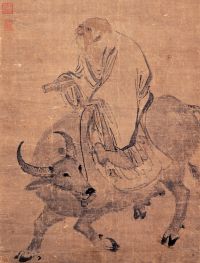
Laozi, a semi-legendary 6th-century BC Chinese philosopher, is traditionally considered the founder of Taoism and the author of the Tao Te Ching, a foundational text that emphasizes harmony with the Tao (the fundamental principle of existence). Although modern scholarship casts doubt on his historical existence and attributes the text to multiple contributors, its teachings—such as wu wei (non-action) and the rejection of ambition—remain central to Taoist philosophy.
Thinkers like Confucius and Zhuangzi engaged with his ideas, offering critiques or elaborations on his paradoxical insights, while later interpreters, ranging from medieval scholars to contemporary philosophers, have debated his impact. The Tao Te Ching’s lasting influence stems from its timeless exploration of balance, humility, and the natural order.
Quotes about “Laozi”
“ Heaven and Earth (under its guidance) unite together and send down the sweet dew, which, without the directions of men, reaches equally everywhere as of its own accord.As soon as it proceeds to action, it has a name. When it once has that name, (men) can know to rest in it. When they know to rest in it, they can be free from all risk of failure and error.The relation of the Tao to all the world is like that of the great rivers and seas to the streams from the valleys.33 He who knows other men is discerning; he who knows himself is intelligent. He who overcomes others is strong ”
“ Therefore they who have the Tao do not like to employ them.The superior man ordinarily considers the left hand the most honourable place, but in time of war the right hand. Those sharp weapons are instruments of evil omen, and not the instruments of the superior man;--he uses them only on the compulsion of necessity. Calm and repose are what he prizes; victory (by force of arms) is to him undesirable. To consider this desirable would be to delight in the slaughter of men; and he who delights in the slaughter of men cannot get his will in the kingdom. ”