“ The boy Boucher, at sturdy twelve, would recall the death of the old king in his lonely last years, and the setting upon the ancient throne of France of the five-year-old child as Louis Quinze—a comely little fellow—with Orleans as Regent. Young François Boucher was to spend his youth and grow up to manhood in a France that lay under the regency of this dissolute, brilliant Orleans. ”
François Boucher
Definition and stakes
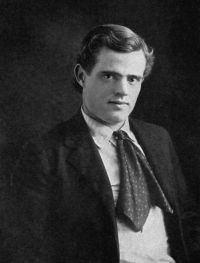
The theme of “François Boucher” has been addressed by authors such as Haldane MacFall, William H. Atherton, Sir J. M. Le Moine, Jennett Humphreys and Jack London. It is often associated with terms like Henry, Beecher, ward, George and John.
Quotes about “François Boucher”
“ The whole of his life long, Boucher gave himself up with equal and passionate devotion to work and to pleasure—working at his easel often twelve hours of his day without losing, to the end when the brush fell from his dead fingers, his blitheness of heart or his generosity of act, and without weakening the pleasure-loving desires of his gadding spirit. ”
“ The rosy carnivals and gay gallantries of his age gave way to the blood-stained romance and fierce tempest of the Revolution. The garrets of the old curiosity-shops received the discarded canvases of the master. His shepherds and shepherdesses were put to rout by the Romans of his pupil, citizen David. The old order was brought into contempt and overthrown. And with it, Boucher’s art, like much that was gracious and charming and good in the evil thing, went down also, and was overwhelmed for a while. ”
“ Poor unfortunate infants! for whom Philosophy could find no happier joy in life than [Pg 77] stripping hemp! Boucher was but an artist. He painted his generation as far as he could see it, and, with all his faults and weaknesses, he never debauched his art with foreign and alien things that had no part in the nation’s life; he painted fair France into his landscapes, not a make-believe land he did not know with preposterous Greek ruins ”
“ Arrived in Paris she sought out the greatest painter of the day, and burst with the shy youth into the studio of the dandified favourite artist of the king’s majesty, Pompadour’s Boucher—large-hearted, generous, much-sinning, world-famed Boucher, then at the very summit of his career—he was at that time living in the Rue Grenelle-Saint-Honoré, which he was about to leave, and in which Fragonard in his old age was destined to end his days. ”
“ Boucher was grown old and ailing; and just as Boucher had been the painter of the France of fashion under the Pompadour, so Fragonard was now to become the mirror of the court, of the theatre, of the drawing-room, of the boudoir, of the age of Du Barry.Finding a ready market for subjects of gallantry, he gave rein to his natural bent, and straightway leaped into the vogue. Pictures were the hobby of the nobility and the rich; and France under the Pompadour, and particularly at this the end of her reign, was madly spendthrift upon its hobbies and fickle fancies. ”
William H. Atherton, Montreal, 1535-1914. Vol. 1. Under the French Régime…
“ Boucher was accompanied from France by Dumont, an officer in charge of 100 soldiers. In Dumont's account of his visit, written in 1663 in the "Relations," he says of Montreal that the inhabitants were the most soldierly in the country—a remark made also by Boucher. Boucher's mission to France helped to persuade the king to take over the colony as a royal possession. When the king's forces came to exterminate the Iroquois the Montreal fighting men did justice to their reputation, as we shall see. ”
“ The youth Boucher, with the quick and astounding gift, that he displayed all through his life, of rapidly making his own what he wanted to acquire, picked up from Lemoyne at once a French way of stating what he desired to state, in a large, broad manner, without having to go through the long years of drudgery to Italian models of style which was then the only schooling for an artist—was therefore enabled to free himself from the equally long years that it would have taken him to rid the Italian style from his artistry. ”
Sir J. M. Le Moine, Picturesque Quebec : a sequel to Quebec past and present
“ M. Bouchard, merchant, M. Panet, N.P. (the father of His Lordship, Bishop B.C. Panet) , as also M. Boucher, Harbor Master of Quebec, " (who was appointed to that post by the Governor, Sir R. S. Milnes, on the recommendation of the Duke of Kent.) ." [89] Boucher had piloted the vessel, having on board the 7th Regiment, (the Duke's) , from Quebec to Halifax.The office in which the Quebec Morning Chronicle has been published since 1847, belonged in 1759 to M. Jean Taché, "President of the Mercantile Body," "an honest, and sensible man," as appears by Mémoirs sur le Canada, (1749-60) . ”
Jennett Humphreys, Dictionary of National Biography… (1886)
“ BOUCHIER, BARTON (1794–1865) , religious writer, born in 1794, was a younger son of the vicar of Epsom, Surrey, the Rev. Jonathan Boucher [q. v.] Barton changed his name from Boucher to Bouchier after 1822. He was educated at Balliol College, Oxford. In 1816 he married Mary, daughter of the Rev. ”
Chauncey Samuel Boucher, The Nullification Controversy in South Carolina… (1916)
“ The light of day shines not upon them; poor, cowardly assassins, they stab only in the dark." [36] Such accusations were based purely upon suspicion. The accusers had to admit that their charges could not be substantiated by positive citations. In May the Mercury had advised caution and careful consideration before action. In June it had approved the suggestion of the Walterboro meeting, that the legislature or a convention be asked to take steps toward such "open resistance" as became a "Sovereign and Independent State" ”
Ralph Stock, The Wet Blanket (1922)
“ IT is difficult to describe Bowker. Outwardly he was sufficiently unremarkable to cheat analysis. Small, quick, busy about being busy, you may find his prototype in any City office. But that is precisely where you would never find Bowker. It is the first peculiarity to be noted in the man that he shunned the environment to which he so obviously belonged. It was ever the "great outside" for him, the home of big men and big things, where, by the way, he looked uncommonly like a black-beetle strayed from its fastness in the light of day. ”
Various, The International Monthly, Volume 4…
“ Boker first appeared as an author at the commencement of the year 1848, when a volume of his poems, under the title of The Lesson of Life, was published in Philadelphia. The publication of a volume was no light ordeal to a young poet whose name was unknown, and who, we believe, had never before seen himself in print. The lack of self-observation and self-criticism, which can only be acquired when the author's thoughts have taken the matter-of-fact garb of type, would of itself be sufficient to obscure much real promise. ”
Library of the World's Best Literature…
“ Boker was a man of leisure by inheritance, and a scholar and author by training and choice. His work is usually deliberate, careful, and polished: the work of a man of solid culture, of much experience and knowledge of the world; of a man of dignity and social position, not a Bohemian. It is thoughtfully planned and carefully executed, but not written through inspiration or prompted by passion. Yet it does not lack vigor, nor are his puppets merely automata. ”
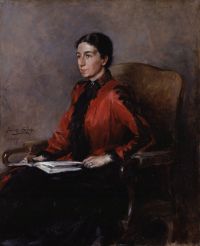 Mrs. Humphry Ward,
Fields of Victory
Mrs. Humphry Ward,
Fields of Victory
“ Pierre Bucher, a gentleman in whom Alsatian patriotism, both before the war and since the Armistice, has found one of its most effective and eloquent representatives. A man of a singularly winning and magnetic presence,—with dark, melancholy eyes, and the look of one in whom the flame of life has burnt in the past with a bitter intensity, fanned by winds of revolt and suffering. Before the war Dr. Bucher was a well-known and popular doctor in Strasbourg, recognised by Alsatian and German alike as a champion of the French spirit and French traditions in the lost provinces. ”
Authors at home: Personal and biographical sketches of well-known American writers (1902)
“ Boker always had a taste for working at what he called his “trade” of producing various articles in metal, on his turning-lathe. In younger days it used to be his boast that he could go into the shop of any machinist, take off his coat, and earn his living as a skilled workman. He still practiced at the bench in his own workshop, at the age of sixty-five. It seems to me that he was unique among American authors, in uniting with the grace and fire of a genuine poet the diversions of a rich society man, the functions of a public official, and a capacity for practical work as a mechanic. ”
Buchanan's Journal of Man, May 1887
“ He believed in the divinity of man and made others believe in it.” In other words, he added much to the sentiment of his hearer, but little to his thought. This was greatness of character and personal power, but not intellectual greatness. Beecher was a great man, but not a great thinker. The great thinker overwhelms his hearers with new and strange thought. The multitude, fixed in habit, reject it all. Clear and dispassionate thinkers feel that they cannot reject it, but it is too new even to them to elicit their enthusiasm. ”
Ralph Stock, The Wet Blanket (1922)
“ He had merely plumbed the fundamental truths that brains will tell even in the wielding of a pickaxe, and that, apart from his own particular genius for successful malingering, there was a knack in most things, which, once mastered, gained the utmost effect with a minimum of effort. Had not the final futility of all human endeavour so impressed him, it is probable that he would have made an excellent inventor of labour-saving devices. The spectacle of a strong man employing the last ounce of his strength filled Bowker with pitying contempt. ”
Various, The International Monthly, Volume 4…
“ In the flush of youth, fortunate in all the relations of life, and with a fame already secured, there is perhaps no American author to whom the future promises more than to Mr. Boker. He has that faithful reverence for his art which makes harmless the breath of praise, more dangerous to the poet than that of censure, and there are yet many years before him ere his mind attains its full scope and stature. That all these promises may be fulfilled, to his own honor and that of American literature, is the earnest hope of Bayard Taylor. ”
Ralph Stock, The Wet Blanket (1922)
“ A large, more or less inarticulate man knows what to do with one of his own species, but how is he to treat a physical worm who in a few well-chosen words flays his adversary alive and holds the carcase up to public ridicule? Bowker came to be known in the toughest camps as a man best left alone. ”
1911 Encyclopædia Britannica (1911)
“ Here he postulates force and mind as emanating from original matter—a materialistic monism. But in other parts of his works he suggests that mind and matter are two different aspects of that which is the basis of all things—a monism which is not necessarily materialistic, and which, in the absence of further explanation, constitutes a confession of failure. Büchner was much less concerned to establish a scientific metaphysic than to protest against the romantic idealism of his predecessors and the theological interpretations of the universe. Nature according to him is purely physical ”
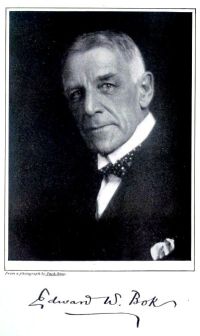 Edward William Bok,
The Americanization of Edward Bok
Edward William Bok,
The Americanization of Edward Bok
“ Edward Bok was in the formative period between boyhood and young manhood when impressions meant lessons, and associations meant ideals. Mr. Beecher never disappointed. The closer one got to him, the greater he became—in striking contrast to most public men, as Edward had already learned.Then, his interests and sympathies were enormously wide. He took in so much! One day Edward was walking past Fulton Market, in New York City, with Mr. Beecher."Never skirt a market," the latter said; "always go through it. It's the next best thing, in the winter, to going South." ”
Authors at home: Personal and biographical sketches of well-known American writers (1902)
“ Boker has, in a measure, been exiled from the companionship of the choicest books in his study; because, in order to obtain uninterrupted quiet, he has been obliged to retire to a small room on the floor above his library, where he is more secure from disturbance. ”
Buchanan's Journal of Man, May 1887
“ Beecher knew supremely well two persons—himself and the man next to him. In interesting the man next to him he interested the multitude. He had in a great degree the same qualities which made Norman McLeod the foremost preacher of his day in the Scotch pulpit. Such a man lives too much on the surface to exhaust himself. He has only to keep within the sphere of commonplace to interest people as long as he lives.... Mr. Beecher lived on the surface of things. ”
Buchanan's Journal of Man, May 1887
“ Beecher never took the position of independence that any great thinker must have occupied. He never moved beyond the sphere of popularity. He never led men but where they were already disposed to go. Upon the great question of the return of the spirit, one of the most important and fundamental of all religious questions, Mr. Beecher was silent. That silence was infidelity to truth, for Mr. Beecher was not ignorant of the truth he concealed. Nor was he faithful to any true ideal of religion. ”
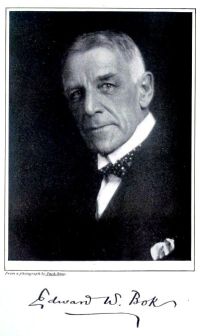 Edward W. Bok,
The Americanization of Edward Bok
(1921)
Edward W. Bok,
The Americanization of Edward Bok
(1921)
“ Beecher ended with “You see, it isn’t always possible to broaden a man.”Mr. Beecher was rarely angry. Once, however, he came near it; yet he was more displeased than angry. Some of his family and Edward had gone to a notable public affair at the Brooklyn Academy of Music, where a box had been placed at Mr. Beecher’s disposal. One member of the family was a very beautiful girl who had brought a girl-friend. Both were attired in full evening décolleté costume. Mr. Beecher came in late from another engagement. ”
J. M. Stone, Studies from Court and Cloister…
“ Interspersed with much able criticism are choice epithets of abuse and reflections on Bucer's personal character, which, although perfectly in accordance with sixteenth century methods of controversy, are quite beside the mark, and certainly not such as to promote peace in any age. ”
Fernand Khnopff, Gerard Brown, Léonce Bénédite, Marion H. Spielmann, Richard Muther and John Van Dyke, 1911 Encyclopædia Britannica (1911)
“ Böcklin has no ancestor in the history of art; no stroke of his brush reminds us of a leader. No one can think of tracing him back to the Academy of Düsseldorf, to Lessing, or Schorner, as his first teacher. Even less can he be called an imitator of the old masters. His works are the result of nature in her different aspects; they have not their origin in literary or historical suggestion. The catalogue of his conceptions, of landscape in varying moods, is inexhaustible. But landscape does not suffice to express his resources. ”
George H. Boker, Representative Plays by American Dramatists…
“ Boker's enthusiasm for Turkish scenery was unbounded, but his difficulties as a diplomat were due to his ignorance of the tongue, and his distrust of interpreters. But by the time his Government was ready to transfer him to another post—that of Minister to Russia (January 3, 1875) —he was heartily sick of his wrangling with the Crescent, and glad, as he wrote Leland, "to shake the dust of this dismal old city from my shoes, and prepare my toes for a freezing at St. Petersburg." ”
Various, The Catholic World, Vol. 19, April 1874‐September 1874
“ Büchner, as with many others of the same ilk, science is a mere pretext. His real object is to attack God's existence, a future life, human liberty, and all those truths which underlie sound philosophy, morality, and religious belief. A work so well calculated to do harm, and which has already infected with its poison a numerous class of readers, needs refutation, and we will engage in the unpleasant task. We hope we shall be able to show that Dr. Büchner's Force and Matter, all its pretensions notwithstanding, is, in a philosophical point of view, a complete failure. ”
Aleksandr Herzen, The Memoirs of Alexander Herzen… (1923)
“ Provo. Among the books in our cellar I unearthed a history of the period, written by a royalist; it was so unfair that, even at fourteen, I could not believe it. I had chanced to hear old Bouchot say that he was in Paris during the Revolution; and I was very anxious to question him. But Bouchot was a surly, taciturn man, with spectacles over a large nose; he never indulged in any needless conversation with me: he conjugated French verbs, dictated examples, scolded me, and then took his departure, leaning on his thick knotted stick. ”