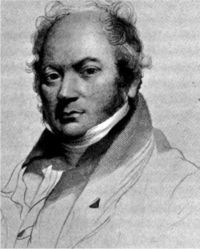
Ludwig Büchner

Definition and stakes

Various Encyclopaedia Britannica, 11th Edition…

BUCHHOLZ, a town of Germany, in the kingdom of Saxony, 1700 ft. above the sea, on the Sehma, 18 m. S. by E. of Chemnitz by rail. Pop. (1905) 9307. It has a Gothic Evangelical church and monuments of Frederick the Wise of Saxony, and Bismarck. There is a school for instruction in lace-making, an industry dating from 1589, which still forms the chief employment of the inhabitants.
BÜCHNER, FRIEDRICH KARL CHRISTIAN LUDWIG (1824-1899) , German philosopher and physician, was born at Darmstadt. He studied at Giessen, Strassburg, Würzburg and Vienna.
Source: Gutenberg

1911 Encyclopædia Britannica (1911)

Here he postulates force and mind as emanating from original matter—a materialistic monism. But in other parts of his works he suggests that mind and matter are two different aspects of that which is the basis of all things—a monism which is not necessarily materialistic, and which, in the absence of further explanation, constitutes a confession of failure. Büchner was much less concerned to establish a scientific metaphysic than to protest against the romantic idealism of his predecessors and the theological interpretations of the universe. Nature according to him is purely physical
Source: Wikisource

Various The Catholic World, Vol. 19, April 1874‐September 1874

Büchner, as with many others of the same ilk, science is a mere pretext. His real object is to attack God's existence, a future life, human liberty, and all those truths which underlie sound philosophy, morality, and religious belief. A work so well calculated to do harm, and which has already infected with its poison a numerous class of readers, needs refutation, and we will engage in the unpleasant task. We hope we shall be able to show that Dr. Büchner's Force and Matter, all its pretensions notwithstanding, is, in a philosophical point of view, a complete failure.
Source: Gutenberg

Get perspective with Kwize: daily news enlightened by great literature