“ This first Hôtel de Ville, however (a handsome Renaissance building) , was unfortunately burned down during the internal struggles of 1871. The present edifice was erected shortly after, in much the same style, but on a larger scale; a walk round the exterior will help to piece out the visitor’s conception of Renaissance Paris. Note here once more the pavillons at the angles, and other features which recall the Louvre. A visit to the interior is quite unnecessary for any save those hardened sight-seers who desire to inspect the decorations and arrangements of purely contemporary buildings. ”
Hôtel de Ville of Paris
Definition and stakes
Quotes about “Hôtel de Ville of Paris”
Francis Hervé, How to Enjoy Paris in 1842
“ The multitude of apartments, the richness of their decorations, and tasteful manner with which they are arranged, are only to be equalled by the careful attention which has been devoted to their distribution with regard to convenience and comfort. As Louis-Philippe justly observed when he recently inspected the exterior of the whole building, that it should no longer be called the Hôtel-de-Ville, but for the future the City Palace, as the splendour within it is not exceeded in any of the other palaces in Paris. ”
Benjamin Ellis Martin, The Stones of Paris in History and Letters…
“ On April 13, 1763, in this building was opened the first public library of the Hôtel de Ville of Paris. One Antoine Moriau had been for many years collecting, in his apartment on this second floor, some 14,000 volumes and 200 manuscripts, all left to the town at his death in 1759. The municipality kept his rooms, and rented additional rooms on this first floor, opening them to the public on Wednesdays and Saturdays. ”
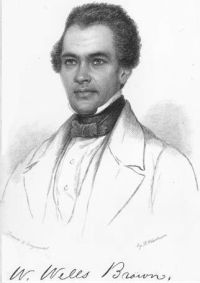
William Wells Brown,
Three Years in Europe — Letter VI.
“ When we take into account the connection of the Hotel de Ville with the different revolutions, we must come to the conclusion, that it is one of the most remarkable buildings in Paris. The room was pointed out where Robespierre held his counsels, and from the windows of which he could look out upon the Place de Greve, where the guillotine stood before its removal to the Place de la Concorde. The room is large, with gilded hangings, splendid old-fashioned chandeliers, and a chimney-piece with fine antiquated carvings, that give it a venerable appearance. ”
Henry-Russell Hitchcock, Architecture (1963)
“ Ranges of four-storey buildings, all carried out in the reticulated vocabulary of his Government buildings of the early thirties in Paris, surround a large sunken plaza; the Hôtel de Ville in the near-Beaux-Arts manner of his Musée des Travaux Publics occupies 317the fourth side. Shops open towards the square under a continuous colonnade. Behind, rising out of small courts, are taller towers occupied by flats; these lend great three-dimensional interest to the formal and absolutely symmetrical layout of this section of the rebuilt quarter. ”
Thomas Frognall Dibdin,
A Bibliographical, Antiquarian and Picturesque Tour in France and Germany…
“ We drove to the Hôtel de Bourbon, an excellent, clean mansion, close to the very façade of the palace, after passing the Hôtel de Ville; and from whence you have an undisturbed view of the broad, wide, direct road to Paris. I bespoke dinner, and prepared to lounge. The palace--of which I purposely declined visiting the interior--reserving Versailles for a future and entire day's gratification--is doubtless an immense fabric--of which the façade just mentioned is composed of brick, and assumes any thing but a grand and imposing air: merely because it wants simplicity and uniformity of design. ”
Benjamin Ellis Martin, The Stones of Paris in History and Letters…
“ We forget its horrid memories in the sight of the new Hôtel de Ville, of no memories, good or bad, to dash our delight in this most nearly perfect of modern structures; perfect in design, execution, and material, a consummate scheme carried out to the last exquisite detail by architects, sculptors, and decorators, all masters of their crafts.Our direct road takes us through the Halles, their huge iron and glass structures the lineal descendants of those heavy stone Halles, started in the twelfth century here in the fields, when the small market on the island no longer sufficed. ”
Thomas Frognall Dibdin,
A Bibliographical, Antiquarian and Picturesque Tour in France and Germany…
“ The HÔTEL DE VILLE, near the Place de Grève, is rather in the character of the more ancient buildings in France: it is exceedingly picturesque, and presents a noble façade. Being situated amidst the older streets of Paris, nothing can harmonise better with the surrounding objects. Compared with the metropolis, on its present extended scale, it is hardly of sufficient importance for the consequence usually attached to this kind of building ”
1911 Encyclopædia Britannica (1911)
“ The Hôtel de Ville in Paris built in the 16th century was burnt by the Commune in 1871 and has since been rebuilt on an extended site, the central portion of the main front being a reproduction of the old design. There is only one town hall in a French town, those erected for the mayors of the different arrondissements in Paris being called mairies. ”
H. E. Noyes, Seventeen Years in Paris: A Chaplain's Story
“ In February, 1906, we had a visit from the London County Council, most of whom attended the ordinary service in the Embassy Church on February 4th. On Monday (5th) , there was a grand reception at the Hotel de Ville. This magnificent structure, erected on the site of the old historic building, is well worth a visit. The decorations and pictures are among the most beautiful in Paris, and when it is lit up and specially decorated with flags, etc., as it was on this occasion, presents a striking scene. ”
Francis Hervé, How to Enjoy Paris in 1842
“ We now arrive at the Hôtel-de-Ville, Place de Grève; the first stone of this interesting and venerable pile was laid in 1533, but was not completely finished until 1606, in the reign of Henry IV. The style of architecture is that which the French call La Renaissance des Arts, it is rich, rather heavy, and has an antique appearance; it is exactly according to the taste which prevailed in the 16th century, and was brought into vogue by Italian architects. ”
Jetta Sophia Wolff, Historic Paris
“ Every house has some feature of old-time interest. Beneath No. 56 there is a Gothic cellar, once, tradition says, a chapel founded by Blanche de France, grand-daughter of Philippe-le-Bel, who died in 1358. At No. 39 we see the narrowest street in Paris, Rue du Paon Blanc, erewhile known as the “descente à la rivière.” Nos. 8-2 is the venerable hôtel de Sens (see p. 117) .In Rue Geoffroy l’Asnier, between Rue de l’Hôtel de Ville and Rue François-Miron, thirteenth century, we find among many other vestiges of old times the fine seventeenth-century door of hôtel Chalons at No. ”
Guy Wetmore Carryl,
Zut, and Other Parisians
“ These two great luminaries of the Parisian demi-monde, blazing crimson with mutual jealousy, followed, for six months of the year, a kind of right-triangular orbit, comprising the restaurant of Armenonville, the race-course of Auteuil, and the Café de Paris, and embracing divers other points of common interest,—the Palais de Glace, of a Sunday afternoon, the tea-room of the Elysée Palace Hotel, the Folies-Marigny, the Salon, and the Horse-Show; and, individually, Gabrielle's apartment on the avenue Kléber, and Thaïs's little hôtel on the rue de la Faisanderie. ”
Jetta Sophia Wolff, Historic Paris
“ Most of the ancient dwellings have been replaced by modern constructions. Where the General Post Office now stands, extending down Rue du Louvre, the comte de Flandre had a fine mansion in the thirteenth century. Destroyed in 1543, it was replaced by another fine hôtel, which became the Paris post office in 1757, rebuilt in 1880. ”
Jetta Sophia Wolff, Historic Paris
“ The builders of les jours d’antan loved their craft; every single house gave scope for some artistic trait. The roofs offered a fine field for architectural ingenuity: wonderfully planned windows, chimneys, balconies, gables are to be seen on the roofs often in most unexpected corners, in every part of the Vieux Paris. Look up!—I cannot urge this too strongly. And within every old hôtel—the French term for private house or mansion—examine each staircase. In the erection of a staircase the architect of past ages found grand scope for graceful lines, and exquisite workmanship. ”
Blanchard Jerrold, The Cockaynes in Paris; Or, 'Gone abroad'
“ So the foreigners no longer make their way direct to the Palais Royal now, on the morrow of their arrival in Paris. If they be at the Louvre, they bend westward along the Rue de Rivoli, and by the Rue de la Paix, to the brilliant boulevards. If they be in the Grand Hôtel, they issue at once upon these famous boulevards, and the ladies are in a [Pg 49] feminine paradise at once. Why, exactly opposite to the Grand Hôtel is Rudolphi's remarkable shop, packed artistically with his works of art—ay, and of the most finished and cunning art—in oxidized silver. ”
“ The square, dome-crowned building opposite you to the left is the modern Tribunal de Commerce; beyond it leftward lie the Marché-aux-Fleurs and the long line of the Hôtel-Dieu, above which rise the towers and spire of Notre-Dame. In front, to the right, the vast block of buildings broken by towers forms part of the Palais de Justice, the ancient Palace of the French kings, begun by Hugues Capet. ”
Various, The Catholic World, Vol. 16, October 1872-March 1873
“ There is a shocking tradition, currently reported, but not positively confirmed, that the architect of the beautiful tower hung himself on its completion, because he had not placed it exactly in the centre of the façade; which certainly did not remedy the evil, as putting himself out of the world did not put the tower in the right place.The first story of the Hôtel de Ville contains a gallery in which are magnificent full-length portraits of Philippe le Beau, Charles V., Philip II., Albert and Isabella, and other dignitaries ”
Eugène Sue,
The Mysteries of Paris, illustrated with etchings…
“ Germain, which the space employed, and, as it were, lost, make so vast. A modern house might, with ease, be contained in the limits devoted to the staircase of one of these palaces, and a whole quarter might be built in the extent they occupy.About nine o'clock in the evening of this day the two vast folding-doors of this hôtel opened on the arrival of a magnificent chariot, which, after having taken a dashing turn in the spacious courtyard, stopped before the large covered flight of steps which led to the first antechamber. ”
Eleanor Hoyt Brainerd,
In Vanity Fair: A Tale of Frocks and Femininity
“ The Hôtel de Paris is the public dining-place par excellence, the best vantage-ground from which to watch the passing show, but it is no easy matter to secure a table at the Hôtel de Paris during the height of the season. ”
William Wells Brown,
Three Years in Europe — Letter VI.
“ All Paris appeared to be on the Boulevards, and looking as if the great end of this life was enjoyment. Anxious to see as much as possible of Paris in the limited time I had to stay in it, I hired a cab yesterday morning and commenced with the Hotel des Invalids, a magnificent building, within a few minutes' walk of the National Assembly. On each side of the entrance gate are figures representing nations conquered by Louis XIV., with colossal statues of Mars and Minerva. The dome on the edifice is the loftiest in Paris—the height from the ground being 323 feet. ”
Francis William Blagdon, Paris as It Was and as It Is
“ Before the revolution, Paris contained 46 parish churches, and 20 others answering the same purpose, 11 abbeys, and 133 monasteries or convents of men and women, 13 colleges, 15 public seminaries, and 26 hospitals. To these must be added the three royal habitations, the Louvre, the Tuileries, and the Luxembourg, also the Hôtel des Invalides, the Palais Royal, the Palais Bourbon, and a great number of magnificent hotels, inhabited by titled or wealthy persons. ”
Francis William Blagdon, Paris as It Was and as It Is
“ Since the revolution, their price is nearly doubled, and is extremely high in the most fashionable parts of the town, such as the Chaussée d'Antin, the Rue de la Loi, the Rue de la Concorde, &c. For strangers that know not in Paris any friend who will take the trouble to seek for them suitable apartments, the only way to procure good accommodation is to alight at a ready-furnished hotel, and there hire rooms by the day till they can look about them, and please themselves. ”
Jetta Sophia Wolff, Historic Paris
“ At No. 5 we see a hook which served of yore to hold the chain stretched across the street to close it. Molière lived there in 1645. Rabelais died there. HÔTEL DE SENSCrossing Rue St-Paul we come to Rue des Lions, recalling the royal menagerie once there. Fine old mansions lie along its whole length. At No. 10 we find a beautiful staircase; another at No. 12, dating from the reign of Louis XIII, and in the courtyard at No. 3 we see an ancient fountain. At No. 14 there was till recent times the fountain “du regard des lions.” No. 17 formed part of l’hôtel Vieuville. ”
Francis Hervé, How to Enjoy Paris in 1842
“ Four galleries with shops encircle the garden of the Palais Royal, three of them are under piazzas opening to the grand area, the fourth, called the Galerie d'Orléans, is enclosed on both sides, and the roof is formed by one immense skylight, whilst the effect of the whole is superb. Over the shops are mostly either coffee-houses or restaurateurs, some of them splendidly decorated and most brilliantly lighted; as may be imagined, this amusing locality forms the lounge of thousands, and no stranger ever comes to Paris without making an early visit to the Palais Royal. ”
John Guy Vassar, Twenty years around the world (1861)
“ At the grand Hotel du Louvre, near the Tuileries, where I lived, I noticed that the [473] number of arrivals kept up pretty well for the season. It is the St. Nicholas of Paris, and a stupendous structure, far exceeding anything of the kind in Europe as a hotel, for its style of architecture, decoration, magnificent marble staircases, luxuriant dining and reading rooms; the former has splendid crystal candelabra and six hundred gas lights at the six o’clock table d’hôte. ”
Nathaniel Hawthorne,
Passages from the French and Italian Notebooks…
“ Nothing really thrives here; man and vegetables have but an artificial life, like flowers stuck in a little mould, but never taking root. I am quite tired of Paris, and long for a home more than ever.MARSEILLES. Hotel d'Angleterre, January 15th.—On Tuesday morning, (12th) we took our departure from the Hotel de Louvre. It is a most excellent and perfectly ordered hotel, and I have not seen a more magnificent hall, in any palace, than the dining-saloon, with its profuse gilding, and its ceiling, painted in compartments ”
James Fenimore Cooper,
A Residence in France
“ The hotel, itself, is one of some pretensions, but his apartments, though quite sufficient for a single person, are not among the best it contains, lying on the street, which is rarely or never the case with the principal rooms. The passage to them communicates with the great staircase, and the door is one of those simple, retired entrances that, in Paris, so frequently open on the abodes of some of the most illustrious men of the age. ”
R. Vashon Rogers, The Law of Hotel Life; or, the Wrongs and Rights of Host and Guest
“ Protoplasm maturing into perfect humanity is as nothing to them. See how, through many gradations, the primeval well has become the well-stocked bar-room of to-day; the antique hovel is now the luxurious Windsor, the resplendent Palace, the Grand Hôtel du Louvre; the uncouth barbarian, who showed to each comer his own proper corner to lie in, has blossomed into the smiling and gentlemanly proprietor or clerk, who greets you as a man and a brother ”
Francis Hervé, How to Enjoy Paris in 1842
“ Henry II often resided in it when it was called Hôtel de Montmorency.Taking the Rue Ste. Croix de la Bretonnerie, we shall find that the first turning in it is the Rue des Billettes, where stand the Lutheran Church; it was built in 1745, and belonged to the Carmelite Friars. In 1808, it was bought by the city of Paris, and given about four years after to the Protestants of the Augsburgh confession. It is a plain neat building. The Duchess of Orléans attends service here when in Paris, which is in German at 2 and in French at 12. ”
Jetta Sophia Wolff, Historic Paris
“ It is known as Tour Montgomery and shelters a ... gas meter! The remains of another tower are seen behind the gymnasium. Before 1908 the last remaining walls of the hôtel du Prévôt still stood in Passage Charlemagne, a picturesque turreted Renaissance bit of “Old Paris” let out in tenements, the last vestiges of the historic mansion where many notable persons, royal and other, had sojourned. Interesting old-time features are seen at Nos. 18, 21, 22, 25; No. 25 underwent restoration in recent years. RUE DU PRÉVÔTIn Rue du Prévôt we see more old-time vestiges. ”