Izdubar

Definition and stakes

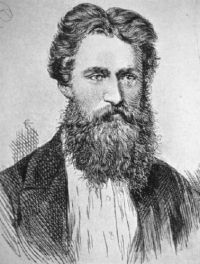
Portrait of George Smith George Smith,  The Chaldean Account of Genesis (1876)

“ Heabani, the friend of Izdubar, is now killed, and Izdubar, mourning his double affliction, abandons his kingdom and wanders into the desert to seek the advice of Hasisadra his ancestor, who had been translated for his piety and now dwelt with the gods.
Izdubar now had a dream, and after this wandered to the region where gigantic composite monsters held and controlled the rising and setting sun, from these learned the road to the region of the blessed, and, passing across a great waste of sand, he arrived at a region where splendid trees were laden with jewels instead of fruit.
”
Source: Wikisource

Portrait of George Smith George Smith,  The Chaldean Account of Genesis (1876)

“ Izdubar, in the Babylonian and Assyrian sculptures, is always represented with a marked physiognomy, and his peculiarities can be seen by noticing the photograph from a Babylonian gem at the beginning of the book, the engraving from an Assyrian sculpture in the last chapter, and the engraving in page 239 showing Izdubar and Heabani struggling with wild animals. In all these cases, and in every other instance where Izdubar is represented, he is indicated as a man with masses of curls over his head and a large curly beard. ”
Source: Wikisource

Portrait of George Smith George Smith,  The Chaldean Account of Genesis

“ It was the special title of Izdubar, who, like his Greek double Herakles, was celebrated for ‘the twelve labours’ he successfully undertook. The title had no doubt been originally given to the fire-god, in whom primitive man sees his most useful servant and workman. The first line of the Epic would consequently have run: “The canals, the toiling hero, the god Izdubar, had seen.” Elsewhere, however, the title of Izdubar is written Zicar, that is, “the male” or “hero.” ”
Source: Gutenberg

Get perspective with Kwize: daily news enlightened by great literature