Jacopo Bellini

Definition and stakes

Evelyn March Phillipps,  The Venetian School of Painting

“ Documents show that Jacopo Bellini was living in Venice in 1437, first near the Piazza, and afterwards in the parish of San Lio. He was a member of S. Giovanni Evangelista, and probably one of the leading artists of the city. His two sons helped him in his great decorative works, and also went with him to Padua, where he painted the Gattamalata Chapel. Their relative position is suggested by a document of 1457, which records that the father received twenty-one ducats for “three figures, done on cloth, put in the Great Hall of the Patriarch,” only two of which were to go to the son. ”
Source: Gutenberg

George Hay,  Bellini

“ Students of Gian Bellini’s life and work can see that only a part of the father’s teaching fell upon fruitful soil. Jacopo Bellini, as we have seen, was a man in whom the early religious spirit that the Renaissance did much to cloud over was of small account, but the pagan revival that found so many adherents in Florence and Venice, towards the close of the fifteenth century, left young Gian Bellini almost untouched. We shall see that the commissions offered by wealthy patrons, who had no love for sacred subjects, were either rejected, or were accepted and not fulfilled. ”
Source: Gutenberg

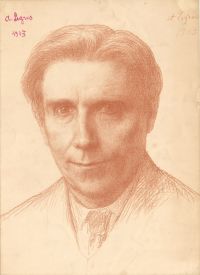
Portrait of Thomas Okey Thomas Okey,  Venice and Its Story

“ But it is to the paintings of Gentile, and Giovanni, sons of Jacopo Bellini, that the traveller will turn again and again with increasing admiration and reverence. In 1421 Jacopo, who had worked under the Umbrian masters in the Ducal Palace, went with Gentile da Fabriano to Florence, and there for several years was his pupil in the very centre of the renaissance of art. In 1430 he set up a workshop in Venice, and about 1450, having moved with his two sons to Padua, came under the powerful influence of Mantegna, who married his daughter Nicolosa. ”
Source: Gutenberg

Get perspective with Kwize: daily news enlightened by great literature