Newtonian mechanics

Definition and stakes

Richard Chace Tolman,  Non-Newtonian Mechanics. The Mass of a Moving Body… (1912)

“ In making such a revision it is desirable to retain as many as possible of the simpler principles of Newtonian mechanics. Some of the consequences have already been presented [2] of a system of mechanics which retains the conservation laws of mass, energy, and momentum, and defines force as the rate of increase of momentum; but to agree with the theory of relativity introduces an idea foreign to Newtonian mechanics by considering that both the mass and velocity of a body are variable. ”
Source: Wikisource

Charles Nordmann,  Einstein and the universe: A popular exposition of the famous theory (1922)

“ Why did Newton, followed by the whole of classical science, believe that gravitation, the fall of bodies, did not belong to the mechanics of which he formulated the laws? Why, in a word, did he regard gravitation as a force or—to use a vaguer but more general term—an action which prevents heavy bodies from changing their positions freely in space? [Pg 103]
Because of the principle of inertia. This principle, the foundation of the whole Newtonian mechanics, may be expressed thus: a body which is not acted upon by any force maintains its velocity and direction unchanged.
”
Source: Gutenberg

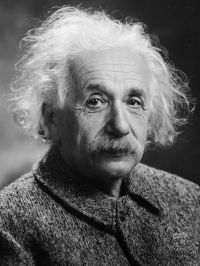
Portrait of Albert Einstein Albert Einstein,  The Principle of Relativity

“ In the mechanics reformed according to the world-postulate, the disharmonies which have disturbed the relations between Newtonian mechanics and modern electrodynamics automatically disappear. I shall now consider the position of the Newtonian law of attraction to this postulate. I will assume that two point-masses m and m1 describe their world-lines; a moving force-vector is exercised by m upon m1, and the expression is just the same as in the case of the electron, only we have to write +mm1 instead -ee1. ”
Source: Gutenberg

Get perspective with Kwize: daily news enlightened by great literature