“ The ordinary English man or woman, unconnected with Oxford, has never heard of them. The undergraduate and the ordinary don has seen some part just now and then, when some enthusiastic guests have had to be taken round the sights.And yet a book of many volumes might be written to tell of the things both rare and exquisite that Oxford hugs most close to her breast. He who cares to look may find them everywhere. There is not a college in all the University that does not possess something precious, either for its intrinsic beauty or for its historical interest. ”
Oxford University
Definition and stakes
Quotes about “Oxford University”
“ To the barbaric mind, ambitious of culture, Oxford is the usual image of the happy reconciliation between research and acceptance. It typifies to an American the union of science and sense—of aspiration and ease. A German university gives a greater impression of science and an English country-house or an Italian villa a greater impression of idle enjoyment; but in these cases, on one side, knowledge is too rugged, and on the other satisfaction is too trivial. Oxford lends sweetness to labour and dignity to leisure. ”
“ We shall have considered Oxford to very little purpose, if it is not plain that the University has been less a home of learning, on the whole, than a microcosm of English intellectual life. At Oxford the men have been thinking what England was to think a few months later, and they have been thinking with the passion and the energy of youth. The impulse to thought has not, perhaps, very often been given by any mind or minds within the college walls; it has come from without—from Italy, from France, from London, from a country vicarage, perhaps, from the voice of a wandering preacher. ”

Nicholas Amhurst,
Terræ-filius: or, the Secret History of the University of Oxford
(1726)
“ To give a just account of the state of the university of Oxford, I must begin where every freshman begins, with admission and matriculation; for it so happens, that the first thing a young man has to do there, is to prostitute his conscience, and enter himself into perjury, at the same time that he enters himself into the university. ”
Augusta Theodosia Drane,
Christian Schools and Scholars
“ It would be little less than audacious to pretend to give any authentic account of the rise of Oxford University, and we may as well at once admit the fact that one of our great national institutions, alive and vigorous in the nineteenth century, dates its beginning from ages whose traditions are purely mythical. ”
George William Erskine Russell,
Sydney Smith
“ Classical literature is the great object at Oxford. Many minds so employed have produced many works, and much fame in that department: but if all liberal arts and sciences useful to human life had been taught there; if some had dedicated themselves to chemistry, some to mathematics, some to experimental philosophy; and if every attainment had been honoured in the mixt ratio of its difficulty and utility; the system of such an University would have been much more valuable, but the splendour of its name something less. ”
“ If Oxford thus, to some extent, moulded to her pattern men who, welcome as they were, were only accidental, surely the college spirit may be trusted to assimilate whatever material the changed conditions of social or of political life furnish to it. The hope of many at Oxford is that there will be a great development and a great change. On one side it will be good if Oxford becomes to a much greater extent not only an all-British, but also a world university; on another side it is to be hoped that far more than ever before men of all classes in England will come to Oxford. ”
Stanley Kuhl Hornbeck,
Oxford and the Rhodes Scholarships
(1907)
“ It is impossible to tell some one else just what Oxford is—but Oxford as it may be is a question with which every Oxford man has to deal for himself. Oxford is a home of ‘influences’; it is all too frequently referred to as the ‘home of lost causes’; what it becomes for each man who trusts himself or is entrusted to its ‘influence’, depends largely upon himself. The University offers each man wide fields for the investment of his time and talent—it offers much for one to learn—but it does not do much choosing for one, nor does it set itself as a task-master. ”
F. Max Müller,
My Autobiography: A Fragment
“ To a man who is taking his M.A. degree, Oxford, as it was when he was a freshman, seems quite a thing of the past. By the public at large no place is supposed to be so conservative, so unchanging, nay, so stubborn in resisting new ideas, as Oxford; and yet people who knew it forty or fifty years ago, like myself, find it now so changed that, when they look back they can hardly believe it is the same place. Even architecturally the streets of the University have changed, and here not always for the better. ”
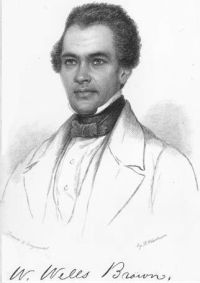
William Wells Brown,
Three Years in Europe: Places I Have Seen and People I Have Met
“ The University, founded by the good King Alfred, still throws its shadow upon the side-walk; and the lapse of ten centuries seems to have made but little impression upon it. Other seats of learning may be entitled to our admiration, but Oxford claims our veneration. Although the lateness of the night compelled me, yet I felt an unwillingness to tear myself from the scene of such surpassing interest. Few places in any country as noted as Oxford is, but what has some distinguished person residing within its precincts. ”
“ We have glanced at the history of Oxford to little purpose if we have not learned that it is an eminently discontented place. There is room in colleges and common rooms for both sorts of discontent—the ignoble, which is the child of vanity and weakness; and the noble, which is the unassuaged thirst for perfection. The present result of the last forty years in Oxford is a discontent which is constantly trying to improve the working, and to widen the intellectual influence, of the University. ”
Herbert Spencer,
Essays on Education and Kindred Subjects
“ The present proposals to widen the influence of Oxford University do not mean, therefore, that the classics, history, and philosophy are to be taught less there, but only that other subjects are to be taught more, and that a greater number and variety of young men will be prepared there for the service of the nation. ”
Various, The Catholic World, Vol. 05, April 1867 to September 1867
“ Allowing the most favorable circumstances to have worked in unison toward assembling a large crowd at Oxford University, we yet believe no one will be likely to uphold the assertion that Oxford University was at that time, or at any time, more densely populated than Paris or Bologna. In the year 1250, we know for a fact Germany was not in possession of one single university, and yet the number of academic scholars in that country was not inconsiderable. ”
Various, Popular Science Monthly (1905)
“ Those who enjoy great influence in the affairs of the university tell us with pride that Oxford not only determines what our best schools shall teach, but has, as a main preoccupation, the education of statesmen, pro-consuls, leaders of the learned professions, and members of parliament! Undoubtedly this claim is well-founded, and its truth is the reason why we can not be content with the maintenance by the university of the compulsory study of Greek and Latin, and the neglect to make the study of nature an integral and predominant part of every man's education. ”
James Wood, The Nuttall Encyclopædia — O
“ Oxford University, Oxford is spoken of as a seat of learning as early as the 11th century. Cloistral schools existed before that. Schools of divinity, law, and topography were founded in the 12th century. In the 13th Dominican and Franciscan scholars raised it to a level only second to Paris, and by the end of the 14th century there were thousands of students in attendance. Oxford responded quickly to the Renaissance, and by the time of the Reformation 13 colleges were founded. ”
F. C. S. Schiller,
Examination v. Research
“ From time to time doubts may well arise as to how far it succeeds in steering the best course. Oxford at present is in the throes of such a discussion. Always critical, she is more critical of herself than of anything less near and dear, and is now enjoying a perfect orgie of self-criticism. But such emotional delights should not lead to oblivion of the fundamental facts of academic life.Oxford has to find a working compromise between four distinct functions which lead up to four distinct ideals (or exaggerations) of a university. ”
“ But there are so many people, to whom the human interest in the fairest city counts for more than all the rest, that it is time to wander among the quadrangles, the halls, the chapels, and the other ancient fabrics that speak of the university life of Oxford. As we pass in through many a massive gateway, tread many a stone-paved path, climb many an old oak stair worn by the feet of many generations, it is strange if no strand of sentiment puts us in touch with some of those who have passed that way before. ”
S. A. Reilly, Our Legal Heritage, King AEthelbert… (2012)
“ Oxford University was granted a charter which put the greater part of the town under control of the Chancellor and scholars. The mayor of Oxford was required to take an oath at his election to maintain the privileges and customs of the university. Roman law and other Regius professorships were founded by the king at Oxford and Cambridge. Teaching of undergraduates was the responsibility of the university rather than of the colleges, though some colleges had live-in teachers as students. Most colleges were exclusively for graduate fellows, though this was beginning to change. ”
Stephen Leacock,
My Discovery of England
“ The excellence of Oxford, then, as I see it, lies in the peculiar vagueness of the organisation of its work. It starts from the assumption that the professor is a really learned man whose sole interest lies in his own sphere: and that a student, or at least the only student with whom the university cares to reckon seriously, is a young man who desires to know. ”
George C. Brodrick,
A history of the University of Oxford
(1900)
“ Seldom in history, and never in the annals of the University, have characters so diverse been grouped together into so brilliant and picturesque a society as that which thronged the good city of Oxford during the Queen’s residence in the autumn and winter of 1643—the last happy interlude of her ill-starred life. ”
J. Wells, The Oxford Degree Ceremony
“ At any rate, it was felt to be, as Evelyn writes, 'comparable to any of this kind of former ages, and doubtless exceeding any of the present, as this University does for colleges, libraries, schools, students and order, all the universities in the world.' We may pardon the enthusiasm of one who was himself an Oxford man, after a day on which 'a world of strangers and other company from all parts of the nation' had been gathered for the Dedication. ”
Some Account of the Oxford University Press…
“ Oxford Books on the Empire Oxford is proud to consider itself as par excellence the Imperial University. The administration of the Empire owes much to Oxford men, as the University in its turn owes much to her sons from overseas. Imperial subjects are an important and growing branch of study at Oxford; and the Press, true to its tradition of building upon the foundations of experience, has in time put together an imposing collection as well of the classics of colonization and administration as of new and original treatises by scholars versed in its theory and practice. ”
Ellwood Patterson Cubberley, The History of Education
“ It is generally acknowledged that both Oxford and the country at large suffer greatly from the absence of a body of learned men devoting their lives to the cultivation of science, and to the direction of academical education. The fact that so few books of profound research emanate from the University of Oxford materially impairs its character as a seat of learning, and consequently its hold on the respect of the nation. ”
Laurence Hutton,
Literary Landmarks of Oxford
(1903)
“ He must be a single man; he may marry a wife. He must be in residence; he may board and lodge wherever he sees fit. He cannot leave Oxford; he need not remain in Oxford. He may be a Tutor, a Lecturer, a Professor; he may be a Fellow and nothing more. He must be a Graduate of the college in which he holds his Fellowship; he may be a Graduate of one college and a Fellow of another. He may be an Honorary Fellow, with no Oxford degree at all. But he must, in most cases, have taken at least the degree of Bachelor of Arts, or of a Student in the Civil Law, from some College or University. ”
Walter Alexander Raleigh,
Six Essays on Johnson
(1910)
“ Like a disdainful beauty, the University of Oxford has often been careless of those who love and serve her best. Her native fascination keeps her truest lovers her slaves, and leaves her free to bestow her kindness on those who will not swell her following till they are assured of her favour. ”
George C. Brodrick,
A history of the University of Oxford
(1900)
“ When instruction in the sciences was only to be obtained from the lips of a living teacher, and when schools hardly existed elsewhere, except in connection with cathedrals or monasteries, the lecture rooms of Oxford were thronged with students of all ages, and represented almost the entire machinery of national education. When the Church ruled supreme over the wide realm of thought, and learning was the monopoly of ‘clerics,’ the great ecclesiastical stronghold of Oxford far surpassed the metropolis itself as an intellectual centre. ”
Cecil Headlam, Oxford and Its Story
“ But one school or one lecturer does not make a University.It has, however, been held, that just as the University of Paris developed from the schools of Notre Dame, so the University of Oxford grew out of the monastic schools of S. Frideswide’s. Such a growth would have been natural. But if this had been the real origin of the University, it may be regarded as certain that the members of it would have been subjected to some such authority as that exercised by the Chancellor of Notre Dame over the masters and scholars of Paris. ”
George C. Brodrick,
A history of the University of Oxford
(1900)
“ Effect of these reformsOther salutary changes naturally grew out of this comprehensive reform, and far greater progress was made by the University during the thirty years immediately following it than in any previous century of its history. The impulse given to education reacted upon learning and research; Oxford science began once more to command the respect of Europe; the professoriate received an accession of illustrious names; and college tuition, instead of being the mere temporary vocation of fellows waiting for livings, gradually placed itself on the footing of a regular profession. ”
Ellen Thorneycroft Fowler,
Concerning Isabel Carnaby
(1898)
“ At first sight it seems funny that the University of Oxford should have been founded by King Alfred, and enriched by the art and learning of the centuries, merely to serve as a background for one particular graduate ”
John Corbin, An American at Oxford
“ The university clearly recognizes all this. It rigidly requires a man to reside at Oxford a certain definite time before graduation; but how and when he studies and is examined, it leaves to his own free choice. A man reads enough at Oxford to keep in the current of tutorial instruction, and to get on the trail of the books to be wrestled with in vacation. ”
Aspects of Modern Oxford, by a Mere Don
“ It has been said that the function of a University is to criticise; but the proposition is at least equally true that Oxford and Cambridge are continually conjugating the verb in the passive. We--and more especially we who live in Oxford, for the sister University apparently is either more virtuous or more skilful in concealing her peccadilloes from the public eye--enjoy the priceless advantage of possessing innumerable friends whose good nature is equalled by their frankness; and if we do not learn wisdom, that is not because the opportunity is not offered to us. ”
“ School and university—Stourbridge fair—the university in the xiii century—Foundation of endowed scholars—hostels.Both our universities doubtless count a school life of eight centuries at least: but a school life, the activity of teachers and scholars, is not the same thing as a university life. We have already said that Oxford owed its history to the constant communication between it and London, to its accessibility from the capital which made it the frequent resort not only of our kings but, what is more to our purpose, of scholars European and English. ”