“ Some, like the Cathari of Alba and Desenzano, taught with the Paulicians an absolute dualism, affirming that all things created came from two principles, the one essentially good, and the other essentially bad. Two other groups, the Concorrezenses and the Bagolenses, like the ancient Gnostics, held a modified form of dualism; they pretended that the evil spirit had so marred the Creator's work, that matter had become the instrument of evil in the world. Still they agreed with the pronounced dualists in nearly all their doctrines and observances ”
Quotes about “Paulicianism”
 Edward Gibbon,
History of the Decline and Fall of the Roman Empire…
Edward Gibbon,
History of the Decline and Fall of the Roman Empire…
“ A creed thus simple and spiritual was not adapted to the genius of the times; 7 and the rational Christian, who might have been contented with the light yoke and easy burden of Jesus and his apostles, was justly offended, that the Paulicians should dare to violate the unity of God, the first article of natural and revealed religion. Their belief and their trust was in the Father, of Christ, of the human soul, and of the invisible world. ”
 Adolf von Harnack,
History of Dogma, Volume 1
Adolf von Harnack,
History of Dogma, Volume 1
“ But Paulinism especially has had an immeasurable and blessed influence on the whole course of the history of dogma, an influence it could not have had, if the Pauline Epistles had not been received into the canon. Paulinism is a religious and Christocentric doctrine, more inward and more powerful than any other which has ever appeared in the Church. It stands in the clearest opposition to all merely natural moralism, [pg 136] all righteousness of works, all religious ceremonialism, all Christianity without Christ. ”
 Henry Charles Lea,
A History of the Inquisition of the Middle Ages…
Henry Charles Lea,
A History of the Inquisition of the Middle Ages…
“ In all essentials the doctrine of the Paulicians was identical with that of the Albigenses. The simple Dualism of Mazdeism, which regards the universe as the mingled creations of Hormazd and Ahriman, each seeking to neutralize the labors of the other, and carrying on interminable warfare in every detail of life and nature, explains the existence of evil in a manner to enlist man to contribute his assistance to Hormazd in the eternal conflict, by good thoughts, good words, and good deeds. ”
J. H. Kurtz, Church History, Volume 1 (of 3…
“ The Catholics, sneeringly called by them Ῥομαῖοι, gave the name of Paulicians to them because they regarded Paul alone as a true apostle. Even before the rise of the Paulicians, a sect existed in Armenia called Children of the Sun who had mixed up the Zoroastrian worship with Christian elements. They, too, during the 9th and 10th centuries, by reorganization reached a position of more importance, and represented, like the Paulicians, a reformatory opposition to the formal institutions of the Catholic church. A similar attitude was assumed by the Euchites in Thrace during the 11th century. ”
 Edwin Abbott Abbott,
The Kernel and the Husk
(1886)
Edwin Abbott Abbott,
The Kernel and the Husk
(1886)
“ Paul, and this is what you say: "I presume that Natural Christianity, however glad it may be to shelter itself under Pauline authority in the low estimate it sets on miracles, will find it difficult to digest or swallow Pauline theology. The abstruse and artificial doctrines of the imputation of righteousness, justification by faith, and the atonement, must surely stand at the very antipodes of any religion, Christian, or other, that can claim the name of natural." ”
Josef Donat, The Freedom of Science
“ In fact, inclination and will, not objective truth, are the measure and norm of free-thought. This Paulsen again expresses with astonishing candour. According to him, intelligence is after all nothing else than a transformation of the will, this doctrine is rooted in the more modern voluntaristic monism, and is akin to subjectivism. If our cognition itself forms its object, then the real concept of cognition has been lost to us, and in its place we have the will determining the action even of the intellect. ”
 William Alexander,
Expositor's Bible: The Epistles of St…
William Alexander,
Expositor's Bible: The Epistles of St…
“ Paul himself, thirty or forty years before, had contaminated the purity of the faith with inferior elements derived from the contagion of local heresy, or from the infiltration of pagan thought. The Ionian intellect seems to have delighted in imaginative metaphysics; and for [Pg 15] minds undisciplined by true logic or the training of severe science imaginative metaphysics is a dangerous form of mental recreation. The adept becomes the slave of his own formulæ, and drifts into partial insanity by a process which seems to himself to be one of indisputable reasoning. ”
Ernest Northcroft Merrington, The Problem of Personality — Chapter V. Mr… (1916)
“ In a sense, therefore, Pluralism seems to be based on Monism, but the One is without reality, being merely an ideal factor in a real plurality. Pluralism seeks a better unity, the actual result to be arrived at by the process of interaction, the perfection and harmony of a real universe, evolved in the course of Time. In this conception Pantheism and Individualism are transcended. The Many and the One are recognized, but the primacy and reality of the Many are more valid than the abstractions of the One. ”
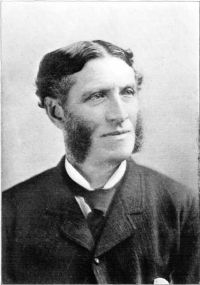 Matthew Arnold,
Culture and Anarchy — Chapter V: Porro Unum est Necessarium
(1882)
Matthew Arnold,
Culture and Anarchy — Chapter V: Porro Unum est Necessarium
(1882)
“ Paul employs, in trying to follow with his analysis of such profound power and originality some of the most delicate, intricate, obscure, and contradictory workings and states of the human spirit, are detached and employed by Puritanism, not in the connected and fluid way in which St Paul employs them, and for which alone words are really meant, but in an isolated, fixed, mechanical way, as if they were talismans ”
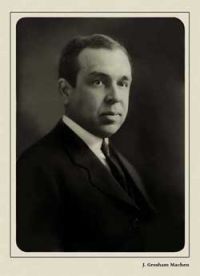 J. Gresham Machen,
The Origin of Paul's Religion
J. Gresham Machen,
The Origin of Paul's Religion
“ Certainly, at any rate, whatever solution may be found for the intricate problem of the Pauline use of the term "flesh," the Pauline pessimism with regard to human nature is totally different from the dualistic pessimism of the Hellenistic age. It is different because it does not make evil reside in matter as such. ”
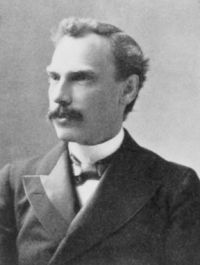 Benjamin Wisner Bacon,
1911 Encyclopædia Britannica, Volume 15…
(1911)
Benjamin Wisner Bacon,
1911 Encyclopædia Britannica, Volume 15…
(1911)
“ Moreover, the author explicitly refers to the apostolic age as already past, and to the fulfilment of the Pauline prediction (1 Tim. iv. 1 sqq.) of the advent of heresy (v. 17 seq.) . The Pauline doctrine of “grace” has been perverted to lasciviousness, as by the heretics whom Polycarp opposes (Ep. Polyc. vii.) , and this doctrine is taught for “hire” (vv. 11, 12, 16; cf. 1 Tim. vi. 5) . The unworthy “shepherds” (v. 12; cf. Ezek. xxxiv. 8; John x. 12 seq.) live at the expense of their flocks, polluting the “love-feasts,” corrupting the true disciples. ”
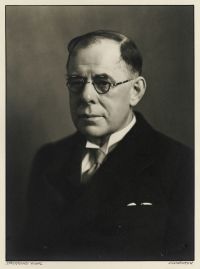 A. E. Taylor,
Elements of metaphysics
(1903)
A. E. Taylor,
Elements of metaphysics
(1903)
“ Again, even if we could accept the pluralist account of the facts, the theory which Pluralism puts forward to account for them is in the end unintelligible. What Pluralism does, consciously or unconsciously, is to separate the unity of the world from its multiplicity. The multiplicity is supposed to be grounded in the ultimate nature of the real things themselves, their unity as a system, if they really are a system, to be imposed upon them from without. ”
Baron Thomas Babington Macaulay Macaulay, Critical, Historical, and Miscellaneous Essays…
“ It is equally unmeaning to say that philosophy refers these events to benevolent general laws of nature. In so far as the laws of nature produce evil, they are clearly not benevolent. They may produce much good. But why is this good mixed with evil? The most subtle and powerful intellects have been labouring for centuries to solve these difficulties. The true solution, we are inclined to think, is that which has been rather suggested, than developed, by Paley and Butler. But there is not one solution which will not apply quite as well to the evils of over population as to any other evil. ”
Henry Giles, Unitarianism Defended
“ And the moment you allow free action to his intelligence and conscience, you inevitably admit the possibilities of error, which are inseparable from the operations of the human mind. To grant that Paul reasons, and be startled at the idea that he may reason incorrectly,—to admit that he speculates, and yet be shocked at the surmise that he may speculate falsely,—to praise his skill in illustration, yet shrink in horror when something less apposite is pointed out, is an obvious inconsistency. ”
J. Gresham Machen,
The Origin of Paul's Religion
“ It seems to him to be an abnormal, an unhealthy thing. To explain its emergence, therefore, in the course of human history he is prone to look for special causes. So he explains the Pauline doctrine of the radical evil of human nature as being due to the piety of a decadent age. ”
A. E. Taylor,
Elements of metaphysics
(1903)
“ The world thus contains minds other than my own, and what makes them other is that the interests and purposes by which their lives are determined are, like my own, unique and incommunicable. Now, Pluralism bids us take the facts, as thus stated, as the model for our conception of the universe. The pattern upon which the pluralist views of Reality are constructed is that of a community consisting of a great number of selves or persons, each with its own unique interests, and each therefore at once internally simple and indivisible and exclusive of all the rest. ”
J. Gresham Machen,
The Origin of Paul's Religion
“ The fundamental difficulty in explaining the origin of Paulinism will never disappear by being ignored; it will never yield to compromises of any kind. It will disappear only when Jesus is recognized as being really what Paul presupposes Him to be and what all the Gospels represent Him as being—the eternal Son of God, come to earth for the redemption of man, now seated once more on the throne of His glory, and working in the hearts of His disciples through His Spirit, as only God can work. ”
 John Stuart Blackie,
Four Phases of Morals: Socrates…
John Stuart Blackie,
Four Phases of Morals: Socrates…
“ But with the most honest purpose to do justice to the moral element of Polytheism, as we may find it exhibited most favourably perhaps in the living pictures of the Homeric poems, it cannot be denied that the obvious deduction from the Polytheistic creed was, in all cases to palliate, in some cases even to justify, vice; and that this deduction was often made we may gather from the familiar fact that the most illogical people even now suddenly become very acute reasoners, the moment it is necessary to defend their prejudices, or to protest against the amendment of their faults. ”
Matthew Arnold,
St. Paul and Protestantism, with an Essay on Puritanism and the Church of England
“ And as the order in which, in any series of ideas, the ideas come, is of great importance to the final result, and as Paul, who did not write scientific treatises, but had always religious edification in direct view, never set out his doctrine with a design of exhibiting it as a scientific whole, we must also find out for ourselves the order in which Paul's ideas naturally stand, and the connexion between one of them and the other, in order to arrive at the real scheme of his teaching, as compared with the schemes exhibited by Puritanism. ”
 John Fiske,
Through Nature to God
John Fiske,
Through Nature to God
“ That there is truth of the most vital sort in the Pauline theory is undeniable; but there are many things that will bear looking at from opposite points of view, for aspects of truth are often to be found on both sides of the shield, and there is a sense in which we may regard the loss of paradise as in itself the beginning of the Rise of Man. ”
 Arthur Drews,
The Witnesses to the Historicity of Jesus…
(1912)
Arthur Drews,
The Witnesses to the Historicity of Jesus…
(1912)
“ Now Paulinism has the closest affinity to Gnosticism, as Holsten, Pfleiderer, Weizsäcker, and others have shown. In both the idea of faith changes into the idea of knowledge; this knowledge is based on divine revelation: the salvation of the soul depends on the recognition of certain facts of revelation. ”
J. Gresham Machen,
The Origin of Paul's Religion
“ At first sight there might seem to be a parallel between the Pauline doctrine of the flesh and the Greek doctrine of the evil of matter, which appears in the Orphic sects, then in Plato and in his successors. But the parallel breaks down upon closer examination. According to Plato, the body is evil because it is material; it is the prison-house of the soul. Nothing could really be more remote from the thought of Paul. According to Paul, the connection of soul and body is entirely normal, and the soul apart from the body is in a condition of nakedness. ”
 John Wesley Powell,
Truth and Error — Chapter XXIV.
(1898)
John Wesley Powell,
Truth and Error — Chapter XXIV.
(1898)
“ The key to the meaning of that which we call ancient philosophy is found in the attempt to discover a unifying principle. Through the centuries this has been the quest of wise men. The seemingly multitudinous properties and qualities of body must be reduced to some unifying principle. As the individual first guesses and then verifies, as already set forth in the chapters on intellection, so the race, at one time and another, guesses, chooses, selects some one property to which all other properties may be reduced as the unifying principle. ”
 Oscar Wilde,
Essays and Lectures
Oscar Wilde,
Essays and Lectures
“ Polybius is the last scientific historian of Greece. The writer who seems fittingly to complete the progress of thought is a writer of biographies only. I will not here touch on Plutarch’s employment of the inductive method as shown in his constant use of inscription and statue, of public document and building and the like, because it involves no new method. It is his attitude towards miracles of which I desire to treat.Plutarch is philosophic enough to see that in the sense of a violation of the laws of nature a miracle is impossible. ”
J. Gresham Machen,
The Origin of Paul's Religion
“ It has been shown that neither the group of Pauline conceptions which centers around the new birth (or, as Paul calls it, the new creation) nor the Pauline teaching about the sacraments was derived from the mystery religions. The third element of Paulinism which is thought to have come from pagan religion is found in the Pauline conception of Christ and of the work of Christ in redemption. This contention is connected especially with the name of Bousset [222] , who is, however, supported in essentials by a considerable number of contemporary scholars. ”
Edward Gibbon,
History of the Decline and Fall of the Roman Empire…
“ The early separation of the Gnostics had preceded the establishment of the Catholic worship; and against the gradual innovations of discipline and doctrine they were as strongly guarded by habit and aversion, as by the silence of St. Paul and the evangelists. The objects which had been transformed by the magic of superstition, appeared to the eyes of the Paulicians in their genuine and naked colors. An image made without hands was the common workmanship of a mortal artist, to whose skill alone the wood and canvas must be indebted for their merit or value. ”
 Origen,
The writings of Origen, Vol. 1…
(1869)
Origen,
The writings of Origen, Vol. 1…
(1869)
“ And why should I repeat and enumerate all the horrors of human misery, from which some have been free, and in which others have been involved, when each one can weigh and consider them for himself? There are also certain invisible powers to which earthly things have been entrusted for administration; and amongst them no small difference must be believed to exist, as is also found to be the case among men. The Apostle Paul indeed intimates that there are certain lower powers, [308] and that among them, in like manner, must undoubtedly be sought a ground of diversity. ”
Frank F. Ellinwood, Oriental Religions and Christianity
“ There is unity. There is one music but many instruments, one body but many members, one spirit but many gifts, one blood but many nations, one Church but many churches. Let Asia and Europe and America and all nations prove this New Dispensation and the true fatherhood of God and the brotherhood of men.'"This remarkable production—so Pauline in style and so far from Paul in doctrine—seems to possess everything except definite and robust conviction. And its limp philosophy was not sufficient to withhold even Chunder Sen himself from the abandonment of his principles not long afterward. ”
 Evelyn Underhill,
The essentials of mysticism
(1920)
Evelyn Underhill,
The essentials of mysticism
(1920)
“ This rich and suggestive conception of the Second Principle, as at once King and Creator of the world of life, and also itself the archetypal world of true values, is the central fact of the Plotinian philosophy. Its apprehension, he says, is beyond ordinary human reason, which is fitted for correspondence with the world of life or soul. It is the function of spiritual intuition; “a faculty which all possess, though few use.” Such communion with the world of supernal reality is possible, because man is potentially an inhabitant of it. ”
