Gravitational acceleration

Definition and stakes

John Knight Fotheringham,  Historical eclipses: being the Halley lecture delivered 17 May 1921 (1921 | noyear)

“ Brown, however, is of opinion that in tables designed for present-day use it is unnecessary to make any addition to that part of, the acceleration which can be computed from gravitational theory, and has preferred to use the gravitational acceleration only, endeavouring to compensate the neglect of the rest of the acceleration by artificial changes in terms which can be determined by observation only. In my opinion the compensation is inadequate, and I venture to predict that the Moon will, subject to fluctuations, move further and further in advance of her computed position as time goes on. ”
Source: Wikisource

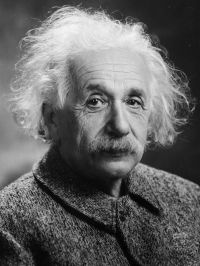
Portrait of Albert Einstein Albert Einstein,  The Meaning of Relativity (1922)

“ It is only when there is numerical equality between the inert and gravitational mass that the acceleration is independent of the nature of the body. Let now be an inertial system. Masses which are sufficiently far from each other and from other bodies are then, with respect to , free from acceleration. We shall also refer these masses to a system of co-ordinates , uniformly accelerated with respect to . Relatively to all the masses have equal and parallel accelerations; with respect to they behave just as if a gravitational field were present and were unaccelerated. ”
Source: Wikisource

Aram D'Abro,  The evolution of scientific thought from Newton to Einstein (1927)

“ Our inability to differentiate between a field of inertial forces generated by acceleration and one of gravitation generated by matter is due solely to a miraculous coincidence, that of the equality of the two masses. Again, when, in the elevator falling in the earth’s gravitational field, we experience no feeling of weight, it is not that the gravitational field has vanished; it is solely that the field of gravity has been counteracted by an equal and opposite field of inertia generated by the elevator’s accelerated motion. ”
Source: Gutenberg

Get perspective with Kwize: daily news enlightened by great literature