“ Get a good specimen of real oak, well coursed with champs or ‘veins,’ and set it up before you where the light will fall best upon it; then, after rubbing down your grounded panel with fine sandpaper, and dusting it carefully, you will put a little ‘scumble’ upon it with your sash-tool, and spread that over equally and thinly with a larger brush until the panel is covered. Take your largest toothed comb, and trail it steadily down the panel from top to bottom, wiping the comb carefully after every passage. ”
Oak paneling
Definition and stakes
Quotes about “oak paneling”
Patrick Matthew,
On Naval Timber and Arboriculture
“ Every carpenter in Scotland knows the extraordinary difference between the durability of Highland oak and oak usually imported from England, for the spokes of wheels. Every extensive timber-dealer is aware of the superior hardness of oak raised in Cumberland and Yorkshire, over that of Monmouthshire and Herefordshire; and such a dealer in selecting trees in the same woods, in any district, will always give the preference to oak of slow growth, and found in cold and clayey soils, and to ash on rocky cliffs, which he knows to be the soils and climates natural to both. ”
Anthony Florian Madinger Willich, Domestic Encyclopædia (1802)
“ The bark of oak, or rather tanner's waste, which has been suffered completely to putrefy, affords an excellent manure for cold, stiff, clay-soils; one load being more efficacious than a double quantity of the richest dung.—If oak-bark be designed for grass-land, it ought to be spread shortly after Michaelmas, that the winter-rains may wash it into the ground: for, if applied in the spring, it will burn the grass, and exhaust, rather than ameliorate the soil, for that season. ”
Henry H. Gibson, American Forest Trees
“ Agricultural implements, balustrades, bar tops, bedsteads, bottoms for wagon beds, bridge approaches and floors, chairs, church pews, cot frames, doors, floors, frames, interior finish, molding, newel posts, pulpits, railing, screens, slack cooperage, stairwork, store fixtures, wagon axles, and other vehicle parts.These uses coincide nearly with those of red oak, and indicate the important position occupied by willow oak in the country’s industries. Those who handle the wood complain that its seasoning qualities are poor, and that care is necessary to bring satisfactory results. ”
H. G. Nicholls, The Forest of Dean: An Historical and Descriptive Account
“ He says that “the sorts of wood or timber delivered to the miners were oak and beech, and none other; chiefly oak in the summer, more pits being sunk in the summer than in the winter, and the keepers having the bark; more beech is allowed in the winter than oak. But oak timber is necessary, and is always allowed, for sinking the pits, and for making what the miners call the gateway, or gangway, from the body of coal to the pit, and also for the gutters in the levels, for draining off the water ”
J. B. Wagner, Seasoning of Wood
“ Structure explains why oak is heavier, stronger, and tougher than pine; why it is harder to saw and plane, and why it is so much more difficult to season without injury. From its less porous structure alone it is evident that a piece of young and thrifty oak is stronger than the porous wood of an old or stunted tree, or that a Georgia or long-leaf pine excels white pine in weight and strength.Keeping especially in mind the arrangement and direction of the fibres of wood, it is clear at once why knots and "cross-grain" interfere with the strength of timber. ”
Vitruvius,
Ten Books on Architecture
(1914)
“ We must also be careful that no common oak gets in with the winter oak boards, for as soon as common oak boards get damp, they warp and cause cracks in floors. But if there is no winter oak, and necessity drives, for lack of this it seems advisable to use common oak boards cut pretty thin; for the less thick they are, the more easily they can be held in place by being nailed on. ”
Sir Herbert Maxwell, Trees: A Woodland Notebook
“ PEDUNCULATE OAK The application of iron to shipbuilding and architecture has done much to dethrone the oak from its [3] former pre-eminence, nor does its timber command the high prices of a hundred years ago. But it has no rival for dignity and durability, and very few equals in beauty, for domestic architecture and public buildings. Moreover, signs are not wanting that the supply of pitch pine and other cheap foreign substitutes for British oak is not inexhaustible; consumption is increasing hand over hand, and natural forests are being stripped far faster than they can be regenerated. ”
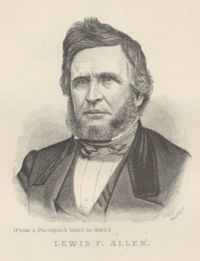
Lewis Falley Allen,
Rural Architecture
“ If white oak cannot be had, the other varieties of oak, or chesnut are the next best. In light frame-timbers, such as studs, girts, joists, or rafters, oak is inclined to spring and warp, and we would prefer hemlock, or chesnut, which holds a nail equally as well, or, in its absence, pine, (which holds a nail badly,) whitewood, or black walnut. The outside finish to a wooden house, may be lighter than in one of stone or brick. The wood work on the outside of the latter should always be heavy, and in character with the walls, giving an air of firmness and stability to the whole structure. ”
Thomas Allen Britton, A Treatise on the Origin, Progress…
“ It is worthy of mention that all the harder woods require increased care in the seasoning, which is often badly begun by exposure to the sun or hot winds in their native climates: their greater impenetrability to the air the more disposes them to crack, and their comparative scarcity and expense are also powerful arguments on the score of precaution. Oak timber requires to be very carefully seasoned, as it is generally used in buildings for the best description of work, and should unseasoned oak be used for “panelling,” any shrinkage will be fatal to the work. ”
Vitruvius,
Ten Books on Architecture
(1914)
“ The winter oak, being composed of a moderate amount of all the elements, is very useful in buildings, but when in a moist place, it takes in water to its centre through its pores, its air and fire being expelled by the influence of the moisture, and so it rots. The Turkey oak and the beech, both containing a mixture of moisture, fire, and the earthy, with a great deal of air, through this loose texture take in moisture to their centre and soon decay. ”
Various, Harper's Young People, April 19…
“ Mast bench of oak an inch and a half thick and six inches wide. If you like, instead of pine for cross-beams, oak can be used, an inch and a half thick, but only four inches wide, and, if it is possible, get them with a slight curve upward.Instead of nailing the floor to the bottom of the side pieces, lay a four-inch plank of oak on the cross-beams, G, Fig. 1, and fasten the floor to that. Make it three-quarters of an inch thick, instead of half an inch, as in Plate I. This will prevent the floor going through when you happen to get in a rough sea, and your craft gives all over. ”
Sir Herbert Maxwell, Trees: A Woodland Notebook
“ Those who desire a quick return from their woodland will hardly be encouraged to plant oak from such a far-sighted consideration; but forestry must always be a business of deferred profits. If ash be esteemed commercially mature at seventy years, larch and Scots pine at eighty or ninety, oak cannot be reckoned ready for the axe at less age than one hundred and twenty, and it continues to improve up to two hundred years. ”
Patrick Matthew,
On Naval Timber and Arboriculture
“ Mr Cruickshank, who has never carried his plan into execution, except in an experiment embracing a few yards, directs that the ground intended for oak forest should first be planted with Scots fir and larch, about 4000 to the acre, by the single-notch process, previously described, which can be accomplished under L. 1 per acre. ”
Ella Rodman Church, Among the Trees at Elmridge
“ You may have noticed the trunk and branches of the oak are often gnarled and knotted, and this helps to give the tree its appearance of great strength. It is just as strong as it looks, and for building-purposes it lasts longer than any other wood. Beams and rafters of oak are found in old English houses, showing among the brick-work, and many of these half-timbered houses, as they are called, were built hundreds of years ago. ”
J. B. Wagner, Seasoning of Wood
“ Never work lumber through the factory that has more than 5 or 6 per cent of moisture or less than 3 per cent.Dry storage rooms should be provided with heating coils and properly ventilated.Oak or any other species of wood that shows 25 or 30 per cent of moisture when going into the dry kiln, will take longer to dry than it would if it contained 15 to 20 per cent, therefore the importance of testing before putting into the kiln as well as when taking it out. ”
James George Frazer,
The Golden Bough: A Study in Magic and Religion…
“ A heavy block of oak-wood, generally a stump grubbed up from the ground, is fitted either into the floor of the hearth, or into a niche made for the purpose in the wall under the hook on which the kettle hangs. ”
J. B. Wagner, Seasoning of Wood
“ If a well-smoothed thin disk or cross-section of oak (say one-sixteenth inch thick) is held up to the light, it looks very much like a sieve, the pores or vessels appearing as clean-cut holes. The spring-wood and gray patches are seen to be quite porous, but the firm bodies of fibres between them are dense and opaque. Examined with a magnifier it will be noticed that there is no such regularity of arrangement in straight rows as is conspicuous in pine. ”
J. B. Wagner, Seasoning of Wood
“ The evaporation of water from wood takes place largely through the ends, i.e., in the direction of the longitudinal axis of the wood fibres. The evaporation from the other surfaces takes place very slowly out of doors, and with greater rapidity in a dry kiln. The rate of evaporation differs both with the kind of timber and its shape; that is, thin material will dry more rapidly than heavier stock. Sapwood dries faster than heartwood, and pine more rapidly than oak or other hardwoods. ”
J. B. Wagner, Seasoning of Wood
“ By air-seasoning oak and similiar hardwoods, nature performs certain functions that cannot be duplicated by any artificial means. Because of this, woods of this class cannot be successfully kiln-dried green from the saw.In drying wood, the free water within the cells passes through the cell walls until the cells are empty, while the cell walls remain saturated. When all the free water has been removed, the cell walls begin to yield up their moisture. Heat raises the absorptive power of the fibres and so aids the passage of water from the interior of the cells. ”
Charles A. King, Elements of woodwork (1911)
“ Oak is not a suitable wood for exposure to trying climatic conditions, though if buried deeply, or in water, where there is no alteration in moisture or dryness, it gives satisfaction. White oak is used to great extent for railroad ties, but what these are to be made of in the future is causing much speculation, as the end of the present supply of white oak is already in sight. ”
Patrick Matthew,
On Naval Timber and Arboriculture
“ It requires to be of clean solid texture, from 12 to 40 feet in length, and at least 8 inches in diameter at small end, or any greater thickness. For the conveniency of transport, oak plank timber is generally squared or planked where grown, and is cut out from 2 1⁄2 to 7 inches in thickness, and from 6 to 18 inches in breadth. Plank is needed of such various dimensions, that any oak tree of clean timber, nearly straight one way, and straight, or with a gentle regular bending, the other, may safely be cut into plank, the section to be in the plane of the {6} curve. ”
J. B. Wagner, Seasoning of Wood
“ Heartwood "oak" brown, sapwood lighter color. Wood heavy, strong, close-grained, durable in contact with the soil. Used in ship- and boatbuilding, all sorts of construction, interior finish of houses, cabinet work, tight cooperage, carriage and wagon work, agricultural implements, railway ties, etc., etc. One of the most valuable and most widely distributed of American oaks, 60 to 80 feet in height, and, unlike most of the other oaks, adapts itself to varying climatic conditions. It is one of the most durable woods when in contact with the soil. ”
Patrick Matthew,
On Naval Timber and Arboriculture
“ The oak should never be pruned severely, and this rule should be particularly observed when the tree is young. We have known several of the most intelligent gardener-foresters in Scotland err greatly in this; and, by exclusively pruning the oak plants, from misdirected care, throw them far behind the other kinds of timber with which they were mixed in planting. There is no other broad-leaved tree which we have seen suffer so much injury in its growth, by severe pruning, as the oak. ”
Harry Marshall Ward,
The Oak
(1892)
“ The oak grows faster than the beech or spruce, for instance, while young, and so keeps its head easily above the others for a time. Very often the oak is cultivated pure at first, and then, when the oaks are becoming too crowded and he has to thin them, the forester puts in the silver fir or beech, which prevents the light coming in to the lower parts of the young oak-trees, and consequently prevents the development of lower branches, which would give the spreading, squat habit he wishes to prevent. ”
Henry H. Gibson, American Forest Trees
“ It is three pounds lighter per cubic foot than white oak, and theoretically it rates a little lower in fuel value, but those who use both woods as fuel consider maple worth more. It is thirty per cent stronger than white oak, and fifty-three per cent stiffer. The wood is diffuse-porous, that is, the pores are not arranged in bands or rows, as they usually are in oaks, but are scattered in all parts. ”
Theophrastus,
Enquiry Into Plants and Minor Works On Odours and Weather Signs
(1916)
“ The 'broad-leaved' oak (scrub oak) [14] comes second as to straightness of growth and length of timber to be got from it, but for use in building it is the worst next after the sea-bark oak, and it is even poor wood for burning and making charcoal, as is also that of the sea-bark oak, and next after this kind it is the most worm-eaten. For the sea-bark oak has a thick trunk, but it is generally spongy and hollow when it is thick; wherefore it is useless for building. Moreover it rots very quickly, for the tree contains much moisture and that is why it also becomes ”
Harry Marshall Ward,
The Oak
(1892)
“ There are various other modes of growing oak in forests, but, whatever the system employed, the following facts have to be borne in mind and provided for: The oak is a tree that requires a soil of great depth, and sufficiently open to allow of the free penetration of air and water to the subsoil; consequently many soils, otherwise rich enough, are unsuited for the culture of this tree. Again, young seedlings and plants are apt to suffer from frost unless they are protected by suitable mixtures of other plants ”
Flora L. Carpenter, Stories Pictures Tell. Book 5
“ Heavy oak boards are nailed upon them and the brick foundation is then started just as we build ours. The back and front of the house are not completed until after the roof is finished, for it is necessary to allow a free circulation of air through the house to dry it. ”
“ Raising oak-timber, on a large scale, will soon be demanded in this country. In some sections we have immense quantities of native oaks; but they are fast disappearing, and the present expense of transporting the timber, to places where it is needed, is much greater than would be the cost of raising it. ”
Various, St. Nicholas Magazine for Boys and Girls…
“ Get a spruce plank, A, 12 feet long, 6 inches wide, 2 inches thick. This is the backbone of the structure. Cut near one end of it a hole two inches square to receive the foot of the mast. Fig. 2. Take two oak cross-bars, E E, 8 feet long, 4 inches deep, 2 inches thick. The cross-bars are bolted to A, one foot apart, the forward one a foot from mast-hole. This distance is best.Next get one oak plank, C, 16 inches long, 3-1/2 inches deep, 2 inches thick.The hard-wood piece, D, is for tiller, 4 feet long, 2 inches wide, 1 inch thick. ”
William Priest, Travels in the United States of America
“ He tells, me they have ten species of oak; viz, white, black, red, spanish, turkey, chesnut, ground, water, barren, and live oak. The white, turkey, and chesnut are used for ship-timber; the acorn of the latter very superiour in size to any other. Red oak is chiefly used for pipe-staves, and exported to most parts of Europe, and the West Indies. Black oak is a dry wood, and easily splits; is chiefly used for the rails and fences of their enclosures. Ground oak is bushy, and seldom exceeds six feet in height ”