Phylloxera

Definition and stakes

Various,  Popular Science Monthly (1913)

“ As one of the first experimenters stated, "a sickness takes hold of the vines and they die." The agent causing the sickness is the phylloxera, a tiny plant louse, undiscovered until the last half of the nineteenth century, which works on the leaves and roots of the European grapes, but which does comparatively little harm to American species. Undoubtedly, the resistance of native grapes to the phylloxera is due to natural selection in the contest that has been going on for untold ages between host and parasite. ”
Source: Wikisource

Various,  The Galaxy, April, 1877

“ M. Mouillefert, who examined this subject under direction of the Academy, reports that as an antidote the sulpho-carbonates are a proved success, and nothing now remains but to educate the vine growers to their proper use. This subject has peculiar interest to Americans, for the phylloxera is our evil gift to France. It is matter of common observation, both in animal and vegetable physiology, that one race or species may live in comfort with an enemy—be it a disease or a parasite—which is destructive to other species. The American vineyards are by no means free from the phylloxera. ”
Source: Gutenberg

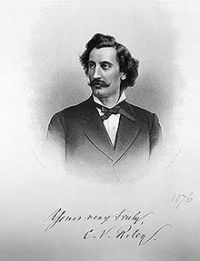
Portrait of Charles Valentine Riley Charles Valentine Riley,  Popular Science Monthly (1874)

“ Injury caused by Phylloxera in America.—In this country, where, compared with Europe, land is so rich and abundant, we are apt to think lightly of injury to our crops, except when such injury becomes very great and wide-spread. It is a fact, long ago remarked by Dr. Fitch, State Entomologist of New York, that while in Europe the whole people become alarmed if a fifth of a given crop is destroyed by insects, the farmer here often thinks himself fortunate if he can save half the average yield from insect depredations. ”
Source: Wikisource

Get perspective with Kwize: daily news enlightened by great literature