Radius of curvature

Definition and stakes

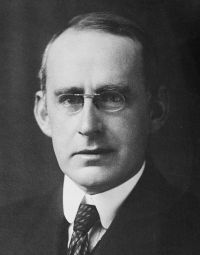
Portrait of Arthur Eddington Arthur Eddington Space Time and Gravitation: An outline of the general relativity theory… (1920)

It is independent of the observer's mesh-system, but it depends on his gauge. It is obvious that the number expressing the radius of curvature of the world at a point must depend on the unit of length; so we cannot say that the curvatures at two points are absolutely equal, because they depend on the gauges assigned at the two points. Conversely the radius of curvature of the world provides a natural and absolute gauge at every point; and it will presumably introduce the greatest possible symmetry into our laws if the observer chooses this, or some definite fraction of it, as his gauge.
Source: Wikisource

Charles Everitt, Olaus Henrici, Edwin B. Elliott, John H. Grace, Bertrand A. W. Russell and Alfred N. Whitehead 1911 Encyclopædia Britannica (1911)

The limit tended to is the sphere of closest contact with the curve at (x, y, z) ; its centre and radius are called the centre and radius of spherical curvature. It cuts the osculating plane in a circle, called the circle of absolute curvature; and the centre and radius of this circle are the centre and radius of absolute curvature. The centre of absolute curvature is the limiting position of the point where the principal normal at (x, y, z) is cut by the normal plane at a neighbouring point, as that point moves up to (x, y, z) .
Source: Wikisource

Get perspective with Kwize: daily news enlightened by great literature