“ When properly dried, they are ready for the cutting, which is the really skilful part of the making of rice-paper. The man who cuts up the pith has a long, sharp knife, which he places against the side of the roll of pith in such a way that it will take off a thin paring as he turns the roll round and round. ”
Rice paper
Definition and stakes
The theme of “rice paper” has been addressed by authors such as Paul Claudel, Sir John Barrow, Gustavus A. Eisen, Various and Vincent H. Gowen. It is often associated with terms like milk, sugar, egg, butter and flour.
Quotes about “rice paper”
Popular Science Monthly (1875)
“ Canada rice-grass is said to afford an excellent material for the manufacture of paper. It is comparatively free from silicates, and the paper is quite as strong and flexible as that made from rags. It is easily bleached, pure in color, and presents a surface of perfect evenness. ”
1911 Encyclopædia Britannica (1911)
“ The cylindrical core of pith is rolled on a hard flat surface against a knife, by which it is cut into thin sheets of a line ivory-like texture. Dyed in various colours, rice paper is extensively used for the preparation of artificial flowers, while the white sheets are employed by native artists for water-colour drawings. ”
Paul Claudel, The East I know (1914)
“ The sun sets on a day of peace and labor, yet men, women, and children, their disheveled hair full of dust and wisps of straw, their faces and legs stained with earth, work on. Here they cut rice, here they gather up the sheaves; and, as on wall-paper the same scene is repeated indefinitely, so on every side we see great wooden vats with men who, face to face, beat ears of corn against the sides; and already the plow commences to turn the clay again. All about is the odor of grain, the perfume of the harvest. At the end of the plain where the men are working is a wide river ”
Vincent H. Gowen, Sun and moon (1927)
“ Amid the smoke and turmoil of crackers six pairs of coolies entered, each pair carrying between them a red wooden tray laden with bales of silk and cotton, with rice, with round pears and balls of steamed bread, and with dried poultry on which had been pasted double characters cut out of red paper to represent the word for happiness; there were eggs too, dyed red, and slippers of silver paper. The overslung handles of the trays had been festooned with garlands of red cloth. ”
Mary F. Henderson, Practical Cooking and Dinner Giving
“ If the rice is now too firm, add a little cream also. When cold, stir into this the whites of the eggs beaten to the stiffest possible froth, and put the mixture into a flat pudding-dish, or into little paper cases (see page 61) . Sprinkle granulated sugar over the top or tops. Bake in the oven about ten minutes. Serve immediately, or the soufflé will fall. Ground rice may be used instead of whole rice. It should be rubbed smooth with a little cold milk, and then added to the remainder of the milk and the butter on the fire, and stirred until it thickens. ”
Sir John Barrow, Travels in China, Containing Descriptions…
“ The discovery of making paper from straw, although new, perhaps, in Europe, is of very ancient date in China. The straw of rice and other grain, the bark of the mulberry-tree, the cotton shrub, hemp, nettles, and various other plants and materials, are employed in the paper manufactories of China, where sheets are prepared of such dimensions, that a single one may be had to cover the whole side of a moderate sized room. ”
Various, Godey's Lady's Book, Philadelphia…
“ For the finer sorts of paper, the pulp receives a second washing in a linen bag; it is then spread out on a smooth table, and beaten with a wooden mallet until it is extremely fine. Thus prepared, it is put into a tub with a slimy infusion of rice and a root called oreni; then it is stirred until the ingredients are properly blended: it is next removed to a large vessel to admit of moulds being dipped into it. These moulds are made of bulrushes cut into narrow strips, and mounted in a frame; as the paper is [201] moulded, the sheets are placed on a table covered with a double mat. ”
 Andrew Ure,
A Dictionary of Arts, Manufactures and Mines
“ Rice consists chiefly of starch, and therefore cannot by itself make a proper bread. It is used in the cotton factories to form weavers’ dressings for warps. The Chinese reduce its flour into a pulp with hot water, and mould it into figures and plates, which they afterwards harden, and ornament with engravings, resembling those of mother-of-pearl. When a decoction of rice is fermented and distilled, it affords the sort of ardent spirit called arrack in the East Indies. ”
Ramon Reyes Lala, The Philippine Islands
“ Four months more are needed for the ripening of the grain, during which the fields are kept clear of weeds, the natives wading back and forth through the mud in their task. After cutting and heaping, the paddy is made into stacks. In six weeks more the grain is separated from the straw by treading or by the use of the flail, or by causing ponies to trot over it. It may be said that there is nothing in nature more beautiful than a valley of green ripening rice in the midst of verdant hills. In the flood of rich color beneath my eyes, I have gazed upon such a scene with inexpressible delight. ”
 Isabella Beeton,
Mrs. Beeton's Book of Household Management
(1907)
“ Method.—Wash the rice, put it into a saucepan with the salt, lemon-rind and milk, simmer until the greater part of the milk is absorbed and the rice becomes tender, then stir in the butter and sugar, and remove the lemon-rind. Peel and core the apples, place them in a piedish, fill the cavities with raspberry jam or a little butter and sugar. Fill the spaces between the apples with rice, and bake in a slow oven until the apples are tender, but not broken. ”
Edith May Bertels Thomas, Mary at the Farm and Book of Recipes Compiled During Her Visit Among the "Pennsylvania Germans"
“ Do not stir often while boiling. When the rice is tender turn on to a sieve and drain; then put in a dish and place in the oven, to dry off, with oven door open, when the grains should be whole, flaky, white and tempting, not the soggy, unappetizing mass one often sees. Serve rice with cream and sugar. Some prefer brown sugar and others like crushed maple sugar with it. Or rice may be eaten as a vegetable with salt and butter. Rice is inexpensive, nutritious and one of the most easily digested cereals, and if rightly cooked, an appetizing looking food. ”
 Marion Harland,
The Dinner Year-Book
“ Enough milk to make the rice into stiff paste. Sweet lard for frying. Work rice, butter, egg, etc., into an adhesive paste, beating each ingredient thoroughly into the mixture. Flour your hands and make the rice into oval balls. Dip each in beaten egg, then in flour, or cracker-dust, and fry [32] in boiling lard, a few at a time, turning each with great care. When the croquettes are of a fine yellow-brown, take out with a wire spoon and lay within a heated colander to drain off every drop of fat. Serve hot, with sprigs of parsley laid about them, in an uncovered dish. ”
 Eliza Leslie,
Miss Leslie's Lady's New Receipt-Book…
“ Put the rice into a sauce-pan, with a quart of rich milk. Having dredged the currants with flour, stir them a few at a time into the rice and milk. Then add four ounces of broken up loaf-sugar, on which you have rubbed off the yellow rind of a large ripe lemon or orange, and squeezed the juice. Stir in two ounces of fresh butter divided into bits. When the rice is well swollen and quite soft, take it from the fire, and mix with it gradually eight well-beaten yolks of eggs. Transfer it to a deep china dish, and put it into an oven for half an hour. ”
“ Let the croquettes rest a while, then fry them in hot lard, to a golden colour. Serve on a napkin with plenty of fried parsley.Croustades.—Boil a quantity of rice in salted water till done. Strain off the water, put the rice in a saucepan, and keep moistening with as much milk or stock as it will absorb; add a handful of Parmesan cheese and a little pepper. When the rice is thoroughly done, or rather overdone, spread it out evenly to the thickness of about 2 in. on a slab or dish. When quite cold, cut with a 2 in. patty cutter as many “rounds” as the layer of rice will admit. ”
Florence Kreisler Greenbaum, The International Jewish Cook Book
“ Wash a quarter of a pound of rice in hot water—about three times—then boil it in milk until very soft and thick. Let it cool, and then add two ounces of butter, the yolks of four eggs, four ounces of sugar and one teaspoon of vanilla, some salt and the beaten whites of two eggs, mix thoroughly. When your dough has been rolled out and pulled as thin as possible, spread the rice over it and roll. Add pounded almonds and raisins if desired. Put in a greased pan and bake until brown, basting with sweet cream or butter. ”
Chautauqua Institution, The Chautauquan, Vol. 05, December 1884…
“ The “small” rice is sometimes ground and employed to adulterate wheat flour. Rice, when prepared in the many forms of puddings, cakes, soups, etc., is very easy of digestion, and is specially fitted for the food of invalids. In Japan, where the rice crop is a leading one, an alcoholic drink called sake is made from it. A wine is made in China from this grain, and the Arrack of the East is also a rice beverage. ”
The Best Short Stories of 1919…
“ Since time was they had sat there, ensconced at the very root of life, seemingly placid and unseeing and unhearing, yet venomously watching to be placated with food. Opposite the stove, on the white wall, hung a row of brass hooks, from which dangled porcelain spoons with pierced handles. On a serving-table stood the piled bowls for the day, blue-and-white rice patterns, of a thin, translucent ware, showing the delicate light through the rice seeds; red-and-green dragoned bowls for the puddings; and tiny saucer-like platters for the vegetables. ”
 Eliza Ruhamah Scidmore,
Jinrikisha Days in Japan
(1891)
“ It was a rainy morning, and the green rice plain looked greener under the gray sky as we rode away from Nara. Men and women were working in the fields, wading knee-deep in the mud and water, stirring the muck around the young shoots, and tearing up the water-weeds with iron hooks. No other grain requires as much care as rice, and from the first transplanting from the seed-bed until the ears of grain are formed, there is continuous grubbing in the mire of the paddy fields. ”
Mrs. Beeton, The Book of Household Management
“ INGREDIENTS.—To every lb. of rice allow 4 lbs. of wheat flour, nearly 3 tablespoonfuls of yeast, 1/4 oz. of salt. Mode.—Boil the rice in water until it is quite tender; pour off the water, and put the rice, before it is cold, to the flour. Mix these well together with the yeast, salt, and sufficient warm water to make the whole into a smooth dough; let it rise by the side of the fire, then form it into loaves, and bake them from 1-1/2 to 2 hours, according to their size. If the rice is boiled in milk instead of water, it makes very delicious bread or cakes. ”
Elizabeth E. Lea, Domestic Cookery, Useful Receipts…
“ Rice that is ground coarse, in a hand-mill, is much better for making flummery than the flour you buy: put three pints of milk to boil, mix with water two tea-cups of ground rice, and stir it in the milk when it boils; while the milk is cold, put in it two dozen peach kernels, blanched, and rolled with a bottle; wet your moulds with cold cream or water; keep stirring the rice till it is thick, when pour it out in the moulds; just before dinner turn them out on dishes, have cream, sugar and nutmeg mixed, to eat with it. ”
 Elizabeth W. Allston Pringle,
A Woman Rice Planter
“ In the loft my man measured out thirty-five bushels of rice, turning the tub into a spout leading to the barn below, where young men brought the clay water in piggins from the barrel and poured it over the rice, while young girls, with bare feet and skirts well tied up, danced and shuffled the rice about with their feet until the whole mass was thoroughly clayed, singing, joking, and displaying their graceful activity to the best advantage. ”
Chautauqua Institution, The Chautauquan, Vol. 05, December 1884…
“ The chemical composition of rice grain is as follows: Water 12.44, ash 0.38, albuminoids 7.44, fiber 0.19, starch, etc. 19.20, fat 0.35. It is seen to contain a less amount of the flesh forming or albuminoid compounds, and a greater per cent. of heat producing or starchy matter, than the other grains. The flour contains so little gluten that it can not be made into light bread. Rice is familiar to all as white, pearly grains, which are employed as the leading ingredient of puddings, etc. ”
Edith May Bertels Thomas, Mary at the Farm and Book of Recipes Compiled During Her Visit Among the "Pennsylvania Germans"
“ The rice, when cooked and drained, should fill 3 cups. Prepare a cream sauce of 1 pint of milk, 3 heaping tablespoonfuls of flour and 2 tablespoons of butter and 2 egg yolks. Stir in 3 cups of flaky, cooked rice, while rice is still hot. When the mixture has cooled, mold into small cone shapes with the hands, stand aside until perfectly cold. Dip the croquettes into the whites of eggs, then roll them in fine, dried bread crumbs and fry in deep fat. If a cube of bread browns in the fat in a little longer time than a half minute, the fat is the right temperature. ”
Ernest Young, The Kingdom of the Yellow Robe
“ The rice is winnowed by the wind as it is poured from one wide shallow basket to another, and as the chaff flies about in the sunlight its gilded hues mingle with the vivid green of the surrounding landscape, to form behind the well-proportioned forms of the girls and women, a background which is unique in its brilliant combinations of light and colour. The grain is stored in large baskets made of cane and plastered outside with mud. These stand on a raised platform, and are covered by a roof made of leaves. ”
Anne Cobbett, The English Housekeeper: Or, Manual of Domestic Management
“ Rice keeps very well, and is useful in a family, particularly in the country, where new milk and eggs are plenty. We once kept a quantity more than three years, by spreading a well-aired linen sheet in a box, and folding it over the rice, the sheet lifted out on the floor, once in two or three months, and the rice spread about upon the sheet for a day or two. This had the effect of keeping away the weevil. Jars and canisters, with closely fitting lids, for tea, sugar, coffee, cocoa, mustard, pepper, spices, and such things, will last many years. ”
Rupert H. Wheldon, No Animal Food; and Nutrition and Diet…
“ We are told that the Burmese and Japanese and other nations who use rice as their principal food-stuff, use the entire grain. As compared to undressed rice, the ordinary, or polished rice is deficient 3 per cent. of protein; 6 per cent. of fat; 5 per cent. of mineral matter. 'Once milled' rice can be procured in this country, but has to be specially asked for. Rice is not nearly so nitrogenous as wheat, but is equal to it in fuel value, this being due to the large amount of starch it contains. It is an excellent food, being easily digested and easily prepared. ”
Catharine Parr Strickland Traill, In the Forest; Or, Pictures of Life and Scenery in the Woods of Canada…
“ With this they bend down the rice across the stick and strike off the heads, which fall into the canoe, as they push it along through the rice-beds. In this way they collect a great many bushels in the course of the day. The wild rice is not the least like the rice which your ladyship has eaten; it is thin, and covered with a light chaffy husk. The colour of the grain itself is a brownish-green, or olive, smooth, shining, and brittle. ”
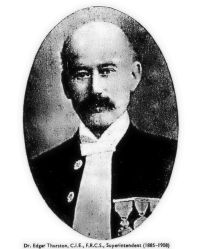 Edgar Thurston,
Castes and Tribes of Southern India
(1909)
“ The paddy and rice are a perquisite of the barber. Those who have been shaved bathe, and then follows the crow-feeding ceremony. Rice is boiled in a bell-metal vessel over a hearth prepared with three young cocoanuts. The eldest son, who tore the cloth of succession from the corpse, makes the rice into two little balls, places them on a plantain leaf, and offers them to the spirit of the departed by pouring libations of water on them over a blade of karuka grass. Men and women who are under pollution then do the same. The rice balls are eaten by crows. ”
Francis Pretty, Sir Francis Drake's Famous Voyage Round the World
“ They boil their rice in an earthen pot, made in form of a sugar loaf, being full of holes, as our pots which we water our gardens withal, and it is open at the great end, wherein they get their rice dry, without any moisture. In the mean time they have ready another great earthen pot, as set fast in a furnace, boiling full of water, whereinto they put their pot with rice, by such measure, that they swelling become soft at the first, and by their swelling stopping the holes of the pot, admit no more water to enter, but the more they are boiled, the harder and more firm substance they become. ”