“ To stir your tea is no mean part of a noble ceremony. It keeps tune with your thoughts if you are alone, and it keeps time with your tongue if you are talking. It helps out the argument, fills up the gaps, provides the animated commentary on your discourse. There are people I shall always remember in the attitude of standing, cup in hand, and stirring, stirring, stirring as the current of talk flowed on. ”
Stirring
Definition and stakes
The theme of “stirring” has been addressed by authors such as A. G. Gardiner, Emily Bronson Conger, Elizabeth O. Hiller, Mary Ronald and Walter Rosenhain. It is often associated with terms like boiling, liquid, flour, butter and water.
Quotes about “stirring”
Emily Bronson Conger, An Ohio Woman in the Philippines
“ Under each pot is a tiny fire. The skillful cook plays upon his several fires as a musician upon his keys, adding a morsel of fuel to one, drawing a coal from another; stirring all the concoctions with the same spoon. ”
Elizabeth O. Hiller, Left-over foods and how to use them (1910)
“ Stirring is combining ingredients by circular motions, enlarging and repeating these motions until all ingredients are thoroughly blended. This motion is most commonly used in all cookery, either alone or alternating with beating. ”
 Mary Ronald,
The Century Cook Book
Mary Ronald,
The Century Cook Book
“ Tin measuring cup holding one half-pint. 2. Spoonful of salt, pepper or spices. 3. One half spoonful. 4. Spoonful of flour, sugar, or butter. 5. Heaping spoonful. (See page 77.) [78] STIRRING AND BEATINGThese two methods should not be confused. The object of stirring is to mix the materials. The spoon is held on the bottom of the dish, and the materials rubbed and pressed together as much as possible. It is not essential to always stir one way. The object of beating is to get air into the mixture to make it lighter, which is done by continuously lifting it up in the same way ”
Walter Rosenhain, Glass Manufacture
“ During the earlier stages of the stirring process the glass is very hot and mobile, but the stirring is continued, with short intervals, until the glass is so cold and stiff that the stirrer can scarcely be moved in it at all, so that the work of moving the stirrer becomes heavy towards the end of the operation. The actual amount of stirring required varies according to the nature of the glass, and the size of the pot or crucible in question. ”
E. E. Kellogg, Science in the Kitchen
“ Stir the grain continuously until it has set, but not at all afterward. Grains are much more appetizing if, while properly softened, they can still be made to retain their original form. Stirring renders the preparation pasty, and destroys its appearance. Grains cooked in a double boiler will require no stirring, and there will be little danger of their being lumpy, underdone on top, and scorched at the bottom, as is so often the case when cooked in a single boiler. ”
Sarah Josepha Buell Hale, Mrs. Hale's Receipts for the Million
“ It should be stirred as little as possible while you are cooking; indeed, a good cookmaid stirs her fire only once during her roasting, and that is when she turns the meat, or alters the hanging of it, at which times she takes the meat and dripping-pan away from the fire, as stirring creates both dust and smoke; but as dust or coal may, by accident, fall into the dripping-pan, keep ready a dish-cloth, to wipe it out directly. Be mindful, also, to keep in the house a stock of the things that are commonly wanted, such as flour, salt, pepper, spices, &c. ”
 Harvey Washington Wiley,
Principles and practices of agricultural analysis…
(1894)
Harvey Washington Wiley,
Principles and practices of agricultural analysis…
(1894)
“ It is then evaporated to dryness on the steam-bath, or more quickly over a direct flame, and with but little attention until a point near to dryness has been reached, when stirring will be found of great advantage in facilitating the volatilization of the remaining liquid and in breaking up the mass of salt. ”
 Jerry Thomas,
The Bar-tender's Guide
(1887)
Jerry Thomas,
The Bar-tender's Guide
(1887)
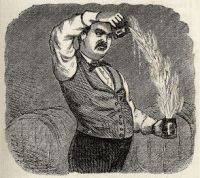
“ When the ale is near to a boil, put it in another pitcher, pour it very gradually in the pitcher containing the eggs, etc., stirring all the while very briskly to prevent the eggs from curdling, then pour the contents of the two pitchers from one to the other until the mixture is as smooth as cream. ”
Anonymous, Family fare: food management and recipes (1968)
“ If drippings are scant, add a bouillon cube or a little meat extract to the liquid.Method 1.—Use with fat or with drippings containing only fat and browned crusty bits. Measure fat or drippings. Stir flour into fat; brown over low heat. Add liquid slowly, stirring constantly. Cook until thickened, stirring occasionally. ”
William Strong, The Wood-Paper Patent — Opinion of the Court
“ K represents two stirrers, the shafts of which run at their lower ends in the steps b, while their upper ends pass through the stuffing-boxes L, and are provided with pinions M, which are driven by suitable gearing. The shafts of the stirrers, K, are provided on one side only with the horizontal stirring arms, which, when the boiler is to be charged are turned towards the periphery of the boiler, and are therefore not in the way of the material as it is thrown into the boiler. ”
Hannah Glasse, The Complete Confectioner (1800)
“ Take oatmeal, steep it in pure clean water till it turns sour; stir it every day, strain it, and put it in a kettle over the fire; keep stirring it with a stick one way all the time, till it is as thick as hasty-pudding ”
Woman's Institute of Domestic Arts and Sciences, Woman's Institute Library of Cookery…
“ A THICK BATTER, which is known as a drop, or muffin, batter, is one that is made of 2 measures of flour and 1 measure of liquid. A batter of this kind may be poured, but it will not immediately seek its own level. Muffins, gems, puddings, and cakes are made of thick batters.A SOFT DOUGH is one whose proportions are 3 measures of flour and 1 measure of liquid. A dough of this kind will stand up alone--that is, without support at the sides--and has more of the properties of a solid than of a liquid. Baking-powder biscuits, tea rolls, and certain kinds of cake are made of this form of dough. ”
 Robert May,
The accomplisht cook
Robert May,
The accomplisht cook
“ Set on a skillet, either full of milk, wine, water, verjuyce, or sack, make the liquor boil, then have twenty eggs beaten together with salt, and some sweet herbs chopped, run them through a cullender into the boiling liquor, or put them in by spoonfuls or all together; being not too hard boil’d, take them up and dish them with beaten butter, juice of orange, lemon, or grape-verjuyce, and beaten butter. ”
“ The stirrer is a hard baked cylinder of fire clay fastened to an iron bar. First heated in the mouth of the pot, the stirrer is plunged in the molten glass and given a steady rotating motion, the long bar being swivelled and furnished with a wooden handle for the workman. ”
Lucy Aikin, Robinson Crusoe — in Words of One Syllable
“ For some of my pots and jars were too weak to bear their own weight; and they would fall out here, and in there, in all sorts of ways; while some, when they were put in the sun to bake, would crack with the heat of its rays. You may guess what my joy was when at last a pot was made which would stand the heat of the fire, so that I could boil the meat for broth. ”
Anthony Florian Madinger Willich, Domestic Encyclopædia (1802)
“ He farther remarks, that water which has endured the fire the shortest time, presided it be hot enough, will make the strongest extract. 6. Of Mashing. When the water is brought to a due heat, the malt is to be put in very leisurely, and uniformly mixed with it. 7. Of boiling the Wort. As the design of boiling the wort is to clear the liquor of its impurities, and to obtain the virtue of the hop, a much shorter time than usual is sufficient. Long boiling of the hop is a most pernicious practice, and produces an austere, nauseous bitter, but not a pleasant aromatic one. ”
 Charles Dickens,
Great Expectations
(1861)
Charles Dickens,
Great Expectations
(1861)
“ I stole some bread, some rind of cheese, about half a jar of mincemeat (which I tied up in my pocket-handkerchief with my last night's slice) , some brandy from a stone bottle (which I decanted into a glass bottle I had secretly used for making that intoxicating fluid, Spanish-liquorice-water, up in my room: diluting the stone bottle from a jug in the kitchen cupboard) , a meat bone with very little on it, and a beautiful round compact pork pie. ”
Phebe Earle Gibbons, "Pennsylvania Dutch," and other essays
“ In a few hours the apples will all be in, and then you will stir, and stir, and stir, for you do not want to have the apple-butter burn at the bottom, and be obliged to dip it out into tubs and scour the kettle. ”
Pierre Blot, Hand-Book of Practical Cookery…
“ Some dishes require high and much seasoning, others just the contrary. With a good fire and a good spit, it is not necessary to be a thorough cook to roast a piece well, but the cook is indispensable to mix the gravy or sauce with the proper seasonings.Simmering.—Simmering differs from boiling only in the amount of heat allowed under the boiler, kettle, or pan. To simmer, is to boil as gently and slowly as possible. ”
Adelaide Hoodless, Public School Domestic Science
“ Use of double boiler. Compare with boiling water the temperature of fat hot enough for frying, and also that of the oven. To illustrate the two latter, croutons may be made.3. Measuring—experiment with the cooking of starch in water; cornstarch pudding, or tapioca or sago jelly. Develop the idea of the effect of the boiling temperature on the starch grains, the bursting of the grains, and the change in flavor due to continued cooking.4. A cereal and a fruit,—say, baked apples. In the cereal, in addition to the starch, is the cooking of the woody fibre. ”
 John Aikin,
Evenings at Home; Or, The Juvenile Budget Opened
John Aikin,
Evenings at Home; Or, The Juvenile Budget Opened
“ The greater heat and agitation of boiling make it act more powerfully. The liquor in which a substance has been boiled is called a decoction of that substance.Pup. Then we had a decoction of mutton at dinner to-day.Tut. We had—broth is a decoction, and so are gruel and barley-water. But when anything is put to steep in a cold liquor it is called maceration. The ingredients of which ink is made are macerated. In all these cases, you see, the whole substance does not mix with the liquor, but only part of it. The reason is, that part of it is soluble in the liquor, and part not. ”
 Gertrude Stein,
Tender Buttons
Gertrude Stein,
Tender Buttons
“ A breeze in a jar and even then silence, a special anticipation in a rack, a gurgle a whole gurgle and more cheese than almost anything, is this an astonishment, does this incline more than the original division between a tray and a talking arrangement and even then a calling into another room gently with some chicken in any way.A bent way that is a way to declare that the best is all together, a bent way shows no result, it shows a slight restraint, it shows a necessity for retraction. ”
S. A. Reilly, Our Legal Heritage: King AEthelbert - King George III, 600 A.D. - 1776
“ Cooking was done over the fire by boiling in iron pots hung from an iron tripod, or sitting on the hot stones of the fire. They ate from wood bowls using a wood spoon. When they had fresh meat, it could be roasted on a spit. Liquids were heated in a kettle. With drinking horns, they drank water, milk, buttermilk, apple cider, mead, ale made from barley malt, and bean and vegetable broth. ”
W. Mattieu Williams, The Chemistry of Cookery
“ The flour is moistened with this liquid, which only demands a temperature of about 70° Fahr. to act with considerable energy on every granule of flour that it touches. Instead, then, of the passive, lumpy, tenacious dough produced by moistening the flour with mere [199] water, a lively ‘sponge,’ as the baker calls it, is produced, which ‘rises’ or grows in bulk by the evolution and interposition of millions of invisibly small bubbles of gas. ”
 Howard Roger Garis,
The Curlytops at Cherry Farm
(1918)
Howard Roger Garis,
The Curlytops at Cherry Farm
(1918)
“ The fat man mixed some batter in a pan, lighted a fire in the small stove and then began to cook something. As smoke arose and a delicious, sweet, brownish smell filled the air, the queer man began ringing a bell. ”
Carlton McCarthy, Southern Historical Society Papers (1876)
“ One skillet and a couple of frying pans, a bag for flour or meal, another bag for salt, sugar and coffee, divided by a knot tied between, served the purpose as well. The skillet passed from mess to mess. Each mess generally owned a frying pan, but often one served a company. ”
Michael Combrune, The Theory and Practice of Brewing
“ In charring, the subject being ultimately divided by fire, the constituent principles are 108set at liberty, and escape in the atmosphere, in proportion to their several degrees of subtilty, and to the fire which urged them. In boiling they are equally divided, and incline to disperse; but, even the more volatile, being surrounded with water, a medium much denser than themselves, they are caught up therein, and, by the violent motion caused in boiling, entangled with it, and with other parts it contains, so as not to be extricated or divided therefrom except by the act of fermentation. ”
Charles J. Barnes, New National Fourth Reader
“ In the great kettles the boiling of the sap goes on slowly, and the liquid, as it thickens, is dipped from one to another, until in the end kettle it is reduced to syrup, and is taken out to cool and settle, until enough is made to "sugar off." ”
 Thomas Frederick Crane,
Italian Popular Tales
(1885)
Thomas Frederick Crane,
Italian Popular Tales
(1885)
“ One day the old woman was cooking her soup and little Pepper-Corn climbed up on the kettle and looked in to see what was cooking, but he slipped and fell into the boiling broth and was scalded to death. ”
 Sir Richard Francis Burton,
The City of the Saints, and Across the Rocky Mountains to California
Sir Richard Francis Burton,
The City of the Saints, and Across the Rocky Mountains to California
“ These hard-working but sorely ill-favored beings are accused of various horrors in cookery, such as grinding their pinole, or parched corn, in the impurest manner, kneading dough upon the floor, using their knives for any purpose whatever, and employing the same pot, unwashed, for boiling tea and tripe. ”
E. E. Kellogg, Science in the Kitchen
“ And in working in the salt the ladle or roll or worker, whatever it is, should never be allowed to slip on the butter,—if it does, it will destroy the grain,—but it should go upon the butter in a pressing or rolling motion. ”
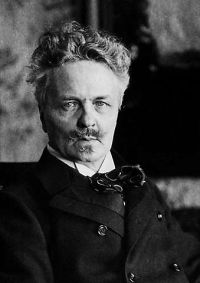 August Strindberg,
Plays by August Strindberg, Fourth Series
August Strindberg,
Plays by August Strindberg, Fourth Series
“ The COOK appears with a bottle of Japanese soy in her hand.YOUNG LADY. There is the one that eats me and all the rest alive.STUDENT. What has she in her hand?COOK. This is my colouring bottle that has letters on it looking like scorpions. It's the soy that turns water into bouillon, and that takes the place of gravy. You can make cabbage soup out of it, or mock-turtle soup, if you prefer.STUDENT. Out with you!COOK. You take the sap out of us, and we out of you. We keep the blood for ourselves and leave you the water—with the colouring. It's the colour that counts! ”
William Tarrant, Ningpo to Shanghai in 1857 (1862)
“ An earthenware pan is filled with a stiff batter of flour, water, salt and eggs, and in this the manipulators, old women generally, dip the fore fingers and spread, or rather smear the batter lightly over the hot pan;—one spread one way, one the other, a second's delay and the food is cooked ”
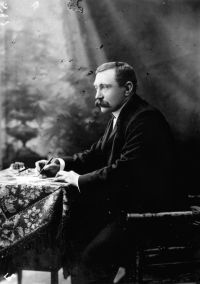 George Essex Evans,
McCarthy's Brew : A Gulf Country Yarn
(1894)
George Essex Evans,
McCarthy's Brew : A Gulf Country Yarn
(1894)
“ M'Kinlay Jim straight answered him: “Those lotions, sauce, and things Should surely make a brew to slake these thirstful sufferings— A brew that slakes, a brew that wakes and burns and bucks and stings.” ”
W. Mattieu Williams, Popular Science Monthly (1883)
“ That the smaller the joint to be roasted the higher the temperature to which its surface should be exposed. The roasting of a small joint should, in fact, be conducted in nearly the same manner as the grilling of a chop or steak described in my last. The surface should be crusted or browned—burned, if you please—as speedily as possible, in such wise that the juices within shall be held there under high pressure, and only allowed to escape by burst and splutters, rather than by steady evaporation. ”
 Robert Augustine Ward Lowndes,
Stirring Science Stories
(1941-02-19)
Robert Augustine Ward Lowndes,
Stirring Science Stories
(1941-02-19)
“ But the crowning horror was the eyes, which could not be closed, appearing to stare restlessly outward, beyond the observer, and the strangely-luminous markings on the dead flesh, curious designs which appeared to move and change form before the eyes of the beholder. ”
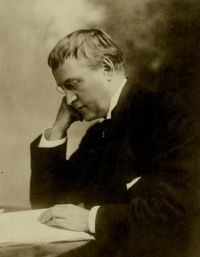 Henry T. Finck,
Food and Flavor: A Gastronomic Guide to Health and Good Living
Henry T. Finck,
Food and Flavor: A Gastronomic Guide to Health and Good Living
“ Boiling yields similar results, but the savors pass into the liquid, leaving the meat almost flavorless, whereas in a stew the flavors enrich the gravy, the vegetables, and the meat alike, in a particularly appetizing manner. ”
 Eliza Ruhamah Scidmore,
Jinrikisha Days in Japan
(1891)
Eliza Ruhamah Scidmore,
Jinrikisha Days in Japan
(1891)
“ A certain weight of leaves is put in each cup, the boiling water is poured on and allowed to stand for five minutes. The expert notes, meanwhile, the color of the liquid and the aroma, carefully watches the unrolling of the leaves, and then tastes the brew by slow sips, meditatively, discriminatingly. ”
Henry Thompson, Popular Science Monthly (1879)
“ Baking, at best in a half-ventilated oven, has long usurped the function of the spit in most houses, thanks to the ingenuity of economical range-makers. And the joint, which formerly turned in a current of fresh air before a well-made fire, is now half stifled in a close atmosphere of its own vapors, very much to the destruction of the characteristic flavor of a roast. ”
