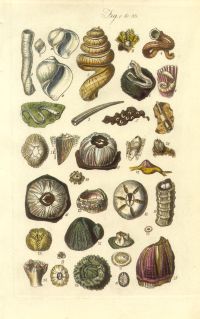
Testacean

Definition and stakes

H. G. Adams,  Beautiful shells (1856)

“ It is pronounced tes-ta-shus, comes from the Latin testaceus—having a Shell, and means consisting of, or composed of shells; so we find that a testacean is a shell-fish, and testaceology is the science of shells. Johnson’s second meaning of the word testaceous is ‘Having continuous, not jointed shells, opposed to crustaceous.’ So we find that some naturalists call those testaceous fish, “whose strong and thick shells are entire and of a piece, because those which are joined, as the lobsters, are crustaceous.” ”
Source: Gutenberg

Portrait of Aristotle Aristotle,  History of Animals (Thompson)… (1910)

“ All insects have eyes, but no other organ of sense discernible, except that some insects have a kind of a tongue corresponding to a similar organ common to all testaceans; and by this organ such insects taste and imbibe their food. In some insects this organ is soft; in other insects it is firm; as it is, by the way, in the purple-fish, among testaceans. In the horsefly and the gadfly this organ is hard, and indeed it is hard in most insects. ”
Source: Wikisource

Portrait of Aristotle Aristotle,  History of Animals (Thompson)… (1910)

“ With the ostracoderma, or testaceans, such as the land-snails and the sea-snails, and all the 'oysters' so-called, and also with the sea-urchin genus, the fleshy part, in such as have flesh, is similarly situated to the fleshy part in the crustaceans; in other words, it is inside the animal, and the shell is outside, and there is no hard substance in the interior. ”
Source: Wikisource

Get perspective with Kwize: daily news enlightened by great literature