Testacea

Definition and stakes

Portrait of Aristotle Aristotle,  On the Parts of Animals — Book IV (1912)

“ In the Testacea the body consists of but few parts, the reason being that these animals live a stationary life. For such animals as move much about must of necessity have more numerous parts than such as remain quiet; for their activities are many, and the more diversified the movements the greater the number of organs required to effect them. Some species of Testacea are absolutely motionless, and others not quite but nearly so. Nature, however, has provided them with a protection in the hardness of the shell with which she has invested their body. ”
Source: Wikisource

Portrait of Aristotle Aristotle,  On the Parts of Animals — Book IV (1912)

“ The former is incorrectly termed ovum, for it merely corresponds to what in well-fed sanguineous animals is fat; and thus it is that it makes its appearance in Testacea at those seasons of the year when they are in good condition, namely, spring and autumn. For no Testacea can abide extremes of temperature, and they are therefore in evil plight in seasons of great cold or heat. This is clearly shown by what occurs in the case of the sea-urchins. For though the ova are to be found in these animals even directly they are born, yet they acquire a greater size than usual at the time of full moon ”
Source: Wikisource

Thomas Brown,  The Conchologist's First Book

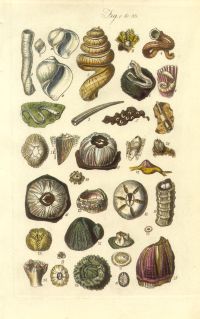
“ In the Testacea, on the contrary, the inhabitant is of a simple and soft texture, without bones, and is attached to its domicil by a certain adhesive muscular force; this domicil, too, is a permanent one, and is increased, from time to time, by gradual additions on the part of the tenant; while the entire shell, which is distributed in layers, or strata, is a combination of carbonate of lime, with a very small portion of gelatinous matter. Such animals, then, with such shells, form, alone, the subject of a proper “Conchology.” ”
Source: Gutenberg

Get perspective with Kwize: daily news enlightened by great literature