“The import trade and the distribution of foreign goods inland, is pretty effectually choked off by the illegal system of transit duties levied at the various stations, and regulated chiefly by the need or avarice of the local officials at the various points along the route.”
“Where a system of cheap railways is adopted, there will be year by year a tendency to multiply lines of traffic, and consequently to multiply also ports and seats of trade—a tendency, however, which may be more than neutralized by any special circumstances which may cause the lines of transit to converge rather than run parallel to one another.”
“National and international communication over water and land, the use of railroads with cheap freight rates and rapid transit in fruit and refrigerator cars created the supply; conversely the supply increased creates the greatest demand—an inexorable law of trade.”
“The facilities for reaching these country homes are already adequate for general purposes, and will be increased every year, as the demand for them grows. Railroads and steamboats are built and run for the purpose of profit on freight and passenger transportation. According to the general law of trade, the supply will equal the demand, and as the population increases along our lines of travel, the facilities and accommodations for transit will be multiplied.”
“The transportation facilities include 18,000 miles of navigable rivers and a railway mileage that is greater than that of all Europe and that is over 39 per cent. of the railroad mileage of the world. The competition of the waterways with the railways gives the country the advantage of cheap rates. Another advantage about which little is said, but which, nevertheless, is great, is the freedom of interstate commerce. In no other equally large area in the civilized world is trade unrestricted by customs, excises, or national prejudice.”
“The two advantages of increased cheapness and speed, besides extending the amount of existing traffic, call into existence new objects of commercial intercourse. For the same reason that the reduced cost of transport, as I have shown, calls new soils into cultivation, it also calls into existence new markets for manufactured and agricultural produce. The great speed of transit, which has been proved to be practicable, must open a commerce between distant points in various articles, the nature of which does not permit them to be preserved so as to be fit for use beyond a certain time.”
“Railways, as developed in England, have thus done more than increase the facilities and decrease the cost of actual transport. They have, in various ways, increased the facilities for, and decreased the cost of the exchange of, commodities, since there is many a trader in the country who conducts his business much more with the help of a railway company's capital than he does with his own. It is not alone that trade and industry have vastly increased in volume as the result of railway operation.”
“All investments of capital which are from their nature permanent, require time for the development of their effects, and may, as regards many of their immediate results, prove rather injurious than beneficial. To this class of speculations railways belong. Introduced for the purpose of facilitating locomotion, and thus improving the industry of the country, this new system of transit was calculated to produce rather an eventual and permanent, than an immediate benefit to the empire.”
“But when we reflect that this system is exerting the very same influence upon trade—and in a much higher degree, so far as the outlay of money is concerned—in reference to the carriage of goods, as in regard to that of passengers, we then come to comprehend in some measure how fertile the railway locomotive is in the production of the fruits of industry.”
“The railway system has had a marked effect upon the state of the money-market of the commercial world in general, and of this country in particular. From the successful experiment made in 1830 in steam locomotion between Liverpool and Manchester, this new method of transit has been developing itself with a rapidity to which no parallel is to be found in the history of mercantile enterprise.”
“Whatever course may be actually taken in regard to these particular aspects of the question, the trend of events in the railway world will probably be more and more in the direction of continuing the policy of agreements and amalgamations on lines which, while giving the fullest transport facilities to the public, should check wasteful competition and ensure all practicable economy in the matter of working expenses.That the trade of the country would suffer, in consequence, is hardly to be anticipated.”
“It is not too much to say that if we possessed the same transportation rates as some of these countries, our trade with the rest of the world would be much greater than it is; while if we had the same distances to traverse as in these countries, at the existing railway rates of our own, competition in neutral markets with the low-rate countries of the Continent would be impossible.”
“The advent of the new means of transport was, in fact, marked by the complete absence of any centralised effort with a view to securing the network of a railway system, so planned or so co-ordinated as to make the best possible provision for the country as a whole, and especially for the rapidly increasing necessities of trade, commerce and industry.”
“The reduction in the cost of transport of manufactured articles, by lowering their price in the market, will stimulate their consumption. This observation applies, of course, not only to the consumer at home, but to foreign markets. In the latter, we already, in many branches of manufacture, command a monopoly. The reduced price which we shall attain by cheapness and facility of transport will still further extend and increase our advantages. The necessary consequence will be an increased demand for manufacturing population”
“So railway magnates and the masses began to see alike that the congestion of freight was a general condition affecting every industry and the entire country, and one not to be remedied by local and temporary means. Thenceforward discussions and conventions took a definite aim—and for the first time in our industrial history, railway corporations, commercial organizations, producers, and consumers, all united in a common movement for the common good. Seen large, our primary industries are production and distribution, the latter effected by trade and transportation”
“Demand for further improvement met by railroads.—Reviewing the substance of preceding sections, we find that of the new means of transportation adopted to develop the resources of the country and to make them available in internaltrade and foreign commerce, none had yet proved adequate to meet the conditions. Transportation on the turnpikes was too expensive to permit the carriage of bulky freight over great distances. River navigation, valuable as it was in opening the interior to commerce, still was tied fast to channels cut by nature”
“He has, therefore, on his hands at all times some unused transportation,—empty cars standing on side-tracks, engines waiting in round-houses, a large demand for them at one time of the year and a decreased demand at another, a demand to handle business east but nothing west. He therefore goes to work to increase trade by seeking to adjust rates so that he can use up part of his idle transportation by moving products between points where there was no such movement before.”
“The result of such a comparison proves that in point of economy, not less than of speed and endurance, railways take precedence over all other known means of locomotion. This combined result of rapidity and cheapness of transit produces a double effect upon a mercantile community: it at once enables merchants to realise the fruits of a given speculation more quickly, which is nothing else than transacting more business in a shorter period than before”
“Cheap carriage by the ocean greyhound instead of the stately clipper, by locomotive-drawn trains instead of stage-coach and caravan, made possible the extension of trade to the innermost and outermost parts of the earth and increased the volume of the world’s commerce to undreamed of proportions.”
“It may be, moreover, observed that this extent of traffic, however great, affords no adequate idea of the vast trade which will arise to feed this line, when in full operation,—with all the important advantages of a completed railway, and of a systematic conduct of business.”
“The express companies have practically a monopoly of the transportation of the smaller packages of goods requiring quick transit and immediate delivery, but the longer, heavier, and slower freight are in the hands of the railroads, and where it can be done, and time is not a first factor, the steamboat takes the place of the train.”
“Among the effects of developed transportation upon the economic organisation may be noted: First, that relations of producers and consumers have been fundamentally changed by placing a larger market at the service of both. Many classes of commodities are now bought and sold in a world market that were formerly restricted to local trade. Second, improved transportation has made the prices of commodities more uniform for different producers and consumers.”
“These cases, collectively, establish that one system of railroad transportation cannot acquire another, nor a substantial and vital part thereof, when the effect of such acquisition is to suppress, or materially reduce the free and normal flow of competition in the channels of interstate trade.”
“Publishing is, however, only one of the many similar trades equally profitable and equally likely to move outward to secondary centres, with the development and cheapening of transit. It is all a question of transit. Limitation of transit contracts the city, facilitation expands and disperses it. All this case for diffusion so far is built up entirely on the hypothesis we attempted to establish in the first paper, that transit of persons and goods alike is to become easier, swifter, and altogether better organized than it is at present.”
“A saving of time upon a long journey, with increased comfort, will necessarily attract to one line in preference to another many travellers from beyond the ordinary distance of local connection, and will thus secure a valuable collateral trade which would not otherwise belong to it. It has also a decided tendency to avert competition, which may with much reason be regarded as the chief peril to which railway property is subjected.”
“The goods, perishable and delicate, must first be carted to the railway station and delivered there, eight miles from the farm, at most inconvenient hours. They must be loaded into slow goods trains, which may not reach town for four-and-twenty hours. There is not the slightest effort to accelerate the transit, and the rates are high. By the time the produce reaches the market its gloss and value are diminished, and the cost of transit has eaten away the profit.”
“Such a plan is to preserve a reasonable degree of competition and to maintain so far as practicable the existing routes and channels of trade and commerce. The desiderata are that the several systems shall be so arranged that the cost of transportation as between competing systems, and as related to the values of the properties, shall be approximately the same, so that these systems can employ uniform rates in the movement of competitive traffic, and can earn, under honest and efficient management, substantially the same rate of return upon the value of their respective properties.”
“Trade and industry have, also, completely changed in method, while thousands of men can carry on a business of their own to-day who, in the pre-railway epoch, must have been content to be little more than hewers of wood and drawers of water.The economy in time, also, due to the speed at which the general merchandise traffic of the country is carried, has been of no less importance than the economy in cost of transport.”
“This, in the growing, progressive, and expanding states of the West, is a steady and constant complaint, and it requires much time, money, and energy for the railroad-owners and officers to keep the supply of transportation up to the demand. The complaints come in for more freight-cars, for more passenger-trains, for better passenger-stations, for more side-tracks, for more switch-engines, for under-crossings and over-crossings in growing cities, for branch lines into new and undeveloped sections of the country”
“But the peculiar nature of a railway, the magnitude and weight of the loads which may be transported on it, and the prodigious speed which may be attained, render the transport of cattle, meat or fish of every species, to almost any distance, both easy and cheap. In process of time, when the railway system becomes extended, the metropolis and populous towns will therefore become markets, not, as at present, to districts within limited distances of them, but to the whole country within 200 miles of the metropolis.”
“It is the task of the transportation system to carry commodities from points of production to consuming centers throughout the United States and to the ports for export. The more freely and cheaply the products are carried, the more competition there will be, the more production there will be, and the better will our transportation system serve our national economy.”
“The parties who had the transit in their hands put their heads together and were able to demand any prices that they pleased. It will be seen that the cost of carrying a bushel of corn from Chicago to Buffalo, by the lakes, was within one cent of the cost of bringing it from New York to Liverpool. These temporary causes for high prices of transit will cease, a more perfect system of competition between the railways and the water transit will be organized, and the result must necessarily be both an increase of price to the producer and a decrease of price to the consumer.”
“Therefore the shippers and buyers of goods at nine-tenths of the shipping points of the country must always be dependent on the facilities and rates offered by a single railway. Such rates of transportation as are fixed, be they high or low, must be paid, if business is carried on at all. And when we consider the ten per cent. of railway stations which are, or may be, junction points, we find that at least three-fourths of them are merely the junction of two lines owned by the same company.”
“It is the railroad, it is the spirit that has moved and stimulated that property which has made it possible to people in the valley of the Mississippi, which has made it possible to create within the limits of the United States a greater wealth than has any other nation on the face of the earth. I speak of the transportation industry as limited to railways, and so limited, it is instructive to reflect that the railways of the earth are now of the value of something near $33,000,000,000, an appalling sum that no human mind can appreciate, save when compared with some other species of property.”
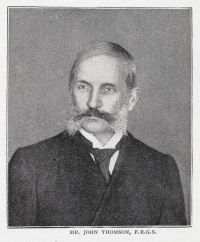 John Thomson,
Through China with a camera
(1898)