“ A general culture of the faculties, also, gives versatility of talent, so that, if the customary business of the laborer is superseded by improvements, he can readily betake himself to another kind of employment. ”
Workplace culture
Definition and stakes
The theme of “workplace culture” has been addressed by authors such as Ira Mayhew, Alice Henry, Johann Jacoby and Barack Obama. It is often associated with terms like employer, employee, factory, worker and labor.
Quotes about “workplace culture”
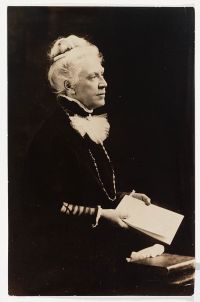 Alice Henry,
The Trade Union Woman
“ In the near future we hope it will mean to all workers even more than a discipline, a storehouse of culture, a provider of joy and of pleasure, of care in sickness, of support in adversity, and best of all, a preparation for and a hastener on of that coöperative commonwealth for which more and more of us ever watch and pray. ”
Johann Jacoby, The Object of the Labor Movement (1887)
“ The true significance of these associations, their value which cannot be overestimated lies in this that, wholly apart from the especial object at which they aim, they are a school for self-culture for their members; that they confer upon them skill in the independent management of their own affairs and in harmonious action with others for common ends; that by education, promotion of a comprehension of business and fraternal public spirit they prepare the worker for a gradual transition from the prevailing Wage-System to the co-operative method of production of the future. ”
Cornelia Stratton Parker, Working With the Working Woman
“ On what other foundation can a saner industrialism be built?The place to make the beginning is in each individual shop and business and industry. The spark to start the blaze in each human heart, be it beating on the side of capital or on that of labor, is the sudden revelation that every worker is far more the exact counterpart of his employer in the desires of his body and soul than otherwise; that the employer is no other than the worker in body and soul, except that his scope and range of problems to be met are on a different level. ”
Andrew Wynter, Once a Week (1863)
“ In thus making themselves responsible to a certain extent for the domestic comfort of their work-people, the employers are doing service to the community at large, for it is to the exertions of individual manufacturers that society must look for the accomplishment of that all-important task, the elevation of the social status of the workman. ”
Cicely Hamilton, Marriage as a Trade (1909)
“ Work in the factory or in the office, work which brings us into contact with the outside world, calls for the exercise of qualities and attainments which we had no need of before, for the abandonment of habits and ideas which can only hamper our progress in our changed surroundings. ”
 Anna Garlin Spencer,
The family and its members
“ This idea cannot be accepted by anyone who realizes the character-drill that may inhere in any form of useful labor. The need is to permeate the methods of modern industry with the creative spirit, to mix the management of all business and manufacturing with the brains of workmen as well as of directors and to make a new connection, strong, obvious, and thought-compelling, between the worker and the control and responsibility of his work. ”
“ What will the American workman do to express his American temperament through his labour union to his employer? The American workmen will go to their employers and say: "Instead of doing six hours' work in nine hours, we will do nine hours' work in nine hours." ”
Margaret F. Hammond, La Réunion, a French Settlement in Texas
“ It is by a minute division of their details; by convenient and labor-saving machinery; by healthy, even elegant workshops, where a certain refinement could be introduced, and scientific thought combined with the pursuit of industry; by short sessions of labor, and the prosecutions of all of its branches by groups of persons united in taste and in sympathy of character, thus bringing the play of the sentiments into industry, and identifying the social and productive life of man ”
 William Isaac Thomas,
The Unadjusted Girl, With Cases and Standpoint for Behavior Analysis
“ The craftsman, the artist, the scientist, the professional man, and to some extent the business man make new experience the basis of organized activity, of work, and produce thereby social values. The division of labor which removes the problematical from the various operations of the work makes the task totally unstimulating. ”
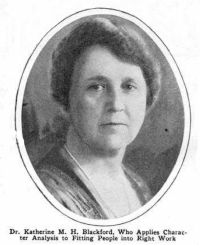 Katherine M. H. Blackford,
Analyzing Character
“ The ideal for every employee, therefore, is that he should be employed in that position which he is best fitted to fill, doing work which by natural aptitudes, training, and experience he is best qualified to do, and working under conditions of material environment—tools, rates of pay, hours of labor, and periods of rest, superintendence and management, future prospects, and education—which will develop and make useful to himself and his employer his best and finest latent abilities and capacities. ”
“ What Lord Grey knows and what Frederick Taylor's workmen know shall be put where all who live shall see it where every employer, every workman, every workman's wife and every growing boy and girl that is passing by, as on some vast billboard above the world, shall see it—shall see and know and believe that employers that are worth believing in—and that workmen who can work and who are skilled and clever enough to love to work—can still be produced by the human race. ”
Katherine M. H. Blackford,
Analyzing Character
“ Employer and employee will learn to understand each other better. The success of all of these methods of organization, when they are adopted, will cause their spread throughout the industrial world, and thus gradually, but surely, we shall approach that ideal organization where every employee is looked upon as a bundle of limitless latent possibilities; where training, education, and development along lines of constructive thought and feeling are held to be of far more importance than the invention of new machinery, the discovery of new methods, or the opening of new markets. ”
“ If an American employer were to insist on butting his American temperament into his industrial machine, what would his industrial machine, when it is well at work at last, show an American employer's temperament to be like? ”
Richard C. Cabot, Social Work; Essays on the Meeting Ground of Doctor and Social Worker
“ It is only when the workshop has grown to the enormous size familiar in modern industrial plants that this relation of employer and employee has to be supplemented through the mediating offices of the home visitor. ”
 Harriet Beecher Stowe,
Sunny Memories of Foreign Lands
(1854)
“ Finding that a strenuous effort was in progress to promote their physical and moral welfare, and that increased industry on their part would be rewarded by diminished hours of work, the assistants have become more attentive, the workrooms are better managed, and both parties, relieved from a system which was oppressive to all and really beneficial to none, have recognized the fundamental truth, that in no industrial pursuit is there any real incompatibility between the interests, rightfully interpreted, of the employer and the employed. ”
“ In the meantime, however, we seem to have been developing—partly by competition and partly by combination and by experience—employers who are not mechanical-minded, who have spirit themselves, and who believe in it and can use it in others; who find ways of adjusting the hours, the wages, and the conditions of work for the men, so that what is most valuable in them, their spirit, their imaginations, their hourly good-will, can all be turned into the business, can all daily be used as the most important part of the working equipment of the factory. ”
Katherine M. H. Blackford,
Analyzing Character
“ First, men who love their work and take pride in it; second, mutuality of interests in that work; third, mutual understanding between employer and employee. By this we mean an understanding by each of the other's point of view, personality, ability, motives, intentions, ambitions, and desires. Already Civilization is groping toward the establishment of a new relation upon this basis. Scientific methods of employment are being adopted in more and more of our industrial and commercial plants. ”
Sue Ainslie Clark, Making Both Ends Meet: The income and outlay of New York working girls
“ The whole tendency of Scientific Management toward truth about industry, toward justice, toward a clear personal record of work, established without fear or favor, had inspired something really new and revolutionary in the minds of both the managers and the women workers where the system had been inaugurated. ”
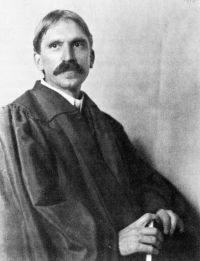 John Dewey,
Democracy and Education
(1916)
“ At the bottom of these distinctions is undoubtedly the tradition which recognizes as employment only those pursuits where one is responsible for his work to a specific employer, rather than to the ultimate employer, the community. ”
Alice Henry,
The Trade Union Woman
“ The rank and, file, too, get the splendid training that is conferred when persons actually and not merely nominally work together for a common end. Their introduction to the great problems of labor is through their practical understanding and handling of those problems as they encounter them in the everyday difficulties of the shop and the factory and as dealt with when they come up before the union meeting or have to be settled in bargaining with an employer. ”
“ Why, the very waiting room of the employer's ordinary office is a much more cosy and pleasant place than the homes of many of the most [Pg 136] industrious workers of England. I plead that the elements of the human order should begin to pervade the relations of the workshop, that the workman should be less of a drudge and more of a human asset than he has been, that he should be brought into partnership in the undertaking and in the management ”
Alice Henry,
The Trade Union Woman
“ There, without any deceiving veils falling between, we come close up to the real point at issue between the employer and the employed, between the employé and the community, the standard of living that is possible, as measured by the employé's share of the product of labor. ”
Alice Henry,
The Trade Union Woman
“ The general introduction of such a plan of training would mean that the young worker would start out on his wage-earning career with an intelligent understanding of the modern world, and of his relations to his employer and to his fellow-laborers, instead of, as at present, setting forth with no knowledge of the world he is entering, and moreover, with his mind clogged with a number of utterly out-of-date ideas, as to his individual power of control over wages and working conditions. ”
Cornelia Stratton Parker, Working With the Working Woman
“ The first step in this process of conversion then is to reorganize the relationship between management and men so that as many outlets as possible within industry can be found for those human expressions whose functioning will enrich the individual and industry. Which means that little by little the workers must share in industrial responsibilities. The job itself, with every conceivable invention for calling out the creative impulse, can never, under the machine process, enlist sufficient enthusiasm for sustained interest and loyalty on the part of the worker. ”
“ The employer who is a master at supplying motives to people, who manages to cut down through to the quick in his employees, to the daily motives, to the hourly ideals, the hourly expectations with which they work, is the employer who already takes the lead, who is already setting the pace in the twentieth-century business world. ”
William Crosbie Hunter, Dollars and Sense
“ Every employe who studies how much he can do is a help to an employer. Every employe who sees how little he can do is a hold-back to the institution. Employes should remember that prosperity goes in cycles, that it is but three generations from shirt sleeve to shirt sleeve. ”
Cornelia Stratton Parker, Working With the Working Woman
“ Some one has to sell the idea of co-operation to labor as well as to the employer. And then know the job is only begun. But the biggest start is made when the atmosphere is cleared so that the partnership idea itself can take root. Some on both sides never will be converted.What about the great body of workers unfit physically, mentally, nervously, to carry any additional load at all? Here is a field for the expert. Yet here is a field where society as a whole must play a part. Most of the physical, mental, nervous harm is done before ever the individual reaches industry. ”
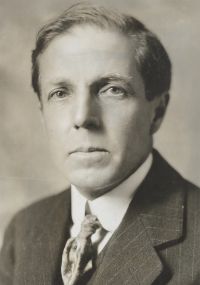 Vernon L. Kellogg,
Herbert Hoover: The Man and His Work
“ With the high specialization and intense repetition in labor in industrial processes, there has been a loss of creative interest. It is, however, the increased production that we have gained by this enlargement of industry that has enabled the standard of living to be steadily advanced. The old daily personal contact of employer and employee working together in small units carried with it a great mutuality of responsibility. ”
 Timothy Thomas Fortune,
Black and White: Land, Labor, and Politics in the South
(1884)
“ The men in the employ of a great establishment can be taught a new interest in their task as they learn to understand its processes and the relation of these processes to society at large, which can easily be done by lectures, etc. Such work as this is a work that demands the leadership, the organizing power, which the employer can best furnish. ”
Henry K. Rowe, Society: Its Origin and Development
“ Office relations are pleasant as well as profitable. The demands are exacting; labor at the typewriter, the proof-sheets, or the bookkeeper's desk is tiresome, but the society of the office is congenial, working conditions are healthful and cheerful in most cases, and there are many opportunities for increasing efficiency and promotion. ”
“ This art of steering heads inside, which has come to be the secret art of all the other arts, the secret religion of all the religions, is also the secret of building and maintaining a civilization and a successful and permanent business. It is hard to believe how largely, for the last twenty years, it has been overlooked by employers as the real key of the labour problem—this art of steering people's heads inside. ”
Lady Marjory MacMurchy Willison, The Canadian Girl at Work: A Book of Vocational Guidance
“ The friend probably will be willing to speak to the foreman or forewoman about the girl's employment. But she should notice the surroundings in which she means to work. Is the workroom light and airy? Are the conditions under which she must work sanitary? Are the workers respectable and well-behaved? If she is to work where there is machinery, it should be properly guarded, so that she will not be in danger. She should not choose a factory where the hours are longer than the average nor one where over-time is encouraged. The management also should be fair and considerate. ”
Katherine M. H. Blackford,
Analyzing Character
“ Every vocation has its social environment. There are fellow employees, or professional associates, inevitable in the work itself; also the particular class of society fixed by locality, income, or the standing of the vocation. ”
 Janet Penrose Trevelyan,
The Life of Mrs. Humphry Ward
“ To her, of course, the human interest of the scene was the all-important thing—the spectacle of the mixture of classes in the vast factories, the high-school mistresses, the parsons, the tailors’ and drapers’ assistants handling their machines as lovingly as the born engineers—the enormous sheds-full of women and girls of many diverse types working together with one common impulse, and protesting against the cutting down of their twelve hours’ day! ”
 Lillian Moller Gilbreth,
The Psychology of Management
“ On the other hand, feelings, such as happiness and contentment, and even hearing rhythmic sounds, music, etc., are an aid toward increasing output. For the best results, therefore, under Scientific Management the worker is furnished with standard conditions; his train of ideas is held upon the work in hand without interruption, and the working conditions are such that the managers furnish the worker with inducements to conform to the standard conditions happily. ”
 Jane Addams,
The American Journal of Sociology
(1896)
“ The employés in this industry practically lead the lives of those who have not discovered the power to combine; of those who "cannot create a sufficiently coherent organization to sustain themselves under changing conditions." ”
Richard C. Cabot, Social Work; Essays on the Meeting Ground of Doctor and Social Worker
“ In the old days, when shops were small and the employer could know his employees personally, no intermediary such as a home visitor was necessary. The employer could keep human touch with his men. He could know not merely the amount of work done by each man, but something of the circumstances of his life, something of his personality, his adventures and misfortunes, so that help could be extended to him from time to time when special need occurred. ”

