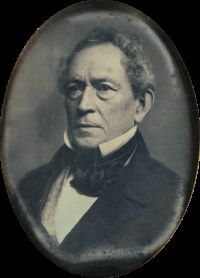
Edward Everett

Edward Everett

Summary

Portrait of Edward Everett Edward Everett The uses of astronomy

But it is when we turn our observation and our thoughts from our own system, to the systems which lie beyond it in the heavenly spaces, that we approach a more adequate conception of the vastness of creation. All analogy teaches us that the sun which gives light to us is but one of those countless stellar fires which deck the firmament, and that every glittering star in that shining host is the center of a system as vast and as full of subordinate luminaries as our own. Of these suns—centers of planetary systems—thousands are visible to the naked eye, millions are discovered by the telescope.
Source: Gutenberg

Portrait of Edward Everett Edward Everett The uses of astronomy

The organized human eye, instinct with life and soul, which, gazing through the telescope, travels up to the cloudy speck in the handle of Orion's sword, and bids it blaze forth into a galaxy as vast as ours, stands higher in the order of being than all that host of luminaries. The intellect of Newton which discovered the law that holds the revolving worlds together, is a nobler work of God than a universe of universes of unthinking matter.
Source: Gutenberg

Portrait of Edward Everett Edward Everett The uses of astronomy

If, still treading the loftiest paths of analogy, we adopt the supposition,—to me I own the grateful supposition,—that the countless planetary worlds which attend these countless suns, are the abodes of rational beings like man, instead of bringing back from this exalted conception a feeling of insignificance, as if the individuals of our race were but poor atoms in the infinity of being, I regard it, on the contrary, as a glory of our human nature, that it belongs to a family which no man can number of rational natures like itself.
Source: Gutenberg

Get perspective with Kwize: daily news enlightened by great literature