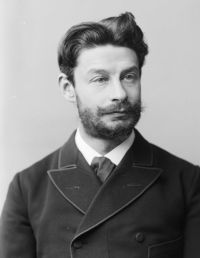
“ But, on the other hand, France is no pessimist. He knows and says of the France of to-day: "The weak are in the wrong. That is the sum of our morality, my friend. Do you suppose that we are on the side of Poland or Finland? No, no! That is not the way the wind blows at present!" But he also knows that the earth will not finally belong to armed barbarity. Alone, unarmed, naked, truth is stronger than everything. Might and violence oppose it in vain. It strikes at injustice and annihilates it. The word of man changes the world. ”
Summary
“Anatole France”, is a work by Georg Brandes. It explores elements such as Putois, Bergeret and irony.
Quotes from Anatole France (Georg Brandes)
“ As an artist, France, even when he is most combative, is Olympian and passionless.That he is not lacking in passion, behind his art and apart from it, was revealed on the day when the serene sceptic suddenly faced round and as polemist adopted a party, as popular orator proclaimed himself a radical Socialist.He was no born orator; according to French custom, he read his speeches. But his greatness as a writer stood him in good stead. He generally began by riveting the attention of the crowd by something graphic and tangible—perhaps some old fairy-tale. ”
“ The secret of the art of France's historical style is, as already said, that he thinks and speaks in the spirit of the age which he is portraying, seems to share its views, to accept its beliefs and superstitions, its prejudices and ideas, without a trace of irony or of fatuity, but with an artistic skill which forcibly brings out the contrast between the spirit of those ages or countries and ours. ”
“ Fame is a Putois, an imaginary, impalpable being, that is pursued by thousands, and that melts into nothing just when it should display itself in full vigour—namely, after their death.Everywhere we have imaginary, artificial existence, proclaimed to be real, and accepted as such. It is not at all necessary to confine ourselves to religion, where it is only too easy to discover Putois, whose huge shadow darkens theology in its entirety. ”
“ What attracts France in these characters is the contrast between the emotional life of the two women, between the religiously erotic rapture of the Asiatic and the tradition-sanctioned conjugal love of the Roman matron.It is always as the creative writer that he touches history.Among the many things in which France does not believe is history as a science. History, he says, is a representation of the events of the past. But what is an event? A remarkable fact. Who decides whether a fact is remarkable or not? The historian decides it, arbitrarily, according to his taste. ”
“ Bergeret, the tranquil philosopher, is absolutely certain of the final victory of reason. "The visions of the philosopher have in all ages aroused men of action, who have set to work to realise them. Our thoughts create the future. Statesmen work after the plans which we leave behind us."Certain it is that the future is hidden from us. But we must, as France says, work at it as the weavers work who produce the Gobelin tapestry without seeing the pictures which they are weaving. ”
“ Highly valuing moderation and tact, he at that time detested his future companion in arms, Zola—detested him, indeed, without moderation—wrote: "I do not envy him his disgusting celebrity. Never has a man so exerted himself to abase humanity and to deny everything that is good and right. Never has any one so entirely misunderstood the human ideal." There is more love of good taste here than appreciation of genius. It must be remembered that France afterwards publicly recanted this and many similar utterances. ”
“ When, in his turn, Monsieur Bergeret addresses the dog, he addresses in him the whole undeveloped portion of the human race."You too, poor little black being, so feeble in spite of your sharp teeth and your gaping jaws, you too adore outward appearances, and your worship is the ancient worship of injustice. You too allow yourself to be seduced by lies. You too have race hatreds. ”
“ France is no optimist. He has seen too much declension and apostasy around him in France and Europe generally, to believe in the fable of uninterrupted progress. He has lived through times of universal indifference and apathy, when no sting was sharp enough to stir men to think, much less to act. When men's souls are hungering and thirsting after unrighteousness, it is of little use offering them a refreshing draught of culture. As is said of the "people" in Bergeret: "It is not easy to make an ass which is not thirsty drink." France knows, too, what popularity means. ”
“ And to such an extent is Paul Vence France himself that when, towards the end of the book, he remarks: "He was a wise man who said, 'Let us give to men for their witnesses and judges Irony and Compassion'"—an utterance to be found in more than one of France's books—Madame Martin-Bellême answers: "But, Monsieur Vence, it was yourself who wrote that."Profound irony is, then, the first quality which he attributes to himself.We have seen how this irony, unlike Renan's, is indirect; we only catch a glimpse of it through the naïveté of another person. ”
“ Delacroix has said that art is exaggeration in the right place. France's exaggeration lies in the wealth of ideas with which he endows his characters, a wealth which the books can hardly contain (vide Thaïs and Balthasar) , and for which place must be made in whole additional volumes, such as Les Opinions de M. Jérôme Coignard, Le Jardin d'Épicure, and a part of Pierre Nozière. He has more ideas than feelings. He has ideas upon every subject, criticises everything—not only human prejudices and institutions, but nature herself. ”
“ The world's history is the world's verdict, wrote Schiller. He is a naïve man who believes this. Posterity is just only to this extent, that the questions are of indifference to it; and as it is with the greatest difficulty that it can examine the dead, and as, moreover, it is itself not an impersonal thing, but an aggregate of more or less prejudiced human beings, the verdict takes shape accordingly. Historic justice is a Putois. ”
“ But in spite of the relationship, France's irony is of a very different description from Renan's. Renan, as historian or critic, always speaks in his own name, and we are directly conscious of himself in the fictitious personages of his philosophic dramas, and even more so in those of his philosophic dialogues. France's irony conceals itself beneath naïveté. Renan disguises himself, France transforms himself. He writes from standpoints which are directly the opposite of his own—primitive Christian, or mediæval Catholic—and through what is said we apprehend what he means. ”
“ Never has his irony been so effective as in his most distinctly polemical work, L'Anneau d'Améthyste, where the most immoral actions, one breach of the Seventh Commandment after the other, become links in the cleverly woven chain of intrigues which, aiming at gratifying an ambitious young parvenu baron's desire to become member of an ultra-Conservative aristocrat's hunt, result in procuring the episcopal ring for a crafty, submissive priest. This priest has cringed to every one, and by his humility has prevailed on men and women to act. ”
“ But from that day Madame Bergeret herself began to have a kind of belief in his existence.The story is both clever and of deep significance, it turns on the question of what an imaginary existence is. Putois' generation is the generation of a myth, and he exerts the influence which mythical characters do. No one can deny the rule of mythical beings over the minds of men, their influence on human souls. Gods and goddesses, spirits and saints, have inspired enthusiasm and terror, have had their altars, have counselled crimes, have, originated customs and laws. ”
“ A critic in the strict sense of the word he was not, and when his books began to sell better he gave up criticism. His utterances in the four volumes referred to are most characteristic of his personality, revealing, as they do, its spirit, its limitations, and its prejudices—prejudices which he has gradually outgrown.The friend to whom France replied, "I have no modern books in my house," asked, smiling: "Not even your own?" "No," answered France; "what a man has built himself—even supposing it to be a palace—he knows so well that he cannot endure the sight of it. ”
“ Why take up this legend of the blind or half-blind old man? Why give this insignificant figure, this poor creature going from place to place earning his bread by his songs, the awe-inspiring name of Homer? But upon maturer reflection we acknowledge how correctly France has seen, and what wisdom there is in his view of the matter. The singer of his tale is unmistakably akin to the bards described in the Homeric poems; and it is only natural that his house should have been cramped and low in comparison with that of his neighbour, the wealthy soothsayer. ”
“ He knows that knowledge is sovereign, not the people. He knows that a foolish cry, though taken up by thirty-six millions of voices, does not cease to be foolish, and that truth is irresistible and will make itself ruler of the earth, though it may be perceived and proclaimed only by a single man, and though millions may unite and shout in chorus against his "individualism." ”
“ It is in virtue of this combination—naïveté and shamelessness—that Riquet the dog becomes one of France's best characters. No man is as devoid of shame as a dog, and no child is more childlike.Biquet has great difficulty in seeing things from Monsieur Bergeret's point of view. He flies at the heels of the worthy carpenter, merely because that workman wears a blouse and carries tools; he is steeped in all the old prejudices of the feudal age. ”
“ Neither has any yellow military expedition landed in France and demanded a strip of territory within which the yellow men are not to be subject to the laws of the country, but to a court composed of Mandarins have come to the conclusion that, things being bad at the best, the existing state of matters was probably as good as the untried—that this man should proclaim himself a son of the Revolution, side with the working man, acknowledge his belief in liberty, throw away his load and draw his sword—this is what moves a popular audience, this is what plain people can understand and can prize. ”
“ Others have maintained that the ideal of justice would be an inequality before the law adjusted to the differences between individuals. Others have said: If there is inequality in law itself, where is equality to be found?But there is only one man who can have written: "The law, in its majestic equality, forbids the rich as well as the poor to sleep under bridges, to beg in the streets, and to steal bread."This one man is Anatole France. Most noticeable in this style is its irony; it stamps him as a spiritual descendant of Renan. ”
“ Suppose that we could transfer to canvas the image of the beloved one which forms itself in the imagination of the lover at the moment when he sees all her supposed perfections, and afterwards place alongside of it the image of her which remains when love has evaporated and he has stripped her, one by one, of all the qualities which enchanted him—the description of the first picture would not seem less unreal than the description of Putois. ”
“ We see how it is that France, in spite of his great gifts as an investigator, has not become a historian, but a novelist and story-writer.He is not, however, so pessimistic as we might conclude from the closing words of his fable. The human beings whom he describes have pleasures as well as pains, and he invariably advocates pleasure as superior to every kind of abnegation of nature, and combats the theory that there is good in suffering. ”
“ For more than half of his life France undoubtedly agreed with his Abbé Coignard, who had an affectionate contempt for mankind, and who would not have signed the Declaration of the Rights of Man, not a line of it, "because of the sharply defined and unjust distinction made in it between man and the gorilla." He in those days inclined, like Coignard, to the belief that men are mischievous animals who can be kept under control only by force or cunning. ”
“ But a whole town, a whole nation, exists in a few individuals who think with more power and more justice than the rest." And later, in the same book, when Biquet, with gaping jaws and flaming eyes, has flown at the heels of the clever workman who has been setting up Bergeret's book-shelves, his master explains to him that what exalts a nation is not the foolish cry that resounds in the streets, but the silent thought which is conceived in a garret, and one day changes the face of the earth.France does not share the reactionary's fear of the power of the masses. ”
“ This naïveté is a rare quality in French literature, the literary art of the French being (in spite of Lafontaine) as a rule not naïve, but even in Molière, and throughout his whole century, as well as the next, perfectly self-conscious. Yet naïveté is a powerful means of producing artistic effects—the indirect process which requires the reader's own co-operation being undoubtedly always more effective than the direct communication, which does not impart the useful little impetus to the intellect. ”
“ France has read Voltaire again and again, and assimilated much of him. How often, for instance, does the story of Cosru's widow in Zadig crop up in France's pages! A Voltairean sentence such as: "The belief in the immortality of the soul is spreading in Africa along with cotton goods," sounds as if it might have been written by France. The naïveté of the modern writer is certainly the more genuine, though in greatness as an author he, of course, falls far short of his predecessor. ”
“ A few years later Paul Bourget had returned to the bosom of the Roman Catholic Church, and was attacking with the utmost violence every progressive movement, even the enlightenment of the people and instruction for the working man. These were France's models of intelligence.Compared with the attitude of these men, France's own attitude during the past six years may almost be termed exemplary.It may be that as the popular orator—a career for which he was not intended by nature—he has proclaimed himself rather more strongly convinced than he is in his inmost soul ”
“ Brutus, who was a mediocrity, believed in the power of the human will. A greater man does not harbour that illusion. He sees the necessity which limits him.... Children are rebellious. A great man is not. What is a human life? The curve traced by a projectile." Bonaparte says this at the very moment when, with implicit faith in his own luck, he is venturing out on the Mediterranean among the English cruisers. The whole short story is based, as it were, upon his premonition of coming greatness.But here, as always, France, with the unerring taste of the really great writer, avoids cheap effect. ”
“ Satyrs and Silenuses have occupied the human imagination, have set chisels and brushes to work century after century. The Devil has his history, extending back for thousands of years—has been terrible, witty, foolish, cruel; has demanded human sacrifices ”
“ The second element is art. France has what he himself calls the French writer's three great qualities—in the first place, lucidity; in the second, lucidity; in the third and last, lucidity. But this is only one fundamental quality of his art. He has proved himself possessed of moderation and tact, in which for him, as the true Frenchman (and to use his own words) , "all art consists." His detestation of Zola as a novelist was due to that Italian's utter lack of moderation as an artist. He himself as narrator is always subdued.He lacks passion, and he is never wanton ”
“ Even many years later, after he has proclaimed himself a democrat, he makes his mouthpiece, Bergeret, say to his dog: "To-morrow you will be in Paris. It is an illustrious and noble city. The nobility, to tell the truth, is not common to all its inhabitants. It is, on the contrary, to be found in only a very small number of the citizens. ”
Common terms
Similar works
Anatole France (Walter Lionel George…Putois (Anatole France)Toleration and other essays — Introduction…1911 Encyclopædia Britannica (Charles Bémont…Crainquebille, Putois, Riquet and other profitable tales…A History of Roman Literature…France (Gordon Home)Through the Year with Famous Authors…Clio (Anatole France)
